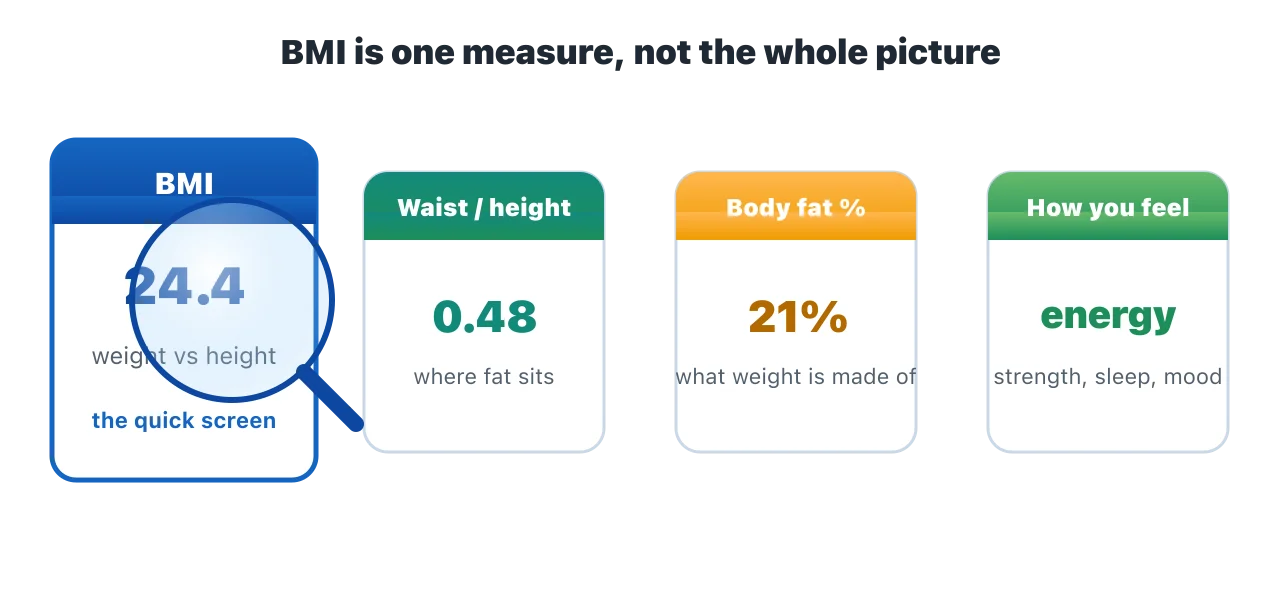
A calculator hands you a single number, a label drops you into one of a few boxes, and suddenly you are left wondering whether that little figure really describes your body at all. It is one of the most common questions people ask after checking a result: is BMI actually accurate? The honest answer is more interesting than a flat yes or no. Body Mass Index is genuinely good at one job and genuinely poor at another, and knowing the difference is what turns a confusing number into a useful one.
BMI is accurate as a population screening tool and often imprecise for any single person. It is a fast, cheap first flag, not a verdict on your health. Read it as a starting point, then add context from measures like waist-to-height and a conversation with a qualified healthcare provider.
What BMI gets right
It is worth starting with what BMI does well, because a measure does not survive for the better part of a century by accident. Your BMI is simply your weight divided by the square of your height, and that plainness is the whole point. It needs no equipment, no clinic, and no cost. Anyone with a set of scales and a tape can produce the same number, and that number means the same thing whether it is taken in Manchester or Manila. For a measure meant to be used across entire countries, being cheap, quick, and consistent is not a small virtue. It is exactly what lets health systems screen millions of people without a single scan.
There is a telling detail in the origins of the measure. What we now call BMI was devised in the nineteenth century by the Belgian mathematician Adolphe Quetelet, who was studying the characteristics of whole populations rather than treating patients. It was built from the very start as a way to describe groups of people in the aggregate, and it was never meant to judge the health of any one person standing on a scale. Keeping that history in mind explains a great deal about the modern debate: BMI performs best at exactly the task it was designed for, and it strains hardest when we ask it to do the one thing it was never intended to do, which is to pronounce on an individual.
BMI also does a genuinely useful job at the level of large groups. Across a whole population, a higher average BMI reliably tracks a higher average level of body fat, and with it a higher rate of the conditions that tend to travel alongside excess fat. That is why bodies such as the CDC, the World Health Organization, and the NHS lean on BMI for public-health monitoring and research. When you are looking at thousands or millions of people at once, the individual exceptions wash out, and the broad relationship between weight-for-height and health comes through clearly enough to guide policy and spot trends.
For you as an individual, BMI still earns a place as a fast first flag and as a way to watch your own trend over time. If your weight drifts well beyond what is typical for your height, that is worth noticing, and BMI is a reasonable way to notice it. Tracked over months and years against your own baseline, rather than measured against anyone else, the number can quietly surface a change that is easy to miss day to day. Used that way, as a starting point rather than a full stop, it does its job perfectly well and asks very little of you in return.
Where BMI misleads
The same simplicity that makes BMI so convenient is also the source of every one of its blind spots. BMI does not measure body fat, and it does not even try to. It only knows your total weight and your height, so it quietly assumes that everyone of a given height who weighs a given amount is carrying that weight the same way. People are not that uniform, and so BMI can be wrong about a specific person in several predictable directions that are worth knowing before you take any single reading to heart.
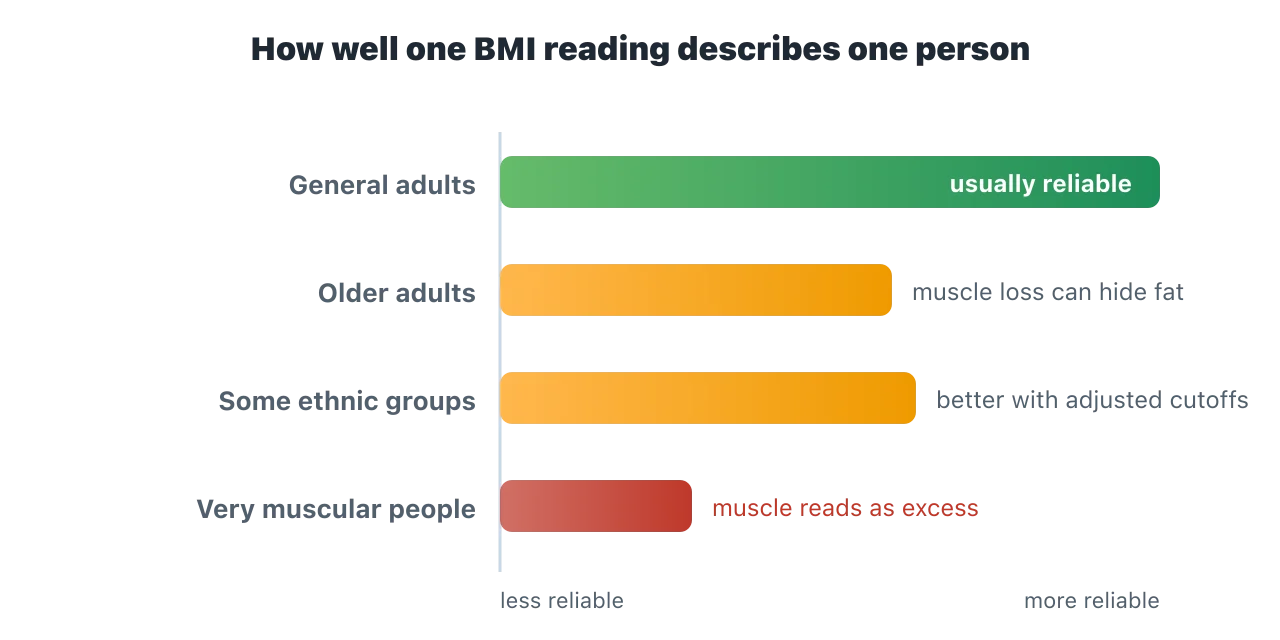
The clearest example is that BMI cannot tell muscle from fat. Muscle is denser than fat, so a lean, muscular body weighs more for its height and reads higher on the scale, even with very little fat to speak of. This is why strong, well-trained people so often get filed under a heavier category by a calculator that has no idea they train. The number is not lying about their weight; it is simply blind to what that weight is made of, and it mistakes hard-won muscle for a problem it is not.
The blind spots do not stop at muscle. BMI ignores where you carry fat, even though fat around the abdomen is more closely tied to health risk than the same amount on the hips and thighs. It does not adjust for age on its own, so an older adult who has lost muscle and gained fat can keep a reassuringly normal BMI while their body composition has shifted underneath it. And it can read differently across populations, which is why some health bodies use lower thresholds for people of South Asian and certain other backgrounds, where risk can begin at a lower BMI. In each case the formula is doing exactly what it was built to do, and exactly that is where it can go astray for an individual.
What the evidence actually shows
So what does the research say when it puts BMI to the test? Broadly, that BMI correlates well with body fat when you average across a population, but that it is an imprecise estimate of fat for any single individual. Studies that compare BMI against more direct measures of body fat find that it can both overstate and understate how much fat a person carries, depending on their build, age, sex, and muscle. The relationship is real, but it is a tendency across many people rather than a guarantee for one, and that distinction is the heart of the whole accuracy question.
This is why every major health authority is careful to frame BMI as a screening tool rather than a diagnosis. The CDC states plainly that BMI is a screening measure and is not intended to diagnose the health of an individual, and it recommends discussing your result with a healthcare provider who can look at the fuller picture. That framing is not a disclaimer tucked into the footnotes; it is the correct way to understand what the number is. BMI raises or lowers a flag and shifts the odds. It does not settle the question of anyone's health on its own.
It helps to think of BMI as a probability statement rather than a measurement. A high BMI means that, statistically, you are more likely to be carrying excess fat, in much the same way that a smoke alarm going off means you are more likely to have a fire. Neither is proof. The alarm is still very much worth having, because it is cheap and it catches real problems, but you would not call the fire brigade without looking first. BMI works the same way. It is a prompt to look closer, not a conclusion to act on blindly, and reading it as the latter is where most of the confusion and worry come from.
What to use alongside it
Because BMI answers only one narrow question, it is at its best as one data point among several rather than the last word. The encouraging part is that the measures which fill in its blind spots are nearly as cheap and simple as BMI itself, so pairing them takes very little effort. A fuller read on your body does not require a laboratory or a fancy scan; more often than not it requires a tape measure and a little context about who you are and how you live.
The single most useful companion is the waist-to-height ratio. Where BMI is blind to fat distribution, your waist speaks to it directly, and the rule of thumb could hardly be simpler: keep your waist to less than half your height. Because central fat carries more health weight than fat elsewhere, this one measurement often adds more information than BMI on its own, and it barely takes a minute. A body fat estimate goes a step further by describing composition directly, telling you how much of your weight is fat rather than muscle and bone, which is precisely the thing BMI can never see.
Beyond the numbers, the context a good clinician brings is part of the picture too. How you feel day to day, your strength and energy, your blood pressure and blood markers, your family history, and the direction your measurements are trending all sharpen a reading that BMI can only sketch. None of these replace BMI, and BMI does not replace them. Taken together they turn a single blunt figure into something much closer to an honest description of your health, which is exactly the job no one number was ever going to do alone.
A quick example shows how naturally these measures work together. Imagine two people who both read a BMI of 28. The first has a waist comfortably under half their height and a low body fat estimate, which together suggest their weight is largely muscle and the raised BMI is not a worry on its own. The second has a waist well over half their height and a higher body fat reading, which points the other way and would be worth discussing with a provider. Same BMI, two very different stories, and it took only a tape measure and a moment of context to tell them apart. That is the whole case for reading BMI alongside other measures rather than in isolation.
The honest verdict
So, is BMI accurate? The fair answer is that it is accurate enough as a screening signal and unreliable as a personal verdict. Trust it as a starting point, and interpret it with context rather than treating it as the final say on your body. For a great many people it lands about where a more detailed assessment would, and for a meaningful minority, the athletes, the older adults, and the people who carry fat in a particular pattern, it can be well off the mark. Knowing which of those groups you most likely belong to is most of the skill in reading your own number wisely.
If your result surprised you, that is a reason to look closer, not a reason to panic. A number that feels wrong is an invitation to reach for a tape measure, a body fat estimate, and a conversation with your provider, all of which can tell you far more than three digits from a calculator ever could. It is worth remembering that a formula which knows only your height and your weight cannot possibly know your training history, your health, or how you actually feel inside your own body. You are the one who supplies that context, and in almost every case it matters more than the figure on the screen.
In the end, BMI deserves neither the blind trust nor the outright dismissal it usually attracts. It is a useful, imperfect first screen, no more and no less. Treat it as one honest but limited signal among several, hold it lightly, and let it point you toward better questions rather than false certainty in either direction. Read that way, an unexpected BMI stops being a verdict to fear and becomes what it was always meant to be: a quick, cheap nudge to pay a little closer attention to your health, and then to go and check the things it cannot see.