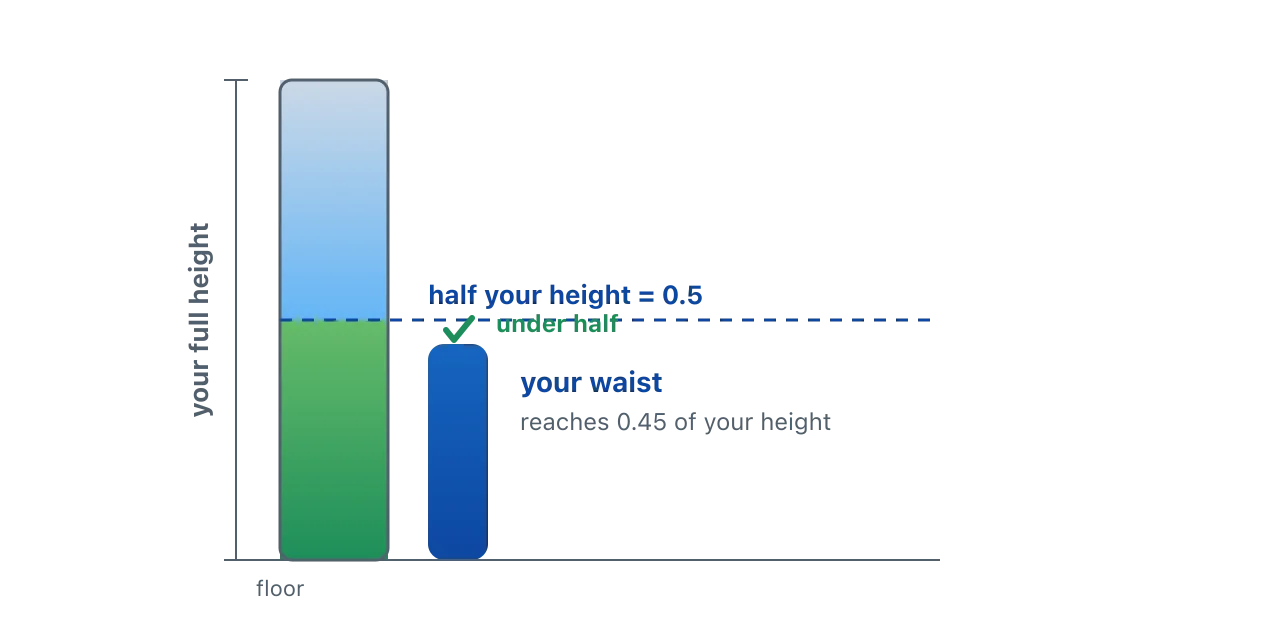
BMI gets almost all of the attention, but there is a second number that many researchers say tracks certain health risks just as closely, and it takes about ten seconds with a soft tape measure. It is your waist-to-height ratio, and the rule behind it is refreshingly easy to remember: keep your waist under half your height. This single comparison captures something your BMI cannot, which is where your body actually stores its fat. Here is how the rule works, what the numbers mean, and how to read it next to BMI.
Divide your waist measurement by your height in the same units. A result under 0.5 means your waist is less than half your height, which is the healthy target. The NHS backs this rule and treats it as a check to use alongside BMI, not instead of it.
The half-your-height rule
Waist-to-height ratio is one of the simplest health screens you can run at home. You measure around your middle, measure your height, and divide the first number by the second, making sure both are in the same units. If your height is 170 centimetres and your waist is 76 centimetres, your ratio is about 0.45. The target that health bodies point to is a ratio under 0.5, which is simply a mathematical way of saying that your waist should stay under half your height.
The reason this rule has caught on is that it needs no chart, no app, and nothing to remember beyond a single fraction. Whatever your height, halve it, and that is roughly the waist figure you want to stay below. A person who is 180 centimetres tall is aiming to keep their waist under about 90 centimetres, while someone who is 160 centimetres is aiming for under 80. The same logic works in inches, so a person who stands 70 inches tall wants a waist under 35 inches. There is nothing to look up and nothing to misread.
The National Health Service in the United Kingdom hosts a waist-to-height calculator built on exactly this idea, and it frames the measure as something to use alongside BMI rather than as a replacement. That endorsement matters, because it means the half-your-height rule is not a piece of internet folklore. It is a screening approach that a national health system is comfortable putting in front of the public, precisely because it is easy to get right and hard to misuse. When a measure is both simple and backed by that kind of authority, it earns a place in the small handful of numbers worth checking now and then.
Why your waist is the part that matters
To understand why waist size earns its own number, it helps to know that not all body fat behaves the same way. Fat stored just under the skin on your hips, thighs, and arms is called subcutaneous fat, and while it is visible, it is relatively harmless in ordinary amounts. The fat that sits deeper inside the abdomen, wrapped around the liver, pancreas, and intestines, is called visceral fat, and it is far more active in ways that affect your health.
Visceral fat releases fatty acids and inflammatory signals directly into the blood supply that feeds your organs. Over time, higher levels of this deep fat are associated with insulin resistance, raised blood pressure, unfavourable cholesterol patterns, and a greater risk of type 2 diabetes and heart disease. Because a larger waist usually reflects more of this deep abdominal fat, waist size becomes a rough but genuinely useful stand-in for the kind of fat that carries the most risk. A tape measure cannot see inside you, but it lines up well with what is happening in there.
This is the exact blind spot that BMI cannot cover. BMI uses only your height and your weight, so it has no way of knowing whether the weight you carry sits low on your hips, fills out your shoulders as muscle, or gathers around your middle as visceral fat. Two people can share an identical BMI while one carries their weight low and safe and the other carries it high and central. A tape measure around the waist sees that difference immediately, which is why it adds information rather than simply repeating what BMI has already told you.
Waist-to-height versus BMI: what the evidence shows
It is tempting to frame this as a contest, but both measures are screening tools rather than diagnoses, and each answers a different question. BMI answers whether your weight is high for your height. Waist-to-height answers where that weight is concentrated. Neither one looks inside your body or runs a blood test, so both are best understood as quick flags that tell you whether a closer look is worthwhile, not as final verdicts on your health.
Where waist-to-height ratio pulls ahead is in two specific situations. The first is the person with a normal BMI who still carries a lot of central fat, sometimes described as being of normal weight but metabolically unhealthy. BMI waves them through as healthy while their waist quietly tells a different story. The second is the very muscular person whom BMI can wrongly flag as overweight, because muscle is dense and adds weight without adding abdominal fat. A single waist measurement clears up both cases in seconds.
Several studies over the past two decades have reported that waist-to-height ratio predicts cardiometabolic risk at least as well as BMI, and sometimes a little better, especially for outcomes tied to abdominal fat. That does not make BMI obsolete, and it does not mean you should throw your BMI away. It means the two numbers form a stronger picture together than either does alone, with BMI describing overall size and waist-to-height describing shape and fat location. Reading them side by side is more informative than leaning on either one by itself.
How to measure your waist correctly
The whole value of this ratio rests on measuring your waist accurately, and this is where most people slip up. The good news is that the technique is simple once you know the common mistakes, and a soft cloth or plastic tape measure is the only equipment you need. Take the reading over bare skin or a single thin layer, never over a thick jumper or a belt, and take it two or three times to make sure the number is steady before you trust it.
- Wrap the tape around the midpoint between the bottom of your ribs and the top of your hip bones, roughly level with your navel.
- Breathe out gently before you read the number, and do not hold your breath or suck your stomach in.
- Keep the tape snug but not tight, so it rests against the skin without digging in or leaving a mark.
- Check that the tape is level all the way around, including across your back, where it tends to ride up.
- Use the same unit, centimetres or inches, for both your waist and your height.
Consistency matters more than pinpoint precision. If you always measure at the same point, at the same time of day, and in the same relaxed way, then any change you see over the weeks reflects your body rather than a shift in your technique. Morning, before breakfast, is a sensible habit, because a full stomach and a day of eating and drinking can nudge the reading up by a centimetre or two without any real change in your fat. A number you can trust is one you take the same way every time.
The risk bands, from under 0.4 to 0.6 and above
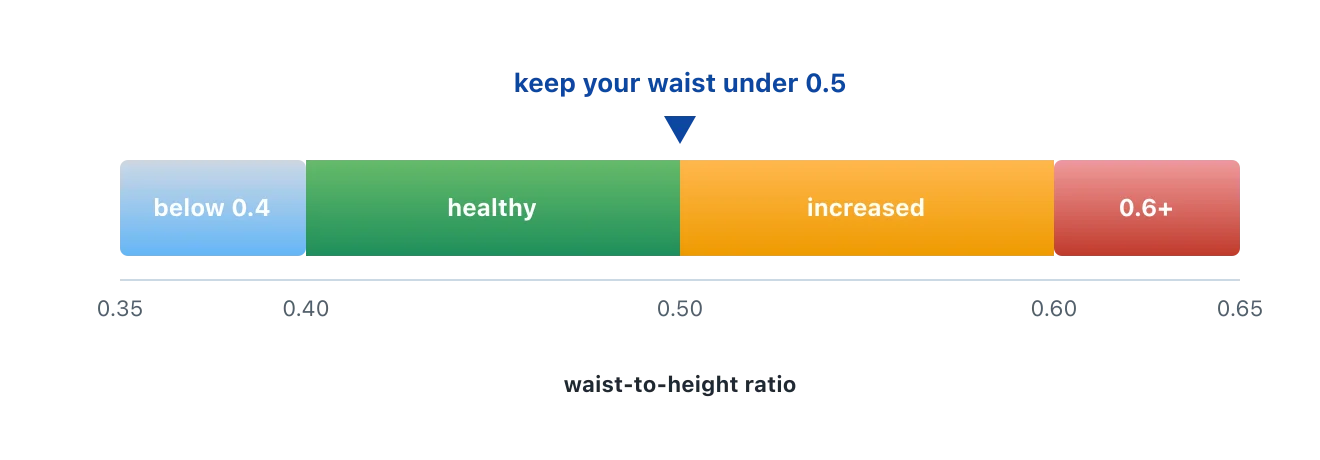
Once you have your ratio, you can read it against a short set of bands. These are screening ranges rather than sharp cliffs, so a number sitting a hair either side of a boundary is not meaningfully different from one just across it. Even so, the bands give you a quick sense of where you stand and whether a conversation with a healthcare provider might be worthwhile.
| Ratio | What it suggests |
|---|---|
| Below 0.4 | Below the typical healthy range |
| 0.4-0.49 | Healthy |
| 0.5-0.59 | Increased risk |
| 0.6 and above | Highest risk band |
A ratio below 0.4 is uncommon and can suggest you carry very little around the middle, which is worth mentioning to a provider if it is unexpected. The broad healthy zone runs from 0.4 up to just under 0.5. From 0.5 to 0.59 the evidence points to increased risk, and at 0.6 and above the risk climbs further. The coloured scale below shows how those bands line up, with the important line, 0.5, marking the point where a healthy waist becomes one worth acting on.
How to use BMI and waist-to-height together
The most practical way to use these numbers is to run them as a pair and see whether they agree. If your BMI sits in the healthy range and your waist-to-height ratio is under 0.5, the two are telling the same reassuring story, and you can be reasonably confident that weight is not a pressing concern. When both land in a higher band, that agreement is a clear prompt to look more closely, ideally with professional guidance rather than on your own.
The interesting cases are the ones where the two disagree. A healthy BMI paired with a waist-to-height ratio over 0.5 is the classic warning that central fat is building even though your overall weight looks fine, and it is a signal not to be reassured by BMI alone. The opposite pattern, a high BMI with a comfortably low waist ratio, often points to a muscular build that BMI is misreading, and it is a reason not to panic about the BMI figure by itself. Reading the two together is what turns a raw number into something you can act on.
A quick example shows how the pairing plays out. Imagine two office workers who are both 170 centimetres tall. One weighs 68 kilograms, giving a BMI of about 23.5, with a waist of 78 centimetres and a ratio of 0.46. The other weighs the same 68 kilograms, so shares an identical BMI, but carries it centrally with a waist of 90 centimetres and a ratio of 0.53. BMI alone would treat the two as interchangeable. The waist-to-height ratio separates them at once, placing the first comfortably in the healthy band and nudging the second into the increased-risk range. Same height, same weight, and the same BMI, yet a genuinely different risk picture, revealed by one extra measurement that took seconds to take.
Whatever the combination, remember that you have the most influence over your waist through the everyday habits that improve health generally, such as regular movement, decent sleep, and an eating pattern you can sustain. The waist, and the visceral fat behind it, tends to respond to these changes, which is part of what makes the measurement encouraging to track. You are watching a number that can genuinely move over a few months, rather than one fixed by the frame you were born with.
When the ratio does not apply
Like every simple screen, waist-to-height ratio has boundaries. The NHS notes that it is not suitable for children under eighteen, who are still growing and are better assessed with age and sex specific charts. It also does not apply during pregnancy, when a changing waist reflects a growing baby rather than stored fat, and it is not recommended as the main measure for adults with a BMI over 35, where broader clinical judgement takes over. Knowing when a tool does not fit is part of using it well.
For most other adults, though, it is a fast and forgiving check that you can repeat as often as you like without any cost or equipment beyond a tape measure. Treat a result in a higher band as a reason to pay attention rather than a diagnosis, and if your waist ratio and your BMI both point the same way, take that as your cue to raise it with a qualified healthcare provider who can see the fuller picture that a tape measure can only hint at. The number opens the conversation; the professional helps you read it.