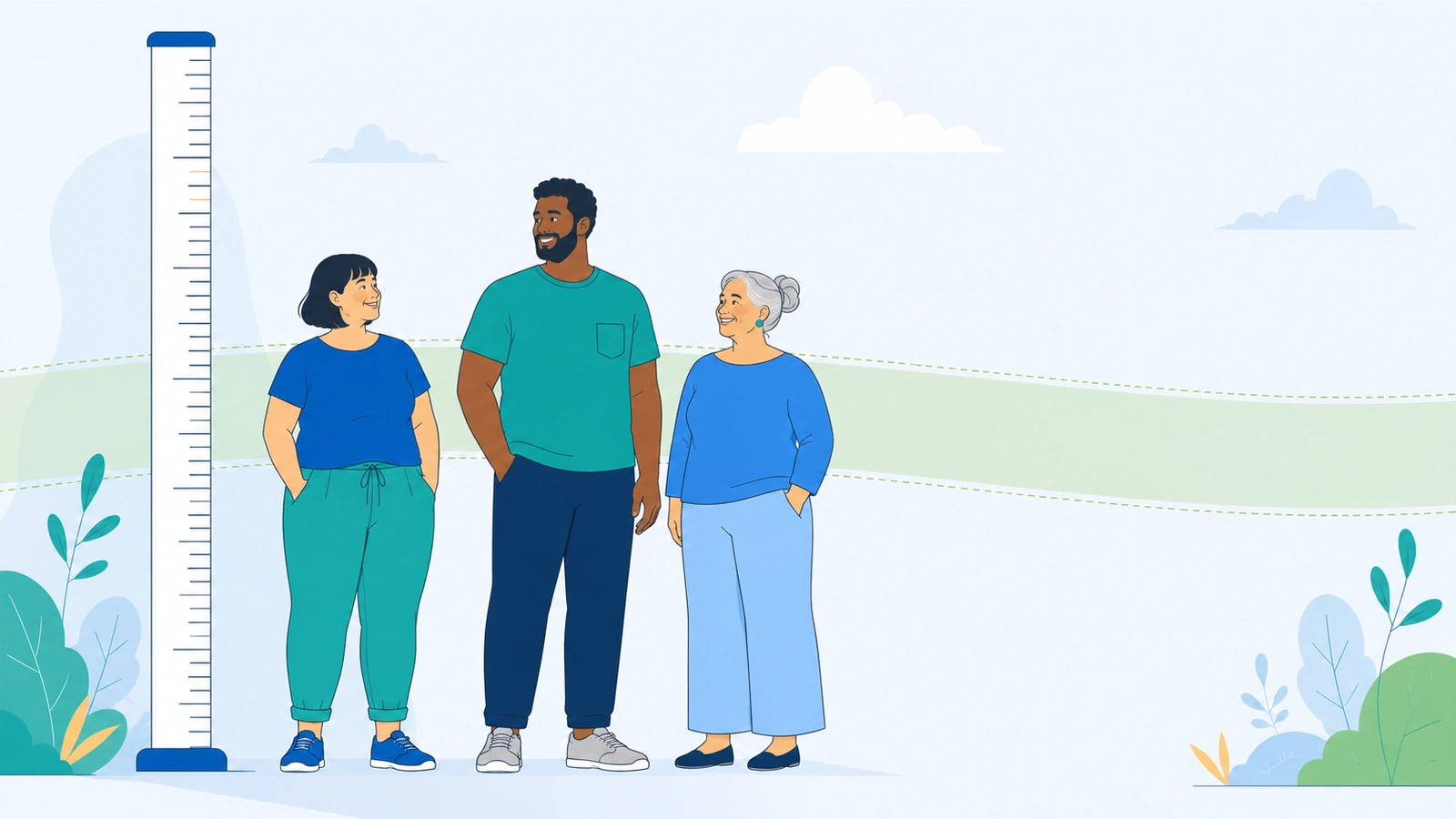
You probably have a number in your head - a goal weight from years ago, or one a chart once gave you. But the honest answer to "how much should I weigh for my height" is not a single number at all. It is a range, and yours depends on more than the bathroom scale suggests. Here is how to find it in seconds, and what the number can and cannot tell you.
The honest answer: a healthy range, not one number
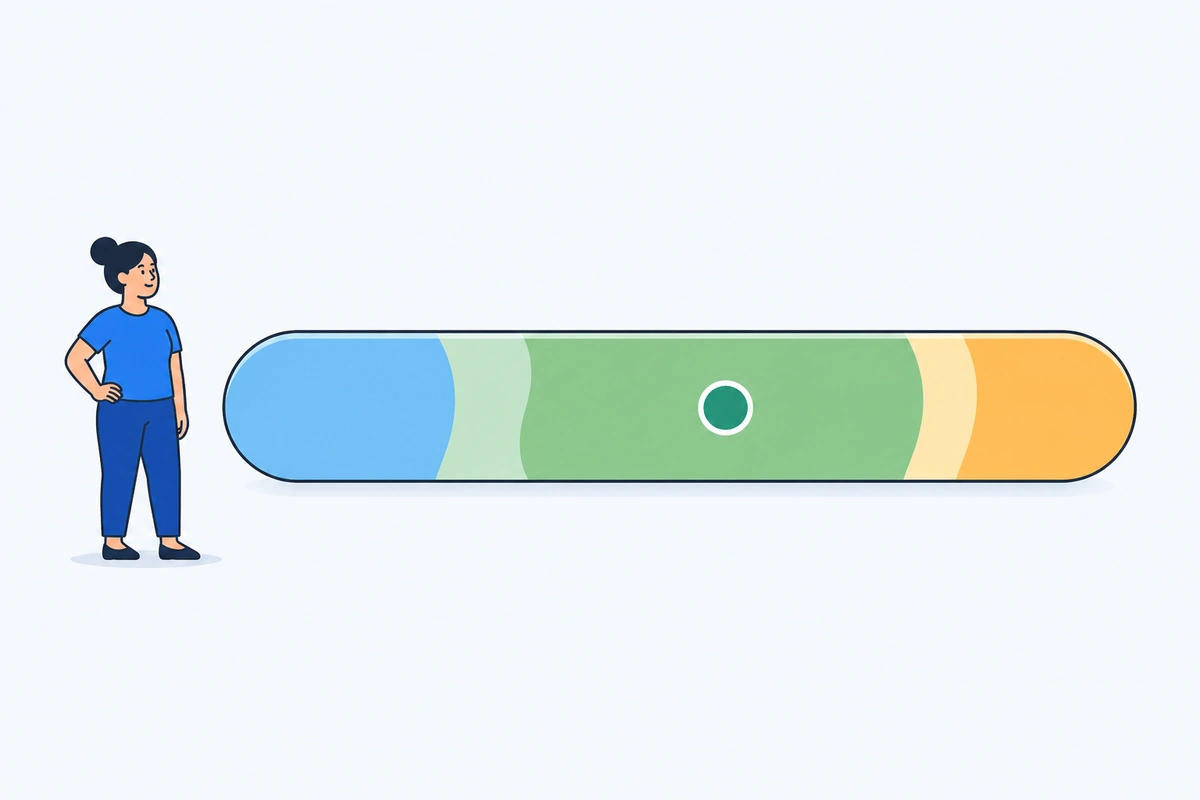
For any given height, there is a span of weights considered healthy - not a single target. That span comes from Body Mass Index: a BMI between 18.5 and 25 is the adult "healthy weight" band used by the CDC and WHO. Convert that band back into weight for your height and you get a range.
For example, at 170 cm (about 5'7") a healthy BMI works out to roughly 53-72 kg (117-159 lb). At 180 cm (5'11"), it is about 60-81 kg (132-178 lb). The range is wide on purpose, because healthy bodies vary. You can see the full ranges on our BMI chart or calculate yours on the BMI calculator.
The "ideal weight" formulas (and why they disagree)
Beyond BMI, four classic formulas estimate an "ideal" body weight from your height and sex: Robinson, Miller, Devine, and Hamwi. They were developed decades ago - originally to help with medical dosing - and each starts from a base weight at five feet of height, adding a set amount per inch above that.
Here is the key thing: they typically disagree with each other by a few kilograms. That disagreement is exactly why a single "ideal weight" is a myth. Our ideal weight calculator shows all four estimates side by side, plus the BMI-based healthy range, so you can see the spread and treat the result as a guide rather than a verdict.
A quick height-to-weight guide
The table below shows the healthy weight range (BMI 18.5-25) for a few common heights. Find the row closest to yours - and remember it is a screening range, not a personal prescription.
| Height | Healthy weight range |
|---|---|
| 155 cm (5'1") | 44-60 kg (98-132 lb) |
| 160 cm (5'3") | 47-64 kg (104-141 lb) |
| 165 cm (5'5") | 50-68 kg (110-150 lb) |
| 170 cm (5'7") | 53-72 kg (117-159 lb) |
| 175 cm (5'9") | 57-77 kg (125-169 lb) |
| 180 cm (5'11") | 60-81 kg (132-178 lb) |
| 185 cm (6'1") | 63-86 kg (140-189 lb) |
What the number can't tell you
Both BMI and the ideal-weight formulas use only your height and weight - not your muscle, frame, age, or where you carry weight. A very muscular person can sit above the "healthy" range while carrying little fat, and an older adult can be inside it with a higher body-fat level than the number suggests.
So use the range as a starting point, alongside how you feel and other simple measures. Our guide to the limitations of BMI explains where it can mislead, and the waist-to-height ratio adds useful context about where you store weight. For personal questions about your weight, a qualified healthcare provider is the best place to start.