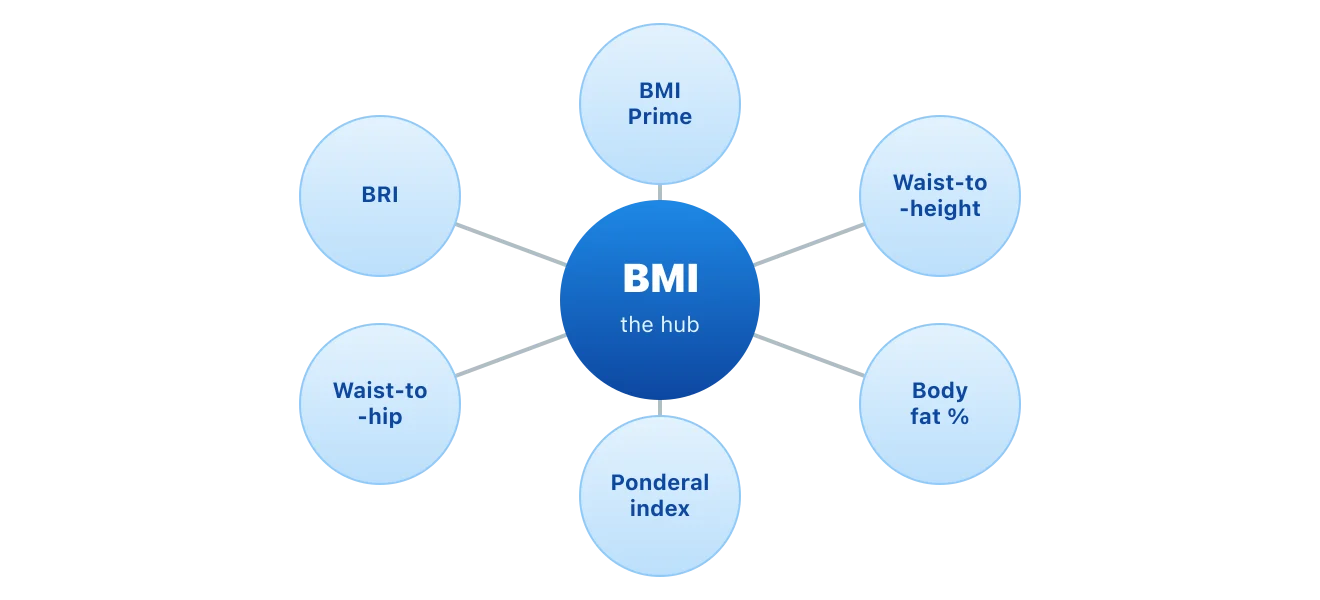
BMI gets all the attention, but it is only one entry in a surprisingly large family of body-measurement numbers. Each of its relatives was invented to patch a specific blind spot: some sense where your fat is stored, some estimate how much of you is fat versus muscle, and some simply re-express BMI in a friendlier form. This is a plain-language field guide to the most useful ones - what each measures, the formula behind it, and when it earns a place alongside BMI. None of them are magic, and none replaces a conversation with a professional - but together they turn a single, blunt number into something closer to a portrait.
Why one number isn't enough
The trouble with any single body number is that a body is not a single thing. Weight, height, fat, muscle, and the location of that fat are all different variables, and no one measurement can capture them at once. BMI compresses weight and height into a screening ratio; the moment you want to know where your weight sits, or what it is made of, you need a different tool. That is not a failure of BMI so much as a fact about information: to see more, you have to measure more.
The good news is that you do not need all of these numbers. Knowing what each one adds lets you pick the one or two that answer your actual question - and quietly ignore the rest.
It also helps to know that these measures were not handed down all at once. BMI itself is nearly two centuries old, devised by a Belgian mathematician studying populations. The waist-based measures arrived much later, as researchers noticed that where people carried fat predicted health better than weight alone. Body-fat methods came from a different direction again - the desire to weigh fat and muscle separately - and the newest indices, like the Body Roundness Index, are products of the last decade or so. Each one is essentially a patch for a limitation someone found in the tools that came before it, which is why they overlap in places and specialise in others.
The measures, at a glance
BMI Prime
BMI ÷ 25Your BMI as a fraction of the healthy-range ceiling. 1.0 sits exactly at the top of healthy; 0.9 is 10% under, 1.1 is 10% over. A fast relative read.
Ponderal Index
weight ÷ height³Like BMI but dividing by height cubed. It stays more stable at very tall or very short heights, where BMI is known to over- or under-read.
Waist-to-Height Ratio
waist ÷ heightA central-fat screen: keep it under 0.5 ("waist less than half your height"). Simple, height-fair, and a strong signal of risk BMI can miss.
Waist-to-Hip Ratio
waist ÷ hipsDescribes fat distribution - an "apple" shape (more around the middle) versus a "pear" (more around the hips), which carry different risk profiles.
Waist circumference
measured waistThe raw number on the tape. Simple thresholds flag higher central fat, and it needs no calculation at all - just a consistent measuring point.
Body Fat %
f(method)The proportion of your weight that is fat, from methods like tape-based formulas, calipers, or scales. It sees composition, which BMI cannot.
Lean Body Mass
weight − fat massEverything that isn't fat: muscle, bone, organs, water. Useful for tracking whether weight changes are coming from muscle or from fat.
Body Roundness Index
f(waist, height)Estimates how "round" you are from waist and height, as a proxy for visceral fat. Newer and less established, but a growing area of interest.
What each one senses
It helps to sort the family by the question each answers. Some measures are really about overall size, some about your shape and where fat sits, and some about your composition.
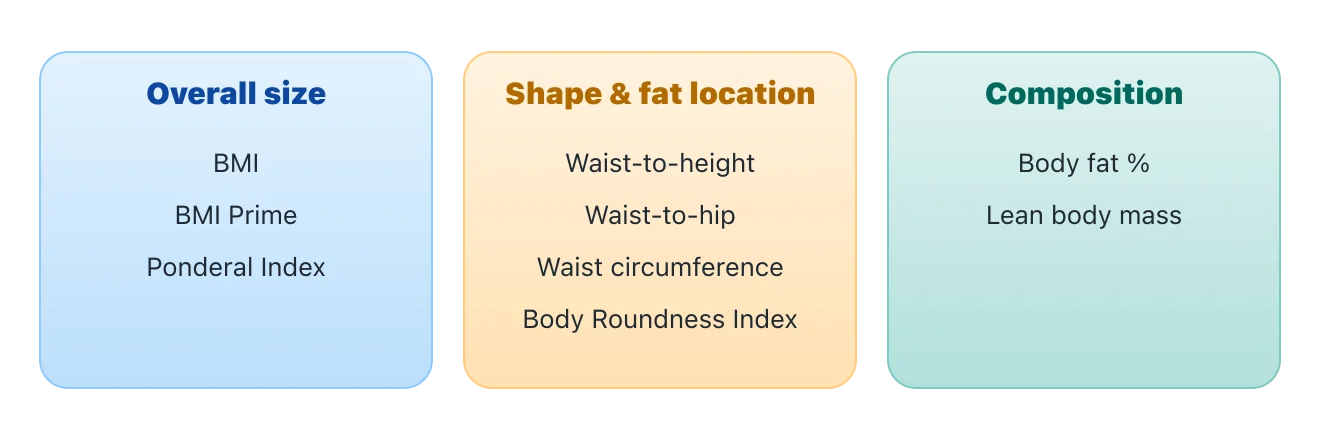
Sorting them this way also exposes the gaps in any single habit. If you only ever check BMI, you are living entirely in the first column, with no read on shape or composition at all. Add a waist measurement and you cover the first two columns at once - which is exactly why that pairing is recommended so often. The third column, composition, is the one most people can happily leave alone unless they are actively training and genuinely want to know what their weight is made of.
Which should you actually use?
For the overwhelming majority of people, the winning combination is simple: BMI plus your waist-to-height ratio. BMI gives you the size screen everyone else uses, and waist-to-height adds the single most valuable thing BMI lacks - a sense of whether fat is gathering around your middle. Both are quick, need no special equipment, and are backed by health authorities.
The other measures shine in narrower situations. The Ponderal Index is worth a look if you are very tall or very short, where BMI is least reliable. Body-fat percentage and lean body mass earn their keep if you are training and want to know whether the scale is moving because of muscle or fat. BMI Prime is pure convenience - a friendlier way to express BMI. And newer indices like BRI are interesting to watch but not yet essential. There is no prize for tracking all of them.
A word on accuracy, because it varies enormously across this list. The ratios - BMI Prime, waist-to-height, waist-to-hip - are only as good as the tape and the scale behind them, but the arithmetic is exact and repeatable. Body-fat percentage is the opposite: conceptually the most informative, yet the home methods (handheld devices, bathroom scales, and tape formulas) can disagree by several points, so the trend over time matters far more than any single reading. Knowing which numbers are precise and which are approximate keeps you from over-reading a wobble in the fuzzier ones.
Putting them together
The real skill is not collecting numbers; it is reading them as a set. A "healthy" BMI with a large waist tells a different story than the same BMI with a slim one. A rising weight with steady body-fat percentage suggests muscle gain, not fat. Any single figure can mislead, but two or three that agree - or revealingly disagree - give you a picture no lone measurement can.
So start with BMI because it is universal, add a waist measurement because it is the highest-value upgrade, and reach for the rest only when you have a specific question they answer. And whenever the numbers surprise or worry you, bring them to a healthcare provider, who can weigh them against everything a tape measure and a formula will never see.
One last piece of perspective: every number on this page is a screening estimate, not a diagnosis. Their job is to tell you whether something might be worth a closer look, not to deliver a verdict on your health. Used that way - lightly, in combination, and as a prompt rather than a judgement - the whole family becomes genuinely useful. Used the other way, as a set of pass-or-fail tests, even the best of them can mislead.