
You train hard, you are in good shape, and a BMI calculator has just filed you under "overweight." It stings, and it almost certainly does not tell the whole story. BMI cannot tell muscle from fat, so fit, muscular people routinely get a label that does not match what they see in the mirror or feel in their body. If that is you, the number is not a judgement on your health. It is a blunt tool bumping into its best-known blind spot, and understanding why is oddly reassuring.
BMI is calculated from weight and height alone, so it cannot tell dense muscle from body fat. A strong, lean, muscular body weighs more for its height and can land in the overweight range while carrying very little fat. Checking body fat percentage and waist-to-height ratio usually clears the confusion up in minutes.
Why muscle pushes BMI up
The mechanism behind an unfairly high BMI comes down to one fact about tissue: muscle is denser than fat. A given volume of muscle weighs noticeably more than the same volume of fat, so a body that has traded soft tissue for firm, trained muscle weighs more even as it gets leaner and tighter. BMI, meanwhile, looks only at your total weight set against your height. It has no way to ask what that weight is made of, so all of that dense, healthy muscle simply registers as extra kilograms, and extra kilograms nudge the number upward.
It can help to make the density gap concrete. Take a small, fixed volume, say the space of a one-litre carton, and fill it once with muscle and once with fat. The muscle-filled carton is meaningfully heavier, because muscle packs more mass into the same room. Now scale that idea up to a whole body: the more of your frame is built from dense muscle rather than lighter fat, the more you weigh at any given size. Two people can stand shoulder to shoulder at the same height and the same clothing size, yet the more muscular one tips the scale higher, and BMI, reading only that heavier weight, quietly assumes the worse of them.
Picture what happens over a couple of years of consistent training. You add muscle gradually while keeping your body fat low, your weight creeps up, and your height, of course, stays exactly the same. Feed those two numbers into the formula and your BMI rises right along with your strength. The calculator is not malfunctioning. It is doing precisely the arithmetic it was designed to do, which is to compare weight with height and nothing else. The label it hands back just happens to be blind to the very thing you worked hardest to build.
It helps to remember that this blindness is not a flaw someone forgot to fix; it is the deliberate trade at the heart of BMI. The measure was meant to be simple enough to use on whole populations with nothing but a scale and a ruler, and the price of that simplicity is that it cannot see inside you. For many sedentary bodies the trade works out fine. For a body carrying a lot of muscle it breaks down, because the one assumption BMI quietly makes, that weight above a certain point means excess fat, is exactly the assumption a muscular build sets out to break.
Who this affects most
This mismatch shows up most in people who have built real muscle while staying relatively lean. Strength athletes and dedicated lifters are the obvious cases, but the list is longer than that: sprinters, rowers, gymnasts, rugby and football players, and plenty of people whose jobs involve heavy physical work day after day. Many naturally muscular builds land here too, without anyone training for a sport at all. If you have put on solid muscle and kept your fat low, BMI is very likely to overstate you, and it will do so with total confidence.
You do not have to be an elite competitor for this to apply. A recreational lifter a couple of years into training, a keen amateur athlete, or a manual worker who hauls and carries all day can each carry enough muscle to be pushed a full category higher than their body fat would justify. The effect is a matter of how much muscle you carry relative to your height, not of how many medals sit on your shelf. Plenty of ordinary, healthy, active people quietly sit in the overweight band for no reason other than that they happen to be strong, and there is nothing wrong with them at all.
It is worth noting that the same blind spot runs in the other direction too, which is a useful reminder not to over-trust BMI in either case. Someone who is inactive and has lost muscle can post a perfectly normal BMI while carrying a higher proportion of fat than the number suggests, a pattern sometimes called skinny fat. BMI misses both the muscular person it over-flags and the under-muscled person it under-flags, which is really the same limitation viewed from two sides. If you want the fuller version of that story, our guide to whether BMI is accurate walks through it in more depth.
Same BMI, two very different people
Person A: the lifter
- BMI 27, labelled overweight
- Body fat around 15 percent
- Waist well under half their height
- Trains with weights several times a week
- Strong, energetic, sleeps well
- Here the high BMI is mostly muscle
Person B: same number, different story
- BMI 27, labelled overweight
- Body fat around 32 percent
- Waist above half their height
- Little regular activity
- Lower energy, carries weight centrally
- Here the number is worth a closer look
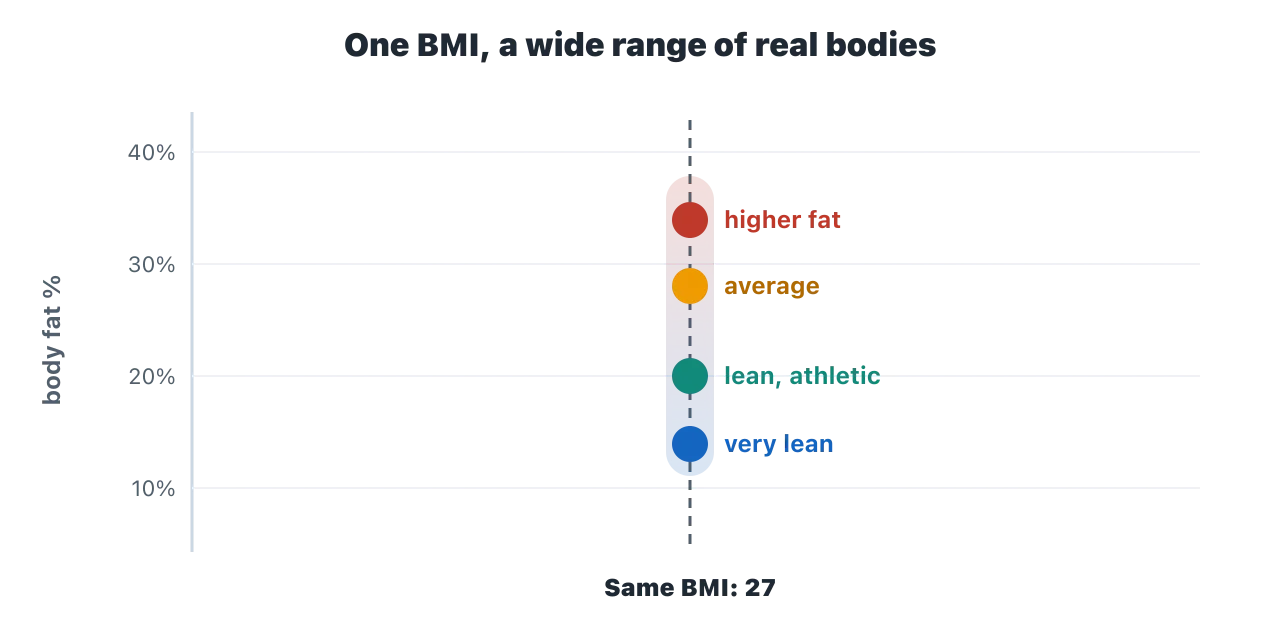
These two people share a single number and almost nothing else. Same height, same weight, same BMI, the same "overweight" label, and yet two completely different bodies with two completely different levels of health. That is the entire problem with reading BMI as a verdict rather than a prompt. It cannot distinguish between Person A, whose weight is muscle, and Person B, whose number really is worth investigating. Only a measure that can see composition is able to tell the two of them apart, and that is precisely the measure BMI is not.
How to check your real picture
If your BMI feels wrong, the fix is not to argue with the calculator but to stop relying on it alone and add a measure that can see what it cannot. You do not need a laboratory for this. A couple of simple, inexpensive checks will usually tell you within minutes whether your high BMI is muscle doing its job or a signal that deserves to be taken seriously, and either way you come away knowing more than the number could tell you.
The most direct check is body fat percentage, because it answers the exact question BMI dodges: how much of your weight is fat rather than muscle, bone, and water. Home methods such as calipers, smart scales, or tape-based estimates are rough and tend to disagree with one another, but even a ballpark figure is enormously more informative than weight alone. If your BMI says overweight while a body fat estimate comes back lean, you effectively have your answer, and the label on the calculator can be safely set in its proper context.
The second check is the waist-to-height ratio, and it may be the single most useful minute you spend. Wrap a tape around your middle and aim to keep your waist to less than half your height. Because this measure responds to central fat and essentially ignores muscle, it cuts straight through the confusion that trips up BMI. A muscular person with a trim waist will pass it easily, whatever their BMI happens to say. Alongside these numbers, the everyday signals matter too: your strength, how your clothes fit, your energy, your sleep, and progress photos over time will often tell you more than any single reading on any single device.
None of these checks needs to be precise to be useful, because you are looking for a clear signal rather than a decimal place. If two or three of them agree, low body fat, a trim waist, and real strength and energy, you can be confident the calculator is simply misreading your muscle. If they disagree with one another, that is worth noticing too, and it is exactly the kind of thing a provider can help you make sense of. The aim is a rounded picture built from a few cheap measures, not one perfect number to replace the imperfect one you started with.
When a high BMI is fine, and when to look closer
Putting it together, there is a version of a high BMI that is genuinely nothing to worry about. If your BMI is raised but your body fat is low, your waist sits comfortably under half your height, you feel strong and well, and you train or work physically on a regular basis, then BMI is almost certainly just misreading your muscle. In that situation the honest response is not to lose weight to satisfy a formula, but to let the number go and trust the better measures. Chasing a normal BMI by shedding hard-earned muscle would leave you weaker, not healthier.
There is also a version worth a closer look, and it deserves the same calm honesty. If a high BMI comes together with a high waist-to-height ratio, where the extra weight is not muscle and the tape confirms it, then the number may be pointing at something real. That is not a cause for alarm or self-criticism either; it is simply useful information, and the sensible next step is a conversation with a qualified healthcare provider who can look at your measurements, history, and overall health together. The point of checking is never to judge your body, only to understand it a little better.
What matters is that the follow-up is guided by the fuller picture, not by BMI alone. A raised BMI with a healthy waist and low body fat, and a raised BMI with a large waist and high body fat, are two very different situations that happen to produce the same three digits. Treating them as identical, purely because the calculator did, is how a genuinely useful screening tool gets turned into a source of needless worry for one person and false reassurance for another. The number is the beginning of the question, not the answer.
It is worth saying plainly that none of this makes one body good and another bad. Person A and Person B from earlier are not a hero and a cautionary tale; they are simply two people whose shared number happens to mean different things. A muscular build is not a moral achievement, and a higher body fat reading is not a moral failing. These measures exist to inform, not to rank, and the healthiest way to use any of them is with curiosity about your own body over time rather than judgement of it, or of anyone else's.
The takeaway
So if a calculator has just called you overweight and it does not square with a strong, active, capable body, do not let those three digits rewrite how you see yourself. BMI is blind to composition by design, and you are the one who supplies the context it lacks. If you have built muscle, a raised number is often a quiet reflection of your training rather than a warning about your health, and it deserves to be read in that generous and accurate light rather than as a failing.
And if the closer look does turn up something worth attention, that is not a failure or a judgement either. It is just an invitation to swap a blunt tool for sharper ones, a tape measure, a body fat estimate, and a provider who can see the whole of you, and then to make decisions from a fuller and fairer picture. Either way, the lesson is the same: no single number gets to define your body, least of all one that cannot tell muscle from fat. Let BMI be the quick first prompt it was meant to be, and let better measures and your own lived experience carry the real weight.