It sounds like it should have a tidy answer: how much weight is one BMI point? A kilo? Two? The honest reply is "it depends on how tall you are" - and there is a beautifully simple formula behind it. Knowing your own weight-per-point is genuinely handy: it tells you what a one-point change actually represents on the scale, why taller people always need more, and why your BMI barely twitches from day to day even when the scale does. Let's unpack it, with worked examples and a by-height table.
The simple rule: one BMI point = your height squared
Here is the whole trick in one line. Because BMI is weight (kg) divided by height (m) squared, changing your BMI by exactly one point takes a weight change equal to your height in metres, squared, in kilograms. If your height is 1.75 m, then 1.75 × 1.75 = 3.06, so one BMI point is about 3.06 kg for you - a little under 7 lb. That's it. The same number you square to calculate BMI is the number of kilograms in one of its points.
This falls straight out of the maths: if you divide weight by a fixed height-squared, then adding one "height-squared" worth of kilograms to the top of the fraction adds exactly one to the answer. It also means the figure is personal - it is set entirely by your height and does not change as your weight goes up or down.
Worked examples
Let's make it concrete with a short person and a tall person, so the difference is obvious.
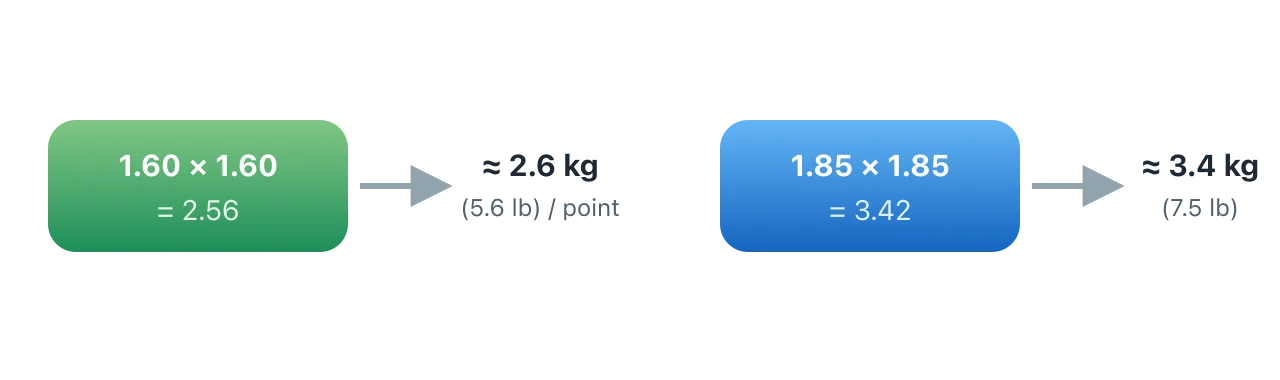
So if two friends - one 1.60 m, one 1.85 m - both want to see their BMI drop by a single point, the shorter friend gets there with about 0.8 kg less weight change than the taller one. Neither is doing anything "better" or "worse"; the arithmetic simply asks more kilograms of a bigger frame.
Why taller people need more
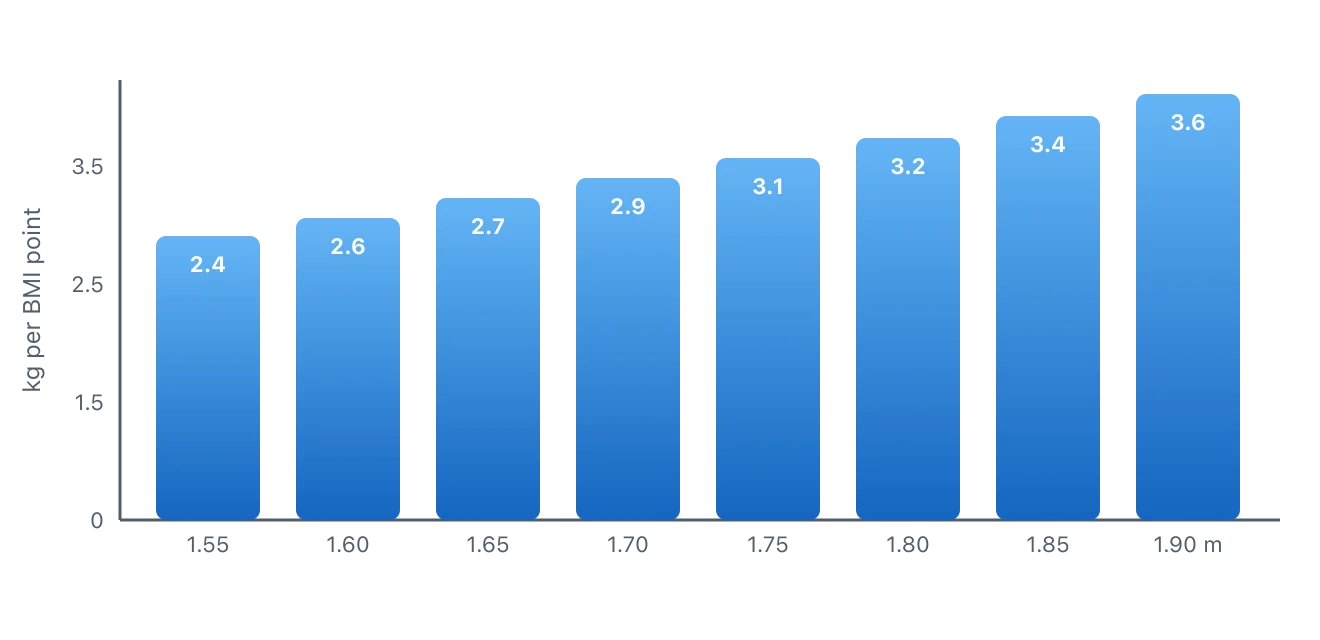
The reason sits in that squared height. BMI deliberately divides by height twice over to account for the fact that taller people are bigger in every dimension, not just height. A side effect is that the denominator grows quickly with height, so each BMI point "costs" more kilograms the taller you are. Between 1.55 m and 1.90 m, the weight per point climbs from roughly 2.4 kg to 3.6 kg - a full extra kilogram per point across that range, as the hero chart shows.
This is also why comparing raw weight changes between people of different heights can be misleading. A 3 kg change is more than a whole BMI point for a shorter person and less than one for a taller person. If you are comparing progress with someone else, BMI points are a fairer yardstick than kilograms - though, as we'll see, chasing points is not really the goal.
There is a neat way to feel this difference. The whole "overweight" band on the international scale runs from a BMI of 25 to 30 - five points wide. For a person 1.60 m tall, those five points are about 13 kg; for someone 1.90 m tall, the very same band spans roughly 18 kg. The categories look identical on a chart, but the amount of weight they contain quietly stretches with height. It is one more reason the boundaries between categories should be read as soft screening lines, not hard cliffs.
kg and lb per BMI point, by height
Find the height closest to yours to see what one BMI point means for you.
| Height | One BMI point (kg) | One BMI point (lb) |
|---|---|---|
| 1.55 m (5'1") | 2.4 kg | 5.3 lb |
| 1.60 m (5'3") | 2.6 kg | 5.6 lb |
| 1.65 m (5'5") | 2.7 kg | 6.0 lb |
| 1.70 m (5'7") | 2.9 kg | 6.4 lb |
| 1.75 m (5'9") | 3.1 kg | 6.8 lb |
| 1.80 m (5'11") | 3.2 kg | 7.1 lb |
| 1.85 m (6'1") | 3.4 kg | 7.5 lb |
| 1.90 m (6'3") | 3.6 kg | 8.0 lb |
What this means for setting goals
Understanding weight-per-point is useful; turning it into a rigid target is not. A healthy weight is a range spanning several BMI points, not a single bullseye, and the things that most reliably improve health - moving regularly, sleeping well, eating mostly whole foods - do not depend on hitting an exact number. Knowing that one point is, say, 3 kg for you is best used to keep expectations realistic: a single point is a real, several-kilogram change that takes time, not something to expect overnight or to chase with drastic measures.
If you are working toward a specific change, especially a large one, it is worth doing so with a qualified professional who can help you set targets that are healthy and sustainable rather than arbitrary. The arithmetic here is a lens for understanding your number, not a prescription for what it should be.
It is also worth being kind to yourself about pace. Because one point is several kilograms of genuine body change, a healthy rate of change means a single BMI point can take many weeks to move - and that is completely normal, not a sign that anything is failing. Expecting a point to shift in days sets you up to feel discouraged by ordinary biology. The arithmetic is quietly reassuring here: it tells you that slow is the honest speed.
A number that moves slowly
There is a quietly reassuring consequence of all this. Because a whole BMI point is a few kilograms, the daily bounce you see on the scale - often a kilo or two from water, food, and timing - is usually a fraction of a BMI point and rarely a real change in fat or muscle at all. People who weigh themselves every morning can be spooked by wobble that means nothing. Zooming out to the trend over weeks, ideally with a private history you can look back on, filters out that noise and shows the signal.
So treat one BMI point as what it is: a personal, height-based unit of a few kilograms that changes slowly and honestly. Knowing yours makes the whole scale feel less mysterious - and makes it much harder for a single jumpy morning reading to ruin your day.
That is really the quiet gift of this arithmetic. Once you know that a whole BMI point is, for you, a matter of several kilograms, the scale loses much of its power to alarm. A morning that reads a kilo heavier is a rounding error, not a relapse; a good week is encouraging but not the finish line. The number becomes a slow, steady companion you can check occasionally rather than a verdict you await each day - which is exactly the healthy relationship to have with it.