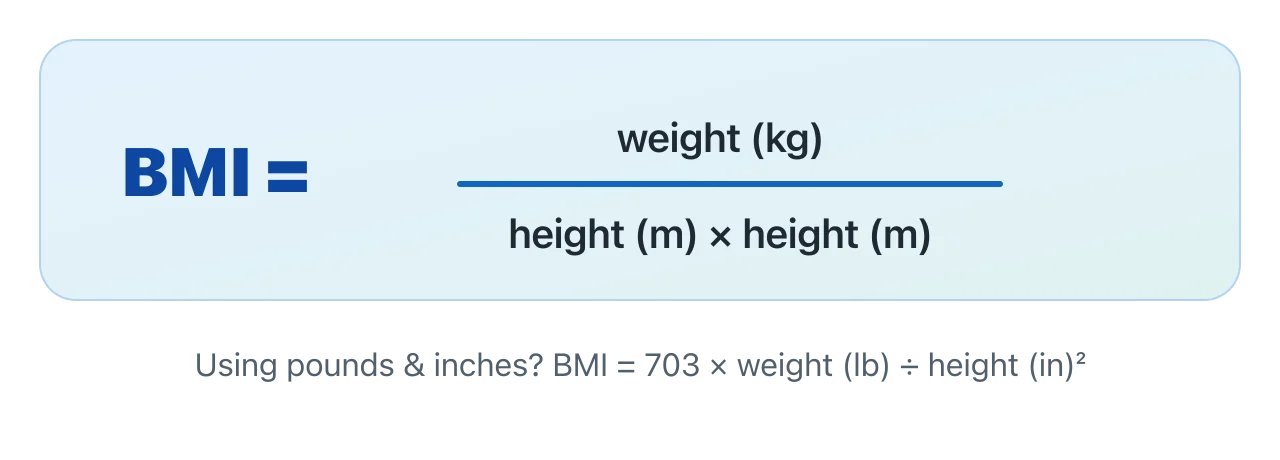
You do not need an app to find your BMI - the whole thing is one short sum you can do on the back of a receipt. Understanding that sum is genuinely useful, too: it shows you exactly what the number is made of, why height matters so much more than it looks, and where the result can quietly go wrong. This guide walks through the formula in plain words, gives you numbered steps for both kilograms and pounds, works two full examples, and flags the small mistakes that trip people up. By the end you will be able to check your own number anywhere, without a signal or an app - and, just as usefully, recognise when a BMI someone quotes at you cannot possibly be right.
The formula, in plain words
BMI compares your weight to your height. But it does not compare weight to height directly - it compares weight to your height multiplied by itself. In metric units, you take your weight in kilograms and divide it by your height in metres, squared. "Squared" just means times itself, so a height of 1.7 metres becomes 1.7 × 1.7.
Why square the height? Because people don't scale up in a single direction as they grow - a taller person is bigger in every dimension. Squaring the height is a simple way to account for that, so the scale roughly balances out across different heights. It is not perfect (very tall and very short people are the classic edge cases), but it is what makes a single set of BMI categories usable for most adults. If you prefer pounds and inches, the maths is identical apart from a conversion factor of 703 that rescales the answer to match the metric result.
There is one more thing the formula quietly tells you: height carries far more weight in the sum than it first appears. Because height is squared, a small difference in how tall you are changes the divisor a lot. That is why two people who weigh exactly the same can have noticeably different BMIs, and why an error of a few centimetres in your height measurement moves the result more than the same error in your weight would. Getting the height right is the part most worth being careful about.
Metric: step by step (kg and m)
Get your weight in kilograms
Weigh yourself and note the number in kilograms - for example, 70 kg. Morning, before breakfast, is the most consistent time.
Get your height in metres
Measure your height and convert to metres. 175 cm becomes 1.75 m (divide centimetres by 100).
Square the height
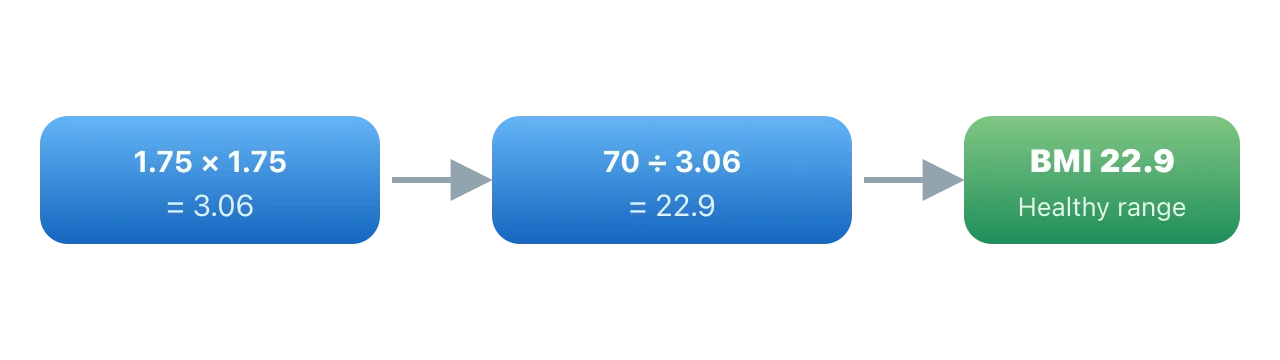
Multiply your height by itself: 1.75 × 1.75 = 3.06. This is the number you will divide by.
Divide weight by that
Divide your weight by the squared height: 70 ÷ 3.06 = 22.9. That is your BMI.
A worked metric example
Let's follow a person who weighs 70 kg and stands 1.75 m tall, so you can see every stage of the sum rather than just the answer.
Imperial: step by step (lb and in)
Weight in pounds
Note your weight in pounds - for example, 154 lb.
Height in inches
Convert your height to total inches. 5 ft 9 in is (5 × 12) + 9 = 69 in.
Square the height
Multiply inches by themselves: 69 × 69 = 4,761.
Multiply by 703, then divide
703 × 154 = 108,262, then ÷ 4,761 = 22.7. That is your BMI.
A worked imperial example
Take someone who weighs 154 lb and is 5 ft 9 in (69 in) tall. Square the height: 69 × 69 = 4,761. Now multiply the weight by 703: 703 × 154 = 108,262. Finally, divide: 108,262 ÷ 4,761 = 22.7. Notice how close that is to our metric example - 22.7 versus 22.9 - because 154 lb and 5 ft 9 in describe almost the same body as 70 kg and 1.75 m. The tiny gap is just rounding in the conversions, not a real difference. That is the whole point of the 703 factor: it keeps both systems honest.
Common mistakes to avoid
The arithmetic is easy; the slip-ups are almost always in the setup. Watch for these:
- Using centimetres instead of metres. Dividing by 175 × 175 instead of 1.75 × 1.75 gives a laughably tiny BMI. Convert centimetres to metres first.
- Forgetting the 703. In pounds and inches, leaving out the factor produces a number far too small to mean anything.
- Squaring the wrong thing. It is the height that gets squared, never the weight.
- Mixing systems. Kilograms with inches, or pounds with metres, will never give a valid result. Pick one system and stay in it.
- Over-precise inputs. Guessing your height to the millimetre feels rigorous but adds false precision; a steady, honest measurement matters more.
Rounding and what your number means
Round your BMI to one decimal place and stop there. The categories on the international scale are simple: below 18.5 is underweight, 18.5 to 24.9 is the healthy range, 25 to 29.9 is overweight, and 30 or above is in the obesity range. Those are screening bands, not grades - a number a whisker over a boundary is not meaningfully different from one a whisker under it.
Remember, too, that these adult categories only apply from around age 20. For children and teenagers, the very same BMI number is read against age-and-sex percentile charts instead, so the hand calculation gives you the figure but not the interpretation. However you arrive at the number, treat it as a prompt to look closer, not a final word on your health.
A quick way to sense-check your answer
Because it is easy to fumble a decimal point, it helps to know roughly what a sensible answer looks like. For the overwhelming majority of adults, BMI lands somewhere between about 15 and 45. If your sum produces 3, or 300, you have almost certainly mixed your units - the usual culprits are centimetres left in place of metres, or the 703 factor forgotten in the imperial version. A second useful anchor: a BMI of 25 sits roughly at the top of the healthy weight range for your height, so if you already know you are comfortably inside that range, an answer far above 25 is a signal that the arithmetic slipped somewhere.
It is also worth doing the sum twice - ideally once in each unit system, or at least by re-entering the numbers fresh. Two independent tries that agree are far more trustworthy than a single confident-looking result, and the whole calculation takes only a few seconds anyway. That habit of quietly double-checking is what stops a small slip from turning into a big misunderstanding.
From a number to a meaning
Once you have your BMI, resist the urge to over-read it. The figure itself is just a coordinate on a scale; its meaning comes from context. Two people can share a BMI of 27 and be in completely different situations - one a heavily-muscled athlete, the other carrying excess fat around the middle - because the formula cannot see what the weight is made of. That is not a flaw in your maths; it is a limit of the measure itself.
So use the hand calculation for what it is genuinely good at: a fast, transparent way to place yourself on the scale and to watch the trend over months. For anything more - deciding whether your number is a concern, or what to do about it - pair it with a waist measurement and a conversation with a healthcare provider. The sum gives you a starting point you can trust; the interpretation is where human judgement comes in.