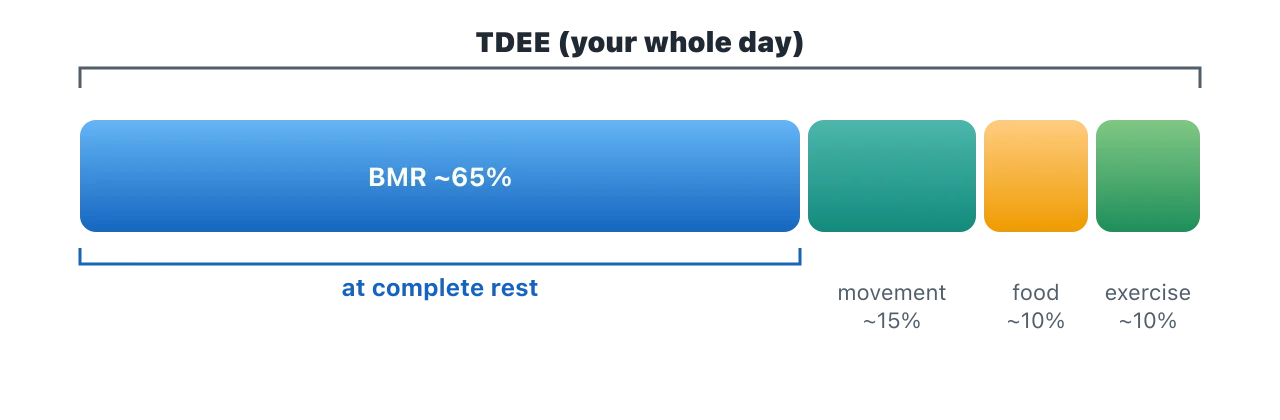
If you have ever poked at a calorie calculator, you have probably met two acronyms that sound almost interchangeable: BMR and TDEE. They are closely related but they answer different questions. One tells you what your body would burn if you did nothing at all; the other tells you what you actually burn living your real life. Getting them straight makes every calorie estimate you ever read far easier to interpret, so let us untangle them.
BMR is the energy you burn at complete rest. TDEE is everything you burn in a day, BMR included. TDEE is your maintenance level; BMR is just the resting floor beneath it.
BMR: your body at rest
Basal metabolic rate is the energy your body spends simply staying alive. Even if you lay perfectly still in bed all day, your heart would keep beating, your lungs would keep breathing, your brain would keep humming, and your cells would keep repairing themselves. All of that costs energy, and for most people it is the single largest chunk of what they burn, often around two-thirds of the daily total.
Because it measures the body at rest, BMR is driven mostly by things you do not consciously control: your size, your age, your sex, and especially how much lean tissue you carry, since muscle is more metabolically active than fat. It is the quiet baseline that ticks along whether you run a marathon or never leave the sofa.
TDEE: your whole day
Total daily energy expenditure takes that resting baseline and adds everything else you do. It layers on three extra pieces: the energy used to digest and process food, the calories burned in everyday movement that is not formal exercise (walking to the kitchen, fidgeting, taking the stairs), and the energy of any deliberate workouts. Add those to BMR and you get the real number: what your body actually spends across twenty-four hours.
This is why TDEE is the figure people usually mean when they talk about "maintenance calories." It is the amount that, on average, keeps your weight roughly stable, because it matches energy in to energy out over a normal day.
BMR vs TDEE at a glance
BMR
- Energy at complete rest
- Keeps your organs and cells running
- Often ~60 to 70% of the daily total
- Set by size, age, sex, and lean mass
- Does not change with your activity
- A baseline, not a daily target
TDEE
- Energy across a whole day
- BMR plus digestion, movement, exercise
- Always larger than BMR
- Rises and falls with how active you are
- Closest thing to "maintenance" calories
- The number most plans are built around
How each is estimated
BMR is usually estimated with a formula. The most widely used today is Mifflin-St Jeor, which combines your weight, height, age, and sex. In words, it multiplies your weight and height by fixed amounts, subtracts a figure for your age, and then adjusts up or down depending on sex. The output is your estimated resting burn in calories per day.
TDEE then takes that BMR and multiplies it by an activity factor, a number that stands in for how much you move. The busier your typical day, the larger the multiplier.
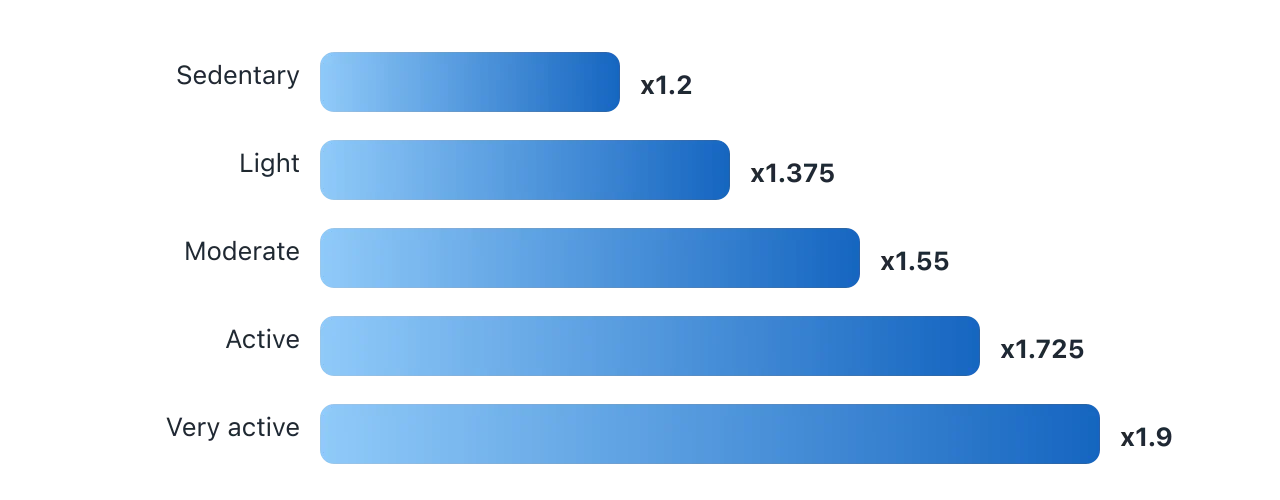
So the recipe is simple: estimate BMR from the formula, pick the activity factor that best matches an honest look at your week, and multiply. A person with a BMR near 1,500 who is lightly active would land around 2,060 for TDEE; the same person with a physically demanding routine could be well above 2,600.
A full example, start to finish
Suppose a 35-year-old woman weighs 68 kg and stands 168 cm tall. Put those into the Mifflin-St Jeor formula and you get an estimated BMR of roughly 1,400 calories a day. That is what her body would burn at complete rest, doing absolutely nothing. On its own, it is not a target for how much to eat; it is the floor beneath her day, the cost of simply being alive.
Now add her life on top. If her weeks involve a desk job with a few light walks, the light-activity multiplier of about 1.375 fits, which lifts her TDEE to somewhere near 1,930 calories. If instead she trained hard most days and was on her feet at work, a higher multiplier could push her TDEE past 2,400. Same body, same BMR, and yet the daily total swings by hundreds of calories purely because of what she does with her hours. That gap between 1,400 and 2,400 is the difference between BMR and TDEE made concrete.
Which one should you use?
For almost every everyday purpose, TDEE is the number you want, because it reflects the life you actually live. It is the sensible reference point for understanding roughly how much energy your days require and for noticing how activity changes that. BMR on its own is mainly useful as a building block, or as a reminder of how much energy your body spends before you have done anything at all.
One thing BMR is genuinely useful for is perspective. Seeing that a large majority of your daily burn happens at rest can defuse the myth that exercise alone drives the whole budget, and it explains why building and keeping muscle, which nudges that resting baseline, matters over the long run.
There is one more reason TDEE tends to win for everyday use: it is the only one of the two that responds to your choices. Because BMR is fixed by your body, watching it tells you little from week to week. TDEE, by contrast, moves when you move, which makes it the number worth paying attention to if you want to understand how your daily habits and your energy budget fit together.
It also helps to know that comparing your calculated figures with someone else's can mislead. Even at the same height, weight, age, and sex, two people can have genuinely different resting burns because of differences in muscle, organ size, and genetics that no formula captures. Your estimate is a personal starting point, not a leaderboard position, and it means the most when measured against your own results over time.
A note on accuracy
Both numbers are estimates, and it is worth holding them loosely. The formulas were built from population averages, so any individual can sit a little above or below their predicted value, and the activity multipliers are broad brush by design. That is not a flaw so much as a feature of any quick calculation: the point is to get a reasonable starting figure, then watch how your body responds over a few weeks and adjust, rather than trusting a single number to the last calorie.
A final and important caveat: calorie targets are personal and can be sensitive. If you are planning a meaningful change to how you eat, especially a large one, it is worth doing so with a qualified professional who can tailor the numbers to your health, rather than following a generic figure from any calculator, including a good one.