Almost everyone has heard some version of it: once you hit thirty, your metabolism slows down, and the weight starts to creep on no matter what you do. It is one of the most repeated ideas in health, and it turns out to be mostly wrong. A landmark study of thousands of people rewrote the timeline of human metabolism, and the real story is both more surprising and, in a way, more useful. Understanding it changes how you think about weight through the decades.
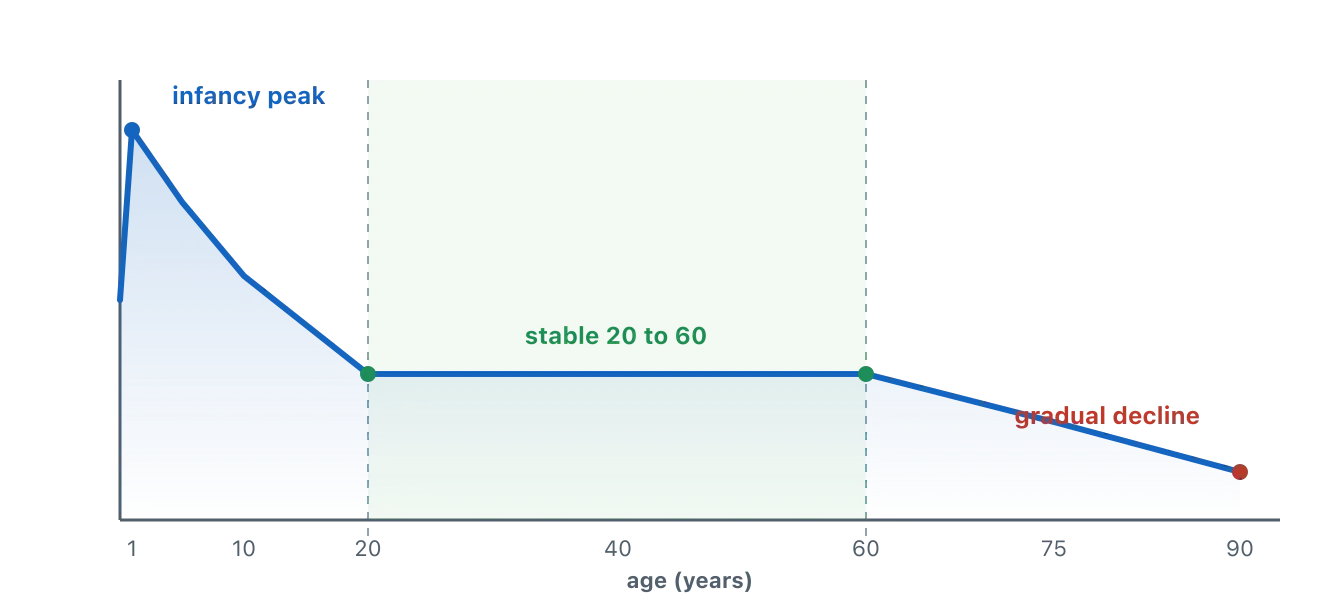
Size-adjusted metabolism is stable from about age 20 to 60, not falling off a cliff in your thirties. It declines only gradually after 60. Midlife weight gain is usually about the life around the metabolism, not a slowing engine.
The myth of the thirties slowdown
The story is so familiar it feels like common sense. You spend your twenties able to eat anything, then some switch flips at thirty, your metabolism downshifts, and midlife weight gain becomes inevitable. It is a comforting explanation because it puts the cause somewhere outside your control, and it lines up with the real observation that many people do gain weight in their thirties and forties.
The trouble is that the timing does not survive close measurement. When scientists actually tracked energy expenditure across the whole lifespan, the sharp thirties decline simply was not there. The weight gain is real; the explanation was wrong.
What the research actually found
In 2021, a large international team published a study in the journal Science, led by the metabolism researcher Herman Pontzer, that measured total energy expenditure in more than six thousand people from infancy into old age. Crucially, they used the gold-standard "doubly labelled water" method and adjusted for body size, so they were comparing like with like rather than just noting that bigger bodies burn more.
Their timeline looked nothing like the folk story. After accounting for size, energy expenditure was essentially flat from about age twenty all the way to about sixty. There was no special drop in the thirties, no sudden change at menopause in the data, and no midlife cliff. Only after around sixty did metabolism begin a slow decline, at a gentle rate of less than one percent per year. The engine, it turns out, runs steadier for far longer than we thought.
Four phases of metabolism
The same research sketched a cleaner map of metabolism across life, with four broad phases that the curve above traces.
The first is infancy, and it is the real headline: pound for pound, babies have the highest metabolic rate of all, peaking around their first birthday at roughly fifty percent above the adult level. The second phase is a long, gentle decline through childhood and adolescence, as that fiery infant metabolism settles down. The third is the long adult plateau, from about twenty to sixty, where size-adjusted metabolism is remarkably stable. The fourth is later life, from around sixty onward, where it declines slowly and steadily. Seen this way, the decades most people worry about are precisely the calm, flat middle of the curve.
One detail from that infant peak is worth pausing on: it means the highest metabolic rate you will ever have is behind you before you can walk. Every stage after it is a settling, not a collapse. Framing the lifespan this way makes the long adult plateau feel less like a decline waiting to happen and more like the steady stretch it genuinely is.
So why the midlife weight gain?
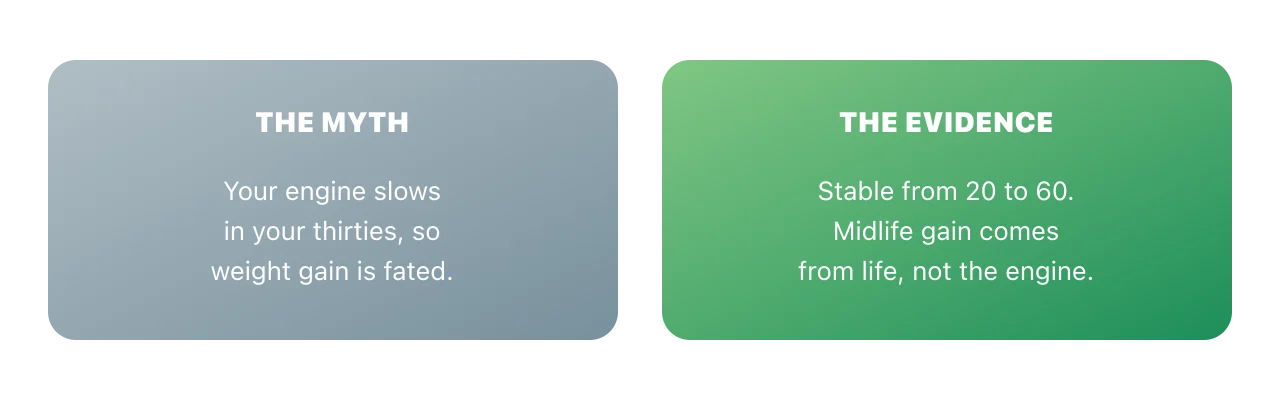
If the engine is not slowing, why do so many people gain weight in their thirties, forties, and fifties? The honest answer is that plenty changes around the metabolism even while the metabolism itself holds steady. Daily movement often falls as careers and family fill the calendar and life becomes more seated. Muscle, which supports resting energy use, is gradually lost unless it is actively maintained. Portions and eating out tend to grow with income and habit. Sleep frequently suffers, and stress tends to rise, both of which can nudge appetite and behaviour.
None of these is a slowing engine, and that distinction matters. It moves the cause of midlife weight gain from something fixed and biological to a set of everyday factors that are, at least partly, within reach. The myth quietly told people not to bother; the evidence suggests the opposite.
Where the myth came from
If the thirties slowdown is not real, why is the belief so universal? Part of the answer is that older, smaller studies did seem to show metabolism falling with age, but many did not fully separate two different things: a genuine change in the metabolic rate of tissues, and the simple fact that people tend to lose muscle and gain fat over the years. Because muscle burns more energy than fat, losing it lowers your total burn even when each kilogram of tissue is behaving perfectly normally. Read carelessly, that looks like a slowing metabolism when it is really a change in body composition.
The scale of the 2021 work is part of why it landed so hard. With more than six thousand participants spanning ages from a few days old into the nineties, and a measurement method considered the most accurate available, it was far harder to wave away than the smaller studies before it. When a dataset that large points clearly in one direction, it tends to settle a question rather than merely nudge it.
The rest is human nature. "My metabolism slowed down" is a tidy, blameless story for the very real experience of midlife weight gain, and tidy stories spread. The research did not say that weight gain is imaginary; it said the popular explanation was pointing at the wrong culprit. Subtle corrections like that travel far more slowly than the myths they replace.
What this means for you
The practical message is encouraging. Since your resting metabolism is not conspiring against you in midlife, the ordinary levers still work. Keeping muscle through regular activity supports the resting baseline that makes up most of your daily burn. Staying generally active raises the total. And because the decline that does come is slow and late, there is a long runway in which habits, not fate, do most of the deciding.
It also reframes the scale. If your weight is drifting up in your forties, the useful questions are about your days and your muscle, not about a broken metabolism. Watching your BMI trend over time, rather than any single reading, can flag that drift early, while the reasons behind it are still the everyday kind you can work with. As always, for a plan tailored to you, a qualified professional beats any general rule, including this one.
There is something freeing in all of this. The myth handed responsibility to an aging metabolism and left you a passenger in your own body. The evidence hands it back: for the long stretch from twenty to sixty, the biggest influences on your weight are the ordinary, repeatable choices of daily life. That is not really a burden so much as an invitation, and it is a far more hopeful place to stand than waiting for a metabolism you cannot see to decide your fate.