"Muscle weighs more than fat" might be the most repeated half-truth in all of fitness. You have heard it at the gym, read it in magazines, and probably said it yourself to explain a stubborn scale. It is also, taken literally, false. A kilogram of muscle and a kilogram of fat weigh exactly the same, because a kilogram is a kilogram. What people are reaching for is a real and useful idea, but the sloppy wording hides it. Getting the fact straight explains a surprising amount about the scale, your shape, and even your BMI.
Muscle does not weigh more than fat. It is about 15 to 18% denser, so the same weight of muscle takes up less space. That single fact is why a leaner body can weigh the same as a softer one, and why muscular people are so often misread by the scale and by BMI.
The short answer: a kilo is a kilo
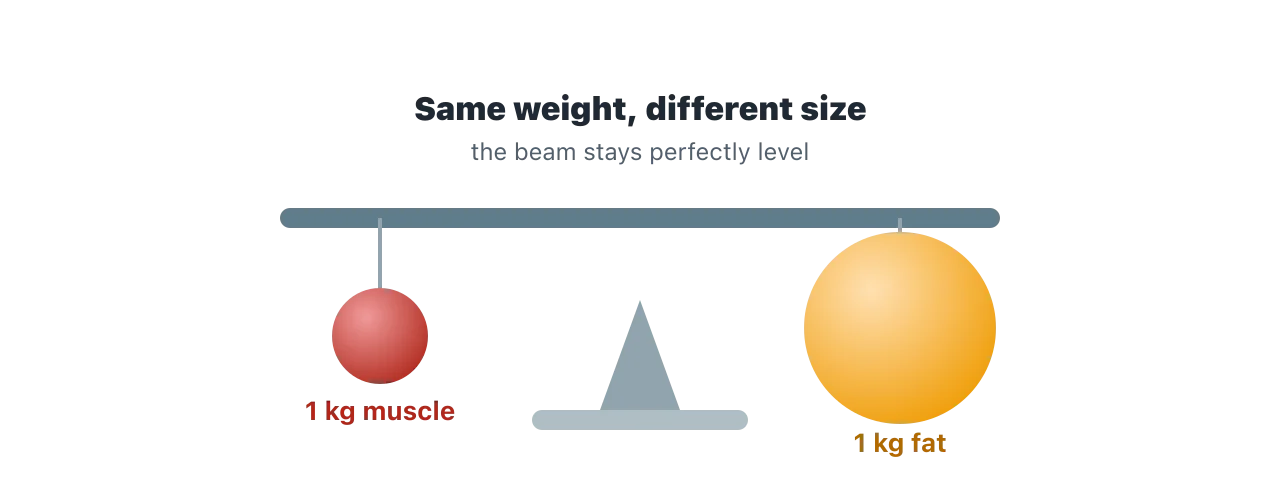
Weight is weight. One kilogram of feathers, one kilogram of muscle, and one kilogram of fat all weigh one kilogram, and all would balance perfectly against each other on a scale, exactly as the illustration above shows. There is no trick and no exception. So on the plain reading of the words, muscle does not weigh more than fat, and neither does anything else weigh more than an equal weight of something else.
If that feels wrong, it is because everyday experience seems to contradict it. The muscular person really is heavier than they look, and the scale really does refuse to fall even as someone gets visibly fitter. Those observations are true. The explanation just is not weight; it is density.
What people really mean: density
Density is how much mass is packed into a given space. Muscle is denser than fat by roughly 15 to 18 percent, which means a lump of muscle is smaller than a lump of fat that weighs the same. Turn that around and it becomes vivid: a kilogram of fat is bulkier, softer, and takes up noticeably more room than a kilogram of muscle, which is compact and firm. Neither is heavier; they simply occupy different volumes.
So the accurate version of the gym saying is "muscle is denser than fat," or "muscle takes up less space than fat." That is not just pedantry. Once you frame it as density rather than weight, several confusing experiences suddenly make sense.
Muscle and fat, side by side
Muscle
- Denser, about 1.06 g per ml
- Takes up less space for its weight
- Firm and compact
- Burns more energy at rest
- Moves you and supports your joints
Fat
- Less dense, about 0.9 g per ml
- Takes up more space for its weight
- Soft and bulky
- Stores energy for later
- Essential in moderation, insulating and protective
Notice that this is not a story of a good tissue and a bad tissue. Fat is essential and does important jobs; muscle is valuable and does different ones. The point is only that, weight for weight, they are built differently, and that difference in size is what the eye and the scale pick up on.

Why the scale can lie
Here is where the density fact earns its keep. Imagine someone who trains consistently for a few months. They gradually build muscle and lose fat at a similar pace. Because muscle and fat weigh the same per kilogram, the two changes roughly cancel out on the scale, so their weight barely moves. Yet their body is visibly changing: firmer, smaller in the places they wanted, and better fitting in their clothes. This is called recomposition, and to anyone watching only the scale it looks like nothing is happening.
That is why weight alone is such a poor judge of a fitness effort. It faithfully reports kilograms, but it cannot tell you whether those kilograms have quietly swapped from fat to muscle. A stalled scale during a period of training is often not a failure at all; it can be exactly the recomposition you were hoping for, hidden behind a number that only measures one thing.
Why this fools BMI
The same density fact is one of the main reasons BMI misjudges muscular people. BMI is calculated from weight and height, and it has no way to know whether your weight is dense muscle or bulky fat. So a well-built athlete carrying plenty of compact muscle can tip into the overweight or even obese BMI band while carrying very little fat. The number is not broken; it is just blind to composition, and density is exactly the thing it cannot see.
This is why very muscular people are the textbook example of when to read BMI with caution. If you lift seriously or do heavy physical work, a high BMI may be measuring your muscle, and a body fat estimate or a waist measurement will tell a truer story than the weight-to-height ratio alone.
What to track instead
If the scale cannot see density, the fix is to measure the things that can. A tape measure around the waist, hips, and limbs captures changes in size that weight misses, and is especially good at revealing recomposition. Progress photos under consistent lighting do the same job for the eye. How your clothes fit is an honest, everyday signal. And a body fat estimate, imperfect as home methods are, adds the composition angle directly.
None of this means you must abandon the scale. Weight is still useful as one input, especially watched as a trend rather than a daily verdict. The point is simply to stop asking it to answer a question it cannot: what your weight is made of. Pair it with measurements and a body fat sense, and bring anything that concerns you to a healthcare provider, who can read the whole picture rather than a single number.
Why the wording matters
It might seem like harmless nit-picking to correct "muscle weighs more than fat" to "muscle is denser than fat." But the loose version quietly does damage. It teaches people that the scale is the thing to watch, and that a stalled or rising weight during training must mean failure, when it may mean the opposite. It also feeds the idea that muscle is a burden to be hauled around, rather than the compact, useful tissue it actually is.
The precise version does the reverse. Once you understand that the difference is size, not weight, the scale loses its grip on you. A steady weight can become a source of curiosity rather than frustration: what is my body actually doing underneath this unchanged number? That question leads naturally to better measures, like a tape and a mirror, and to a healthier relationship with progress that is not held hostage by a single reading each morning.
So the fact is small but the payoff is large. Muscle and fat weigh the same per kilogram; muscle simply takes up less room. Hold on to that, and a stubborn scale, a muscular friend's surprising BMI, and your own slowly changing shape all stop being mysteries and start being exactly what you would expect.