Once you know that body fat percentage tells you more about your body than weight alone, the obvious next question is how to measure it without a lab. The honest answer is that you can get a useful estimate at home, but not a perfect one, and understanding the trade-offs is the difference between a number you can trust and one that quietly misleads you. Here are the six main methods, what each gets right and wrong, and how to get the most out of whichever you choose.
First, a reality check
No method you can do at home will match a clinical body-composition scan for accuracy. The gold-standard approaches, such as DEXA scans and underwater weighing, exist precisely because measuring fat well is hard. Home methods all rely on shortcuts: they estimate fat indirectly from electrical signals, skin pinches, or tape measurements, and every shortcut introduces error.
That is not a reason to give up on measuring at home. It is a reason to set expectations correctly. A home method that is a few points off but consistent is genuinely useful for answering the question most people actually care about, which is not "what is my exact body fat" but "is it moving in the direction I want." Keep that framing in mind and every method below becomes more useful.
The main methods
Smart scales (BIA)
Send a tiny electrical current through the body and estimate fat from the resistance. Very convenient and good for trends, but readings shift with hydration, meals, and time of day, so a single number can be several points out.
Skinfold calipers
Pinch and measure the fat under the skin at set points, then convert with a formula. Cheap and reasonably reliable in skilled hands, but the result depends heavily on technique, so self-measuring can be inconsistent.
Tape method
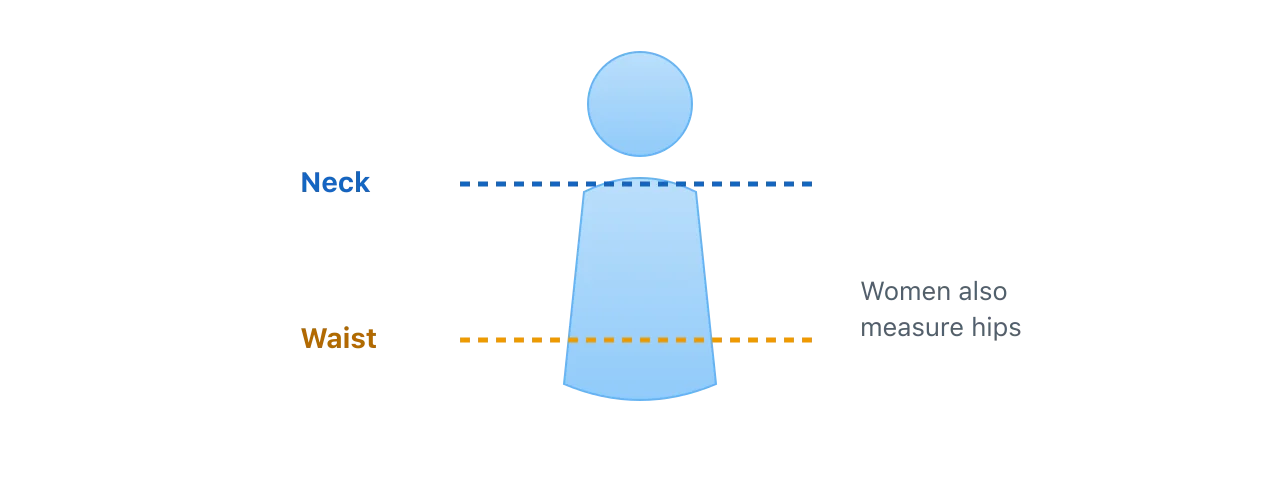
Estimates body fat from circumferences such as neck and waist, plus hips for women, alongside height. It is free, needs only a tape measure, and is easy to repeat, though it remains an estimate rather than a direct read.
Handheld BIA devices
Work like body fat scales but pass the current through the arms. Portable and quick, with the same hydration sensitivity, and they often read differently from foot-to-foot scales, so do not mix the two.
Clinical scan (DEXA)
Not a home method, but worth knowing. A DEXA scan is highly accurate and even shows where fat sits, at the cost of a clinic visit and a fee. Useful as an occasional benchmark for your home method.
Visual estimation
Comparing yourself to reference photos. It is free and surprisingly not useless for a rough band, but it is subjective and easily swayed by lighting and wishful thinking, so treat it as the loosest guide.
Of these, the tape method deserves a closer look, because it is free, repeatable, and needs nothing you do not already own.
The tape method, step by step
To use the tape method, measure your height and then the key circumferences with a flexible tape held level and snug against the skin without compressing it. Men measure the neck, just below the larynx, and the waist at the navel. Women add the hips at their widest point. Take each measurement two or three times and average them, since small wobbles are normal. Then feed the numbers into a body fat estimator, which applies the standard formula for you.
The reason this works at all is that fat tends to distribute in predictable ways, so circumferences carry real information about it. The reason it is only an estimate is that everyone distributes fat a little differently, so the formula cannot be exact for any individual. Its great strength is repeatability: measured carefully at the same points, it will track your changes faithfully even if the absolute number is a touch high or low.
Accuracy versus convenience
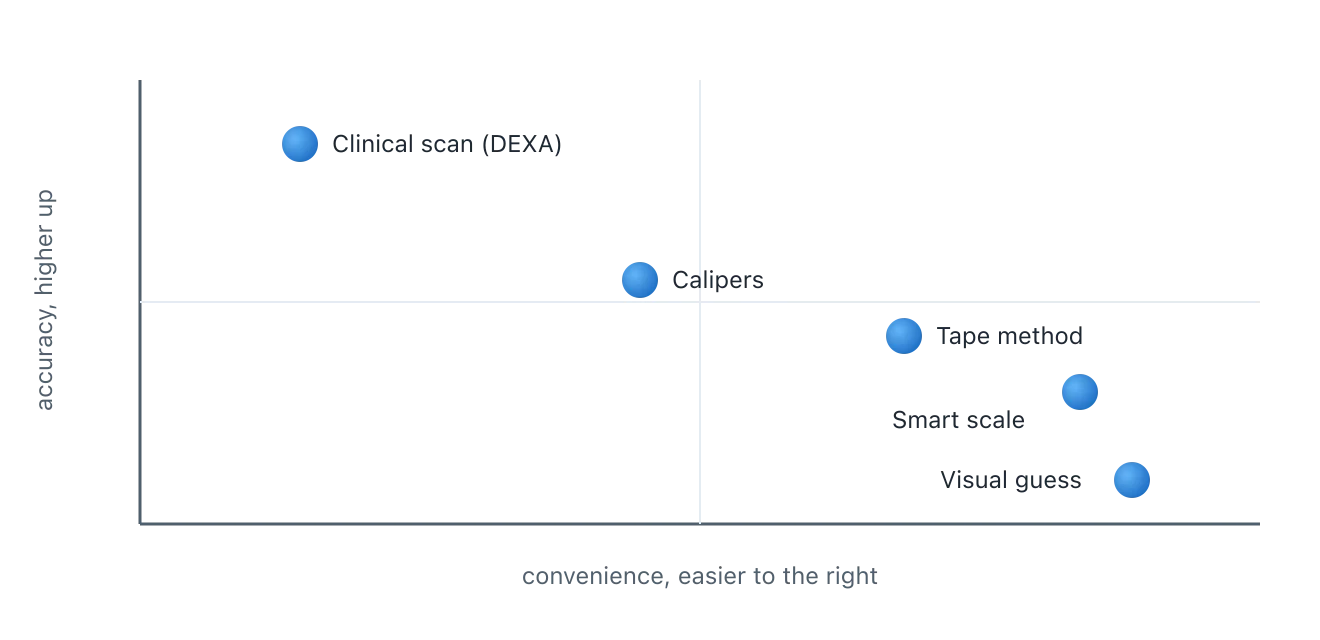
The quadrant at the top of this article captures the central trade-off. As you move toward the accurate methods, they become less convenient, more expensive, or both. As you move toward the effortless methods, accuracy falls away. There is no home option that is both perfectly accurate and perfectly easy, and any product promising otherwise is overselling.
This matters because the best method is not the most accurate one in the abstract; it is the most accurate one you will genuinely keep using. A DEXA scan you take once and never repeat tells you less about your progress than a body fat scale you step on every couple of weeks under the same conditions. Convenience that leads to consistency often beats precision that leads to abandonment.
Consistency beats precision
If you take one idea from this article, make it this: how you measure matters more than what you measure with. Body fat readings are sensitive to hydration, food, exercise, and the time of day, so the way to get trustworthy information is to hold all of those steady. Measure first thing in the morning, before eating or drinking, under the same conditions each time, with the same device.
Do that, and even a method with a built-in offset becomes reliable for the thing that counts, which is change over time. A reading that is consistently two points high is still perfectly good at showing you a downward or upward trend. Obsessing over the absolute figure, meanwhile, is chasing a precision that home measurement simply does not offer.
Which should you use?
For most people, the sensible choice is either a body fat scale, for effortless trend tracking, or the tape method, for a free option with no gadget required. If you want an occasional accurate benchmark, a single clinical scan can calibrate your expectations for the home method you use day to day. Calipers can be excellent but really reward good technique, so they suit the more committed.
Whatever you pick, remember that body fat percentage is one lens among several. Pair it with your BMI and, for a quick sense of where fat sits, your waist-to-height ratio, and take anything that concerns you to a healthcare provider. A home body fat number is a useful companion to those measures, not a replacement for professional judgement.
Putting the number in context
A body fat reading means little in isolation, so it is worth pairing with the ranges that give it meaning. A healthy body fat percentage differs by sex and shifts with age, so the same figure can be perfectly healthy for one person and a flag for another. Before reacting to a number from any device, check it against the appropriate band for your sex and rough age group, and remember that the acceptable range really is acceptable rather than a place to escape from.
It also helps to zoom out to the other measures you already have. Your BMI gives a quick weight-to-height screen, and your waist-to-height ratio senses where fat is stored. A home body fat estimate slots in alongside these as the composition angle. When two or three of them broadly agree, you can be fairly confident in the story they tell; when they disagree sharply, that disagreement is itself useful information and a good prompt to look closer or ask a professional.
Above all, hold the figure lightly. The value of measuring body fat at home is not a precise readout but a direction of travel and a fuller sense of your body than the scale alone provides. Measured consistently and read in context, even an imperfect number earns its place.