Body fat percentage is one of the most useful numbers you can know about your body, and one of the most misunderstood. Unlike weight or BMI, it tells you what your body is actually made of. But a "healthy" body fat percentage is not a single figure, and it is emphatically not the same for everyone: it depends heavily on your sex, shifts with your age, and looks very different for an athlete than for the rest of us. Here is how to read the ranges sensibly, and why lower is not always better.
A healthy body fat percentage is roughly 21 to 31% for women and 14 to 24% for men, with athletes lower and older adults often a little higher. Both a too-high and a too-low figure carry risks, so these are ranges to sit comfortably within, not numbers to chase downward.
What body fat percentage means
Your body fat percentage is simply the share of your total weight that is fat, with the rest being lean mass: muscle, bone, organs, and water. If you weigh 70 kilograms and 21 of them are fat, your body fat percentage is 30 percent. That one number carries information BMI cannot touch, because it distinguishes a lean, muscular 70 kilograms from a softer 70 kilograms that weighs exactly the same on the scale.
Not all of that fat is optional. A certain amount, called essential fat, is required for survival: it cushions organs, insulates the body, and supports hormone production. Below that floor, health deteriorates. Above it, fat is stored energy, useful in moderation and a problem in excess. Body fat percentage is really a measure of where you sit on that spectrum.
Why women's healthy range is higher
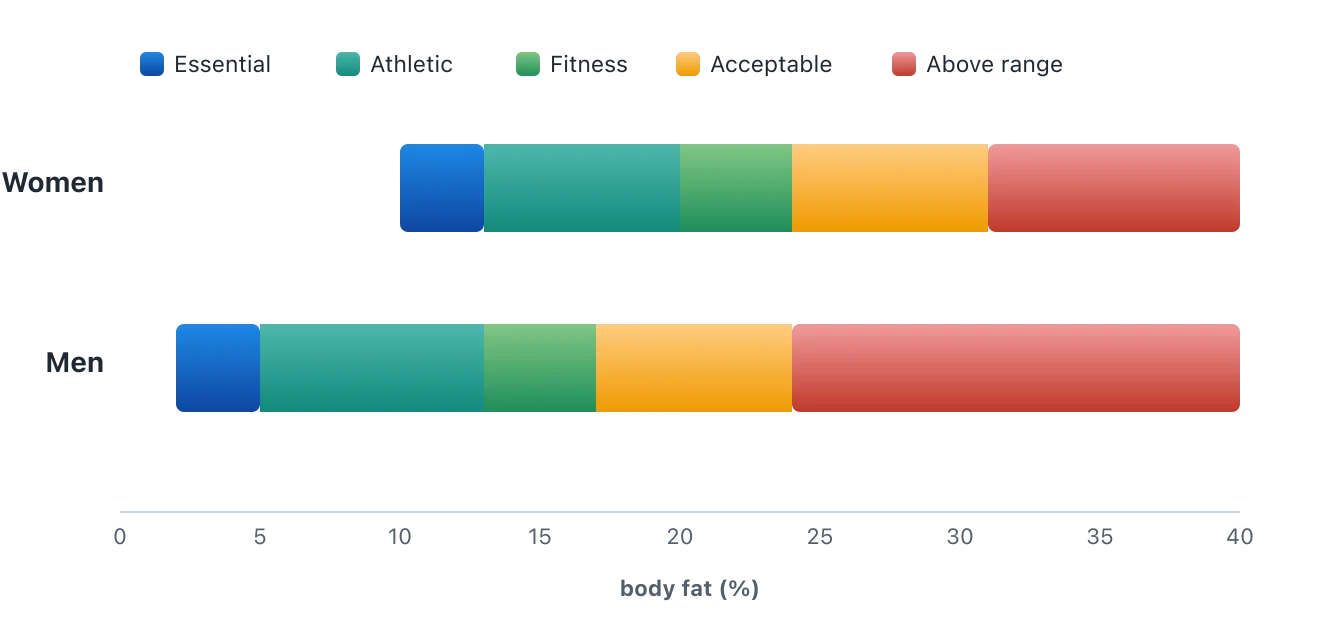
Look again at the two bars above and the most striking feature is that every one of a woman's bands sits several points to the right of a man's. This is not a quirk of the chart; it reflects real biology. Women carry substantially more essential fat than men, roughly two to three times as much, because that fat supports reproductive and hormonal function. A woman's essential minimum is around 10 to 13 percent, while a man's is closer to 2 to 5 percent.
Because the whole scale is shifted, comparing a woman's body fat percentage directly to a man's is misleading. A body fat percentage that would be lean and healthy for a man could be dangerously low for a woman. Any healthy range, and any judgement about whether a number is high or low, has to start by asking which set of bands applies.
The category ranges
Reference tables usually split body fat into a handful of bands, shown in the chart above. The essential band is the survival minimum. The athletic band is where competitive and highly trained people often sit. The fitness band describes people who exercise regularly and look visibly lean. The acceptable band is a healthy, unremarkable middle where a great many people live. And above that lies the range associated with a higher chance of weight-related health problems.
It is worth saying clearly that "acceptable" is genuinely acceptable. There is a cultural pull to treat the athletic band as the only good place to be, but that band reflects a demanding lifestyle that is neither realistic nor necessary for most people, and pushing toward it is not automatically healthier. For the majority, sitting comfortably in the fitness or acceptable band is a perfectly good place to be.
How the ranges shift with age
Body fat percentage does not stand still over a lifetime. As we age, we gradually lose muscle unless we work to keep it, and the same body weight then contains a higher proportion of fat. For that reason, the body fat percentage considered healthy tends to rise modestly with age. A figure that would be on the high side for a twenty-five-year-old can be perfectly reasonable for someone in their sixties.
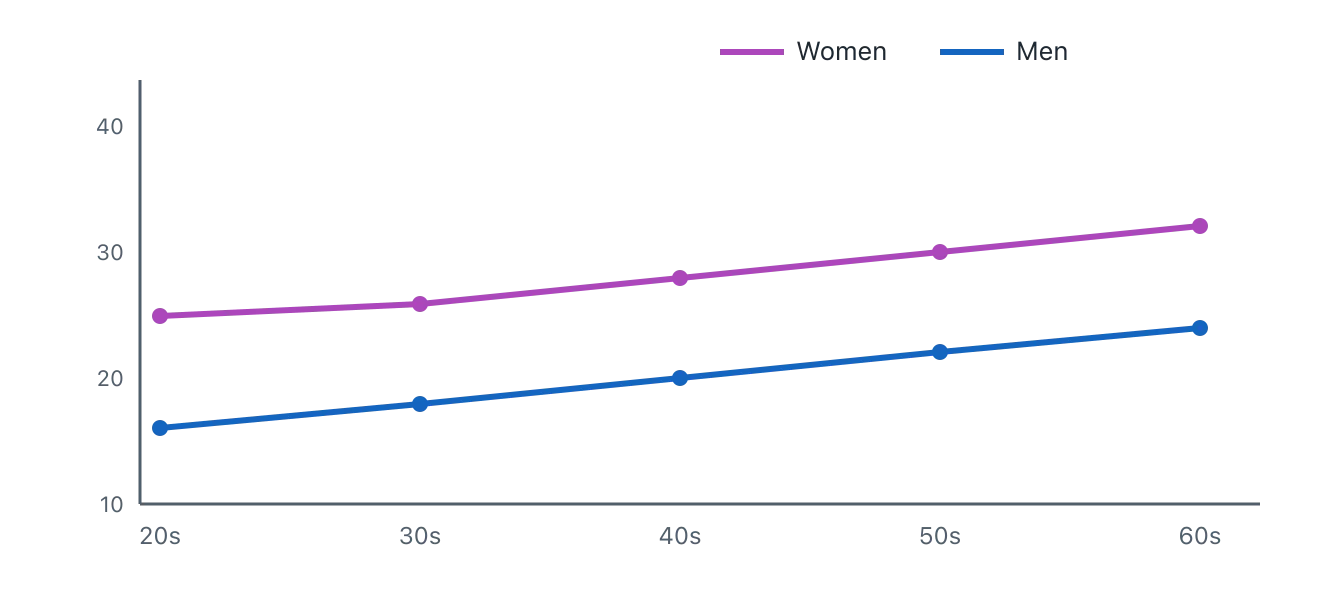
There is an important nuance here. The fact that body fat tends to rise with age does not mean it should be left to. Much of that rise comes from losing muscle, and that muscle loss is not inevitable: regular activity, especially resistance training, slows it dramatically. So the age-adjusted ranges are best read as a realistic description of what happens, not as permission to stop caring.
Body fat versus BMI
Body fat percentage and BMI answer different questions. BMI compares your weight to your height and is a fast, universal screen; body fat percentage looks inside that weight and tells you how much of it is fat. The two usually agree, but the interesting cases are where they diverge. A muscular person can have a high BMI and a low body fat percentage; a sedentary person with little muscle can have a normal BMI and a high body fat percentage, the pattern sometimes called skinny fat.
Neither number is a rival to the other. BMI is quicker and needs no special equipment, which is why it remains a sensible starting point. Body fat percentage is richer but harder to measure well. Used together, they give a fuller picture than either alone, which is exactly why it is worth understanding both.
How accurate are the numbers?
This is the catch. While the concept of body fat percentage is precise, measuring it at home is not. The common methods each have meaningful error. Bathroom scales that use a small electrical current can be thrown off by hydration and time of day. Handheld devices vary. Skinfold calipers depend heavily on the skill of whoever is pinching. Even the more advanced scans have their own margins. It is common for two methods to disagree by several percentage points on the same person on the same day.
The practical response is to care more about the trend than the absolute figure. Pick one method, use it consistently under the same conditions, and watch the direction over weeks and months rather than trusting any single reading to the decimal. A number that is a little off but consistently measured still tells you which way you are moving, which is usually what matters.
What to do with this
The healthiest way to use body fat percentage is as context, not a target to grind downward. Find the band that applies to your sex and roughly your age, and simply notice where you sit. If you are within the fitness or acceptable range, that is a good place to be, and there is no prize for pushing lower. If you are above the range, the productive levers are the familiar ones: building and keeping muscle, staying active, and eating well, which tend to shift composition gently over time.
And do take the lower end seriously too. Chasing very low body fat, especially near or below the essential level, is not a health win; it can disrupt hormones, mood, energy, and immune function. If a body fat goal ever starts to feel like a fixation, that is a sign to step back and, ideally, talk it through with a qualified professional. Composition is a tool for understanding your body, and like every number on this site, it is a screening guide rather than a verdict.