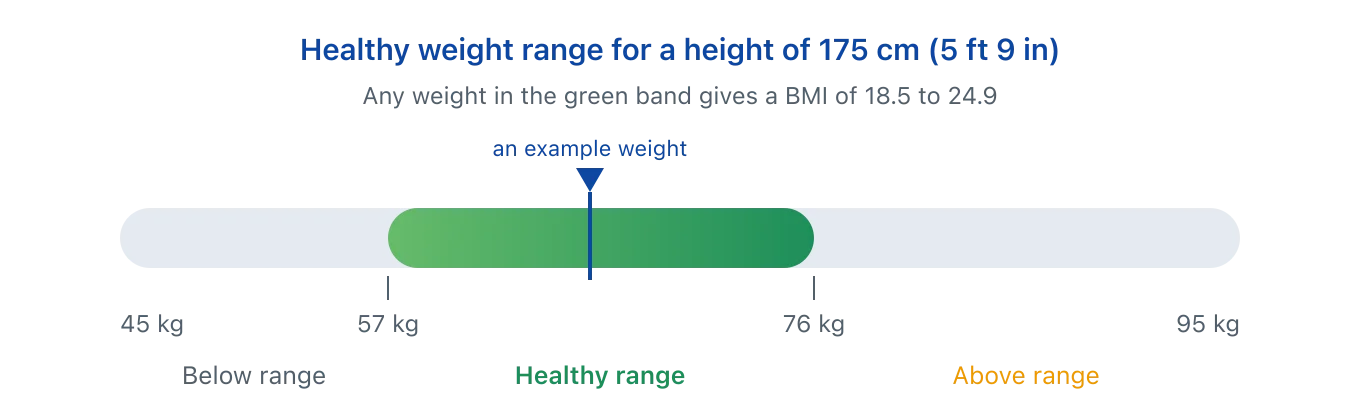
Type your height into almost any search box next to the words how much should I weigh, and a single confident number comes back, sometimes down to the decimal. It looks authoritative. It is also, in the way that matters most, misleading. Your height does not demand one exact weight. What decades of population data actually support is a healthy range: a band of weights broad enough to fit the natural variety of real bodies that share your height. This guide explains where that range comes from, why the famous ideal weight formulas quietly disagree with each other, what a single weight figure can never capture, and how to treat all of it as a gentle screening signal rather than a target to chase.
For any height there is a healthy weight range, drawn from a BMI of 18.5 to 24.9, not a single correct weight. The famous ideal weight formulas each land on a slightly different figure, which is the clearest sign that no one perfect number exists.
The honest answer is a range, not a number
The reason a range beats a number starts with how healthy weight is defined in the first place. Public health bodies such as the CDC and the World Health Organization do not set a single correct weight for each height. Instead they describe a healthy zone using Body Mass Index, the ratio of your weight to the square of your height. For adults, a BMI from 18.5 to 24.9 is treated as the healthy weight band. Because that band spans more than six BMI points, translating it back into kilograms or pounds for your specific height always produces a spread of weights, never a solitary figure.
Working the arithmetic backwards is straightforward. Multiply 18.5 by your height in metres squared to find the lower edge of your healthy range, then multiply 24.9 by the same figure for the upper edge. Someone who is 170 cm tall lands at roughly 53 to 72 kg, or about 117 to 159 lb. At 180 cm the band shifts up to around 60 to 81 kg, close to 132 to 178 lb. Notice how wide each of those ranges is: almost twenty kilograms of healthy variation at a single height. That width is not sloppiness in the science. It is an honest admission that two people of exactly the same height can both be perfectly healthy while weighing very different amounts, because bodies simply are not uniform.
You do not have to run the sums yourself. The BMI chart lays out these ranges by height and category, and the BMI calculator converts your own height and weight in metric or US units in a second. Whichever you reach for, the message is the same. The green band in the figure above is the real answer to the question, and it is a stretch of the ruler rather than a pin stuck in one spot on it. Once you see the answer as a band, the pressure to hit one precise figure starts to fade, which is exactly as it should be.
The classic ideal weight formulas, and why they disagree
For more than half a century, clinicians have also leaned on a second family of estimates: the ideal body weight formulas named after Robinson, Miller, Devine, and Hamwi. Each was published between the 1960s and the 1980s, and several were designed not for dieting at all but for practical medical purposes such as calculating drug doses, where a quick weight estimate from height was genuinely useful. They share a common shape. Each sets a base weight at a height of five feet, then adds a fixed amount for every inch above that, using slightly lower numbers for women than for men.
Here is the revealing part. Feed the same height into all four and they hand back different answers. For a man of about 175 cm, or five feet nine inches, the Hamwi formula lands near 72 kg, Devine near 71 kg, and Robinson and Miller closer to 69 kg. The gap of a few kilograms between the highest and lowest estimate is not a rounding error or a mistake. It is the fingerprint of a deeper truth: the very experts who built these formulas could not agree on one ideal figure, because no single ideal figure exists to be found. The small chart below sets those four bars side by side so you can see the disagreement at a glance.
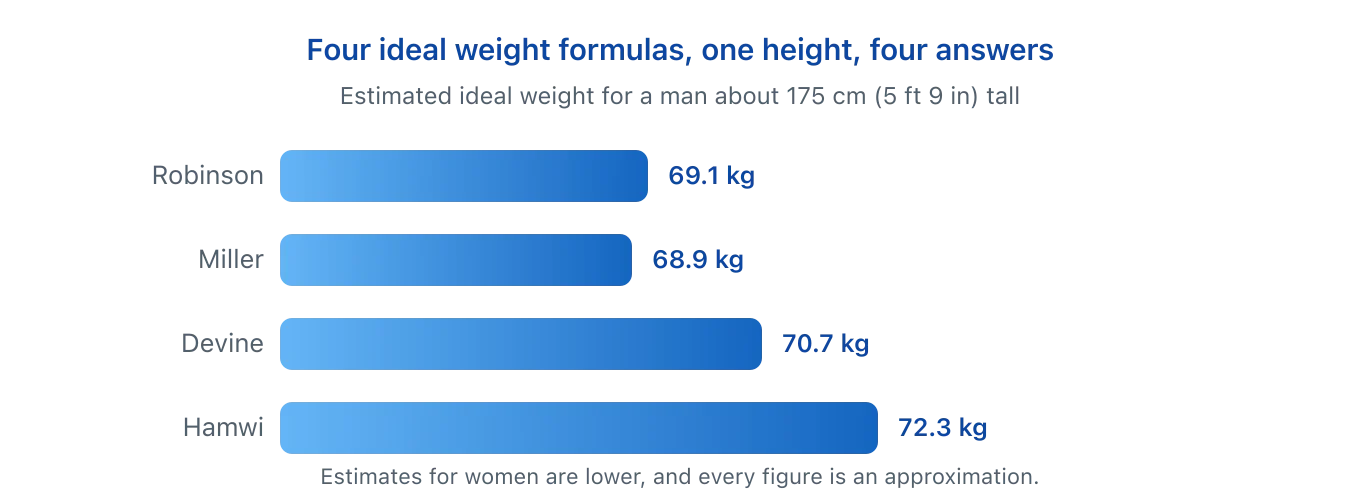
So how should you read them? Treat the formulas as rough reference points rather than verdicts, and read them together rather than singling one out as the truth. Notice, too, that their spread usually sits comfortably inside the wider BMI based healthy range from the previous section, which is a handy reality check. The ideal weight calculator on this site shows all four formula estimates next to the BMI range at once, precisely so the result reads as a spread to consider rather than a number to obey. If a formula ever spits out a figure that feels oddly low or high for you, that mismatch is usually a clue that height alone is missing something important about your build.
A quick height to weight guide
The table below turns the BMI based healthy band into weight ranges for a handful of common heights, so you can find the row nearest your own. Read it the way a nurse reads a growth chart: as a screening reference, not a personal prescription. If your weight already sits inside the range for your height, that is reassuring context and not an instruction to move toward any particular point within it. If it sits outside, that is simply a prompt to raise the topic with a healthcare provider who can see the rest of your health, and never a diagnosis on its own.
| Height | Healthy weight range (BMI 18.5 to 24.9) |
|---|---|
| 155 cm (5 ft 1 in) | 44 to 60 kg (98 to 132 lb) |
| 160 cm (5 ft 3 in) | 47 to 64 kg (104 to 141 lb) |
| 165 cm (5 ft 5 in) | 50 to 68 kg (110 to 150 lb) |
| 170 cm (5 ft 7 in) | 53 to 72 kg (117 to 159 lb) |
| 175 cm (5 ft 9 in) | 57 to 76 kg (125 to 168 lb) |
| 180 cm (5 ft 11 in) | 60 to 81 kg (132 to 178 lb) |
| 185 cm (6 ft 1 in) | 63 to 86 kg (140 to 189 lb) |
Every figure in that table is rounded, and every one of them assumes nothing at all about your muscle, your frame, or your age. Two readers on the same row can have genuinely different bodies and both be healthy. That is exactly why the next section matters as much as the numbers do, and why a wide band is a feature rather than a flaw.
What a weight number cannot capture
Both BMI and the ideal weight formulas share the same blind spot: they know only your height and your weight, and nothing else about you. They cannot tell muscle from fat, they cannot feel the width of your frame, and they have no idea how old you are. Those three omissions are the reason a single weight, however carefully calculated, can quietly mislead a real person standing on a real set of scales.
Muscle is the clearest example. Muscle tissue is dense and heavy, so a fit, strongly built person can weigh more than the formulas suggest, or sit above the top of the BMI healthy band, while carrying very little excess fat at all. Read only by the scale, they look heavy; measured by body composition, they are lean. The reverse happens just as often. A person can fall neatly inside the healthy range yet carry more fat and less muscle than the tidy number implies, a pattern sometimes described informally as being a normal weight with a higher body fat level. The weight figure reports both of these people as simple data points and misses the far more important story of what their weight is actually made of. Our checklist on whether BMI is accurate for you walks through the cases where this gap tends to appear.
Frame size is the next missing variable. The original Hamwi work even acknowledged this by suggesting adjustments for people with smaller or larger frames, a quiet admission that bone structure shifts the picture. Someone with broad shoulders and thick wrists carries more healthy weight than someone finely built of the same height, and no height only formula can see that difference. Age matters as well. As the years pass, most people slowly trade muscle for fat and may lose a little height, so the same weight can mean something rather different at 60 than it did at 30. A number that ignores all three of these factors at once is not worthless, but it should be held loosely and read with a little humility.
Why a tape measure belongs beside the scale
Because a weight figure cannot see where your body stores fat, it helps to pair it with a measure that can. The simplest and best supported is the waist to height ratio. You measure around your waist, then compare it to your height, and the guideline most health bodies converge on is to keep your waist to less than half your height. It is quick, it needs only a tape measure, and it captures something the scale cannot: fat carried around the middle, which sits close to your internal organs and tends to carry more health risk than fat stored elsewhere on the body.
The appeal of a waist measure is that it sidesteps several of the weaknesses just described. It does not care how much muscle you carry, so it does not penalise an athletic build the way a raw weight reading can. It also responds to changes in central fat that a stable weight might hide, which makes it a useful companion when the number on the scale refuses to move even as your shape slowly shifts. Used together, a healthy weight range and a healthy waist ratio give a fuller reading than either can manage alone, which is why our guide to the waist to height ratio is worth a few minutes alongside this one.
None of this makes the scale obsolete. Weight is easy to track, and its trend over months carries real information about the direction you are heading. The point is simply that one measurement rarely tells the whole story, and a second, inexpensive, thirty second measurement fills in much of what the first one leaves out. Two cheap numbers, read side by side, beat one number treated as gospel.
Screening, not a diagnosis or a target
It is worth being clear about what all of these tools are actually for. A healthy weight range, a BMI figure, and an ideal weight formula are screening aids. They are designed to flag when a conversation with a professional might be useful, not to hand down a diagnosis or a goal. A weight that sits outside the usual range does not by itself mean anything is wrong, and a weight inside it does not guarantee good health. Only a qualified healthcare provider, looking at your history, your bloodwork, your activity, and the rest of the picture, can turn a screening signal into anything approaching a conclusion.
That framing also lifts some of the pressure the original question tends to carry. Because the healthy band is genuinely wide, there is no need to aim for its exact centre, and no reason to treat one end of it as better than the other. Chasing a precise goal weight, especially a remembered figure from years ago, can do more harm than good, and fixating on a single number is a habit worth gently stepping away from rather than feeding. The healthier practice is to watch the direction and speed of change over time rather than any one reading, and to pay attention to how you actually feel, move, sleep, and function alongside the figures on any chart.
So if you arrived hoping for one tidy number, the honest gift is the opposite of that: permission to stop hunting for it. Find the range for your height, glance at how the classic formulas scatter loosely around it, add a waist measurement for context, and carry anything that genuinely surprises you to a provider who knows you. Read that way, the question how much should I weigh has a calmer and more truthful answer than any single figure could ever pretend to give.