BMI is a bit like a one-size-fits-most jacket: it fits a lot of people reasonably well and a few people badly. The trouble is that the number itself never tells you which group you are in - a muscular athlete and a sedentary person of the same height and weight get the identical reading. This checklist fixes that. Run through nine quick, honest checks about your body and situation, and you will come away knowing how much to trust your BMI, and what to reach for if it turns out to be a poor fit.
How to use this checklist
Read each of the nine cards below and mentally tick the ones that clearly apply to you. There is no complicated scoring - the idea is simply that each item you tick is a reason BMI may be misreading your body, and a few of them together mean the number deserves real caution. Keep a running count as you go; we'll interpret it just after the cards.
A quick word before you start: ticking a box is not bad news. Each item simply describes a body or a situation that BMI, being a blunt one-size-fits-most tool, handles poorly. A powerlifter, a marathoner, a grandparent, and a pregnant person can all tick a box for completely healthy reasons. The checklist is about the fit of the measurement, not about anything being wrong with you.
You're very muscular
If you strength-train seriously or do heavy physical work, dense muscle can push your BMI into "overweight" while your body fat is low. BMI counts the weight but can't see that it's muscle.
You're an older adult
After around 65, natural muscle loss means a "healthy" BMI can sit on top of more fat than the number implies, and lost height can nudge BMI up. It can under-read risk.
You're of Asian descent
Weight-related risks can begin at a lower BMI in some Asian populations, so several authorities use lower cut-offs (overweight from 23, not 25). The standard scale may run high for you.
You're pregnant or recently postpartum
Adult BMI categories are not designed for pregnancy, when weight gain is expected and healthy. Pregnancy weight is guided by pre-pregnancy BMI and a clinician, not the standard bands.
You're very tall or very short
Because BMI divides by height squared, it tends to over-read for very tall people and under-read for very short ones. At the height extremes the categories are least reliable.
You're under 20
For ages 2-19, adult categories simply don't apply. BMI must be read as an age- and sex-specific percentile, because a healthy range for a growing body changes constantly.
You've had a big recent weight change
BMI is a snapshot. After a large, rapid change, your composition may still be shifting, so a single reading can lag behind what is actually happening in your body.
You're an endurance or physique athlete
Very lean endurance athletes can read low, and heavily-built power athletes can read high, without either being a health concern. Sport can pull BMI away from the norm in both directions.
You carry weight around your middle
BMI is blind to where fat sits, yet central fat is the kind most linked to risk. A normal BMI with a large waist is a classic case of the number missing the real story.
Now tally your ticks and read the band your count falls into.
Reading your result
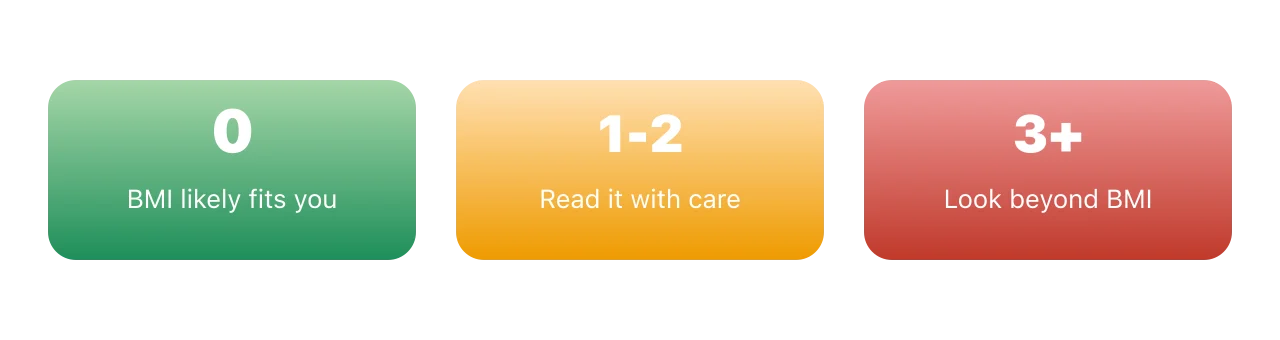
Zero ticks. BMI probably fits you well. You can read your number against the usual categories with reasonable confidence, while remembering it is still only a screen - a healthy BMI is not a clean bill of health on its own.
One or two ticks. Read your BMI with a pinch of salt. It is likely in the right ballpark but could be off by a category, especially if the item you ticked is a strong one like serious muscle or Asian-descent cut-offs. This is the ideal moment to add a second measure rather than to agonise over the BMI figure alone.
Three or more ticks. Your BMI may genuinely misrepresent your body, and it should not be the number you lean on. That does not make it useless - its trend can still be informative - but the headline category is unreliable enough that you really do want other measures and, ideally, a professional's read.
What to do if several apply
The single most useful move, in almost every case, is to add your waist-to-height ratio. It takes a tape measure and ten seconds, it is fair across heights, and it senses the central fat that BMI is blind to - which covers the most common reasons BMI misfires. For muscular or athletic readers, a body-fat estimate adds the composition view that finally explains a stubbornly high BMI.
For situations tied to life stage - pregnancy, older age, or a young person's growth - the right answer is less about a different formula and more about the right context: pregnancy weight is guided by a clinician, a child's BMI belongs on a percentile chart, and an older adult's health is better judged by strength and function than by a single ratio. In all of these, a healthcare provider can interpret your numbers against everything a calculator cannot see. The goal is never to "beat" BMI, but to stop asking one simple number to do a job it was never built for.
Keep this checklist handy
Because the factors here don't change often, this is a checklist worth remembering or printing. The next time a BMI reading surprises you - yours or someone else's - running back through these nine questions is the fastest way to tell whether the number is genuinely worth acting on or simply a poor fit. Most alarm over a surprising BMI evaporates the moment you realise one of these items explains it.
And if none of them do explain it - if your BMI is a good fit and it still sits somewhere that concerns you - then the number is doing exactly its job, which is to prompt a closer look. Either way, you finish with clarity instead of anxiety, which is the whole point of measuring anything about your body in the first place.
A note on the number and how you feel
It is worth saying plainly: BMI is a screening ratio, not a measure of your worth, your discipline, or your health as a whole. It was built to compare populations, and it says nothing about the parts of you that actually matter to the people in your life. If a BMI reading ever leaves you feeling anxious, ashamed, or fixated, that reaction is far more important than the digits that triggered it - and it is worth talking to someone about, whether a trusted person or a professional.
Used well, a number like BMI is a quiet, occasional check that points you toward a useful question. Used badly, it becomes a stick to measure yourself against every morning. This checklist exists to keep you firmly in the first camp: to help you understand what your number can and cannot say, take the useful signal, and leave the rest. A measurement should serve your understanding of your body, never your opinion of yourself.