
Imagine two people of the same height and the same weight. Their BMI is identical - a healthy 22 - and a doctor glancing only at that number would tick the same box for both. Yet one is lean and muscular, and the other carries a third of their body weight as fat with very little muscle to balance it. That second person is what the internet has nicknamed "skinny fat," and their story is the clearest possible proof that a healthy BMI is not the same thing as a healthy body.
A normal BMI can still hide a high proportion of body fat and too little muscle - sometimes called normal-weight obesity. Because the scale looks fine, it often goes unnoticed. The fix usually involves building muscle, not losing weight.
What "skinny fat" actually means
"Skinny fat" is a casual label for a real pattern that researchers call normal-weight obesity: a body mass index inside the healthy range paired with a body-fat percentage that is too high, and a muscle mass that is too low. Nothing about the term is meant as an insult - it simply captures the mismatch between what the scale says and what the body is actually made of.
The reason it flies under the radar is baked into BMI itself. BMI is only your weight divided by your height squared; it has no way to know whether that weight is muscle or fat. So a person can lose muscle and gain fat, keep exactly the same weight, and watch their BMI stay reassuringly put - even though their body composition, and with it their metabolic risk, has quietly drifted in the wrong direction.
Two bodies, one BMI
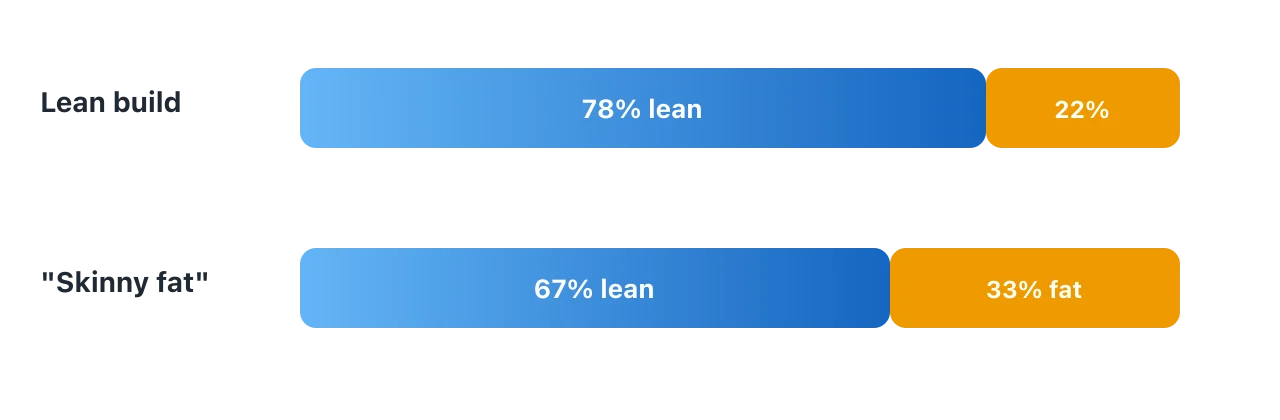
Put the two people from the illustration side by side and the difference becomes obvious - even though a BMI chart would treat them as interchangeable.
Person A - lean and active
- BMI 22, body fat around 22%
- Trains with weights; carries good muscle
- Slim waist; fat spread evenly
- Strong grip, steady energy
- Blood markers typically in a healthy range
Person B - "skinny fat"
- BMI 22, body fat around 33%
- Rarely trains; little muscle to speak of
- Softer middle; more fat around the organs
- Tires easily, low strength
- Higher chance of raised blood sugar or lipids
Their weight is the same. Their health trajectory may not be. This is exactly why clinicians increasingly pair BMI with something that senses fat and its location, rather than trusting the weight-to-height ratio on its own.
Why it happens
Normal-weight obesity usually builds slowly, from a mix of everyday factors rather than any single cause. A largely sedentary routine is the big one: without a reason to keep it, muscle gradually shrinks, and muscle is the tissue that burns the most energy at rest. Diets very low in protein give the body little raw material to maintain that muscle, so it is lost more readily than it needs to be.
Repeated crash diets can make things worse. Losing weight quickly, especially without resistance training, sheds muscle alongside fat; the weight often comes back as fat, and after a few cycles a person can weigh the same as ever while carrying more fat and less muscle than when they started. Age plays a role too - after the thirties, muscle is lost naturally unless it is actively maintained - as do genetics and where your body prefers to store fat. None of these are moral failings; they are simply the conditions under which composition drifts while the scale stays still.
It is worth naming what this is not: it is not a character flaw, and it is not something that only happens to people who "let themselves go." Plenty of people with normal-weight obesity eat modestly and are not visibly out of shape at all - that is precisely why the scale and the mirror both fail to raise a flag. The pattern is common in people who have spent years dieting without training, in those whose jobs and commutes are almost entirely seated, and in anyone who has drifted past their thirties without ever picking up something heavy. Recognising it is not about blame; it is about noticing something that ordinary measurements are designed to miss.
How to spot it in yourself
Because BMI is blind to this, you need a couple of extra data points. The quickest is your waist: measure around the middle and compare it to your height. Keeping your waist under half your height is a simple, evidence-backed screen, and our waist-to-height ratio tool does the sum for you. A large waist alongside a normal BMI is one of the classic fingerprints of the pattern.
A body-fat estimate adds another angle - our guide on BMI versus body fat percentage explains the methods and their trade-offs. Beyond numbers, ask yourself honest questions: can you carry shopping and climb stairs without strain? Do you do any resistance training at all? Has your weight stayed flat while your shape has softened? If the scale says "fine" but these answers say otherwise, the pattern is worth taking seriously.
What to do about it - gently
The counter-intuitive part is that the answer is usually not to lose weight. If your weight is already healthy, aggressive dieting can strip away the very muscle you are short of. The more productive direction is to change the composition: add resistance training a couple of times a week, eat enough protein to support muscle, keep generally active, and protect your sleep, which is when the body repairs.
Because this is about building rather than shrinking, progress often shows up in strength, energy, and a slimmer waist long before the scale moves at all - which is exactly as it should be. And since everyone's starting point and health history differ, it is worth shaping a plan with a qualified professional rather than chasing a generic internet regimen. The goal is a stronger, better-composed body, not a lower number on a scale that was already telling you something reassuring.
Does the label even matter?
It is fair to ask whether "skinny fat" is just another way to make healthy-weight people anxious. The honest answer is that the label matters only insofar as it points at something useful: a normal BMI is not a full bill of health, and composition is worth knowing about. It is not a diagnosis, it is not a reason to panic, and it is certainly not a cue to start skipping meals. If anything, the concept should be reassuring for the many people who have been told their weight is fine yet sense that something is off - it gives them a more precise thing to look at than the bathroom scale.
Used well, the idea simply nudges you toward the measures that describe your body more faithfully than BMI can: waist size, body-fat percentage, strength, and how you feel day to day. Used badly, it becomes one more stick to beat yourself with. Aim for the first version. The purpose is to understand your body a little better, not to manufacture a new insecurity out of a healthy weight.