Blood pressure is one of those numbers everyone has heard of and few people can actually read. Two figures, one over the other, sort you into a category that can sound alarming or reassuring, yet the meaning behind them is rarely explained. This guide unpacks what the two numbers are, how the categories work, why the top one tends to climb as you age, and how to take a reading you can actually trust. It is educational background, not a diagnosis, so treat your own numbers as a conversation starter with a professional.
Normal blood pressure is below 120 over 80. The top number (systolic) tends to rise with age as arteries stiffen, and your category is decided by whichever number is higher. A reading above 180 over 120 needs urgent care.
What the two numbers mean
Every blood pressure reading is written as one number over another, such as 118 over 76. The top number is your systolic pressure, the force in your arteries at the moment your heart beats and pushes blood out. The bottom number is your diastolic pressure, the force between beats when your heart relaxes and refills. Both are measured in millimetres of mercury, the units behind the "mmHg" you sometimes see.
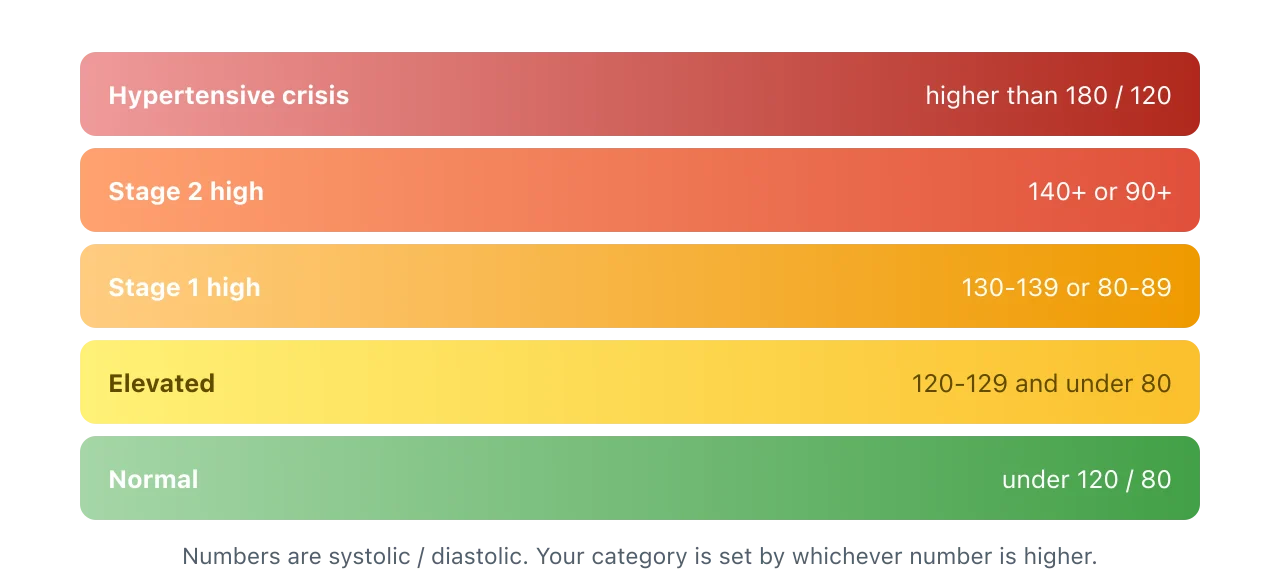
Both numbers carry information, and a common mistake is to focus only on the top or only on the bottom. The standard approach is that your category is set by whichever number is higher: if your systolic sits in one band and your diastolic in a higher one, the higher band wins. That is why a reading can land in a raised category even when one of the two numbers looks fine.
The categories
The chart at the top of this article lays out the standard adult categories. Normal is below 120 over 80. Elevated covers a systolic of 120 to 129 while the diastolic is still under 80, a nudge to pay attention rather than a diagnosis. Stage 1 high blood pressure is 130 to 139 systolic or 80 to 89 diastolic, and stage 2 is 140 or above, or 90 or above. Above 180 over 120 is a hypertensive crisis, which is a medical emergency.
A single high reading does not place you in a category for good. Blood pressure naturally fluctuates through the day and can jump in a clinic through simple nerves, the so-called white-coat effect. A category is meant to reflect your typical pressure across several careful readings, not one measurement taken on a stressful afternoon.
Why it rises with age
Blood pressure has a clear age pattern, and it is mostly a story about the top number. As we get older, the large arteries gradually stiffen and lose some of their youthful elasticity, so they cushion each heartbeat less effectively. The result is a systolic pressure that tends to climb steadily across adulthood, which is why raised systolic readings become more common with age.
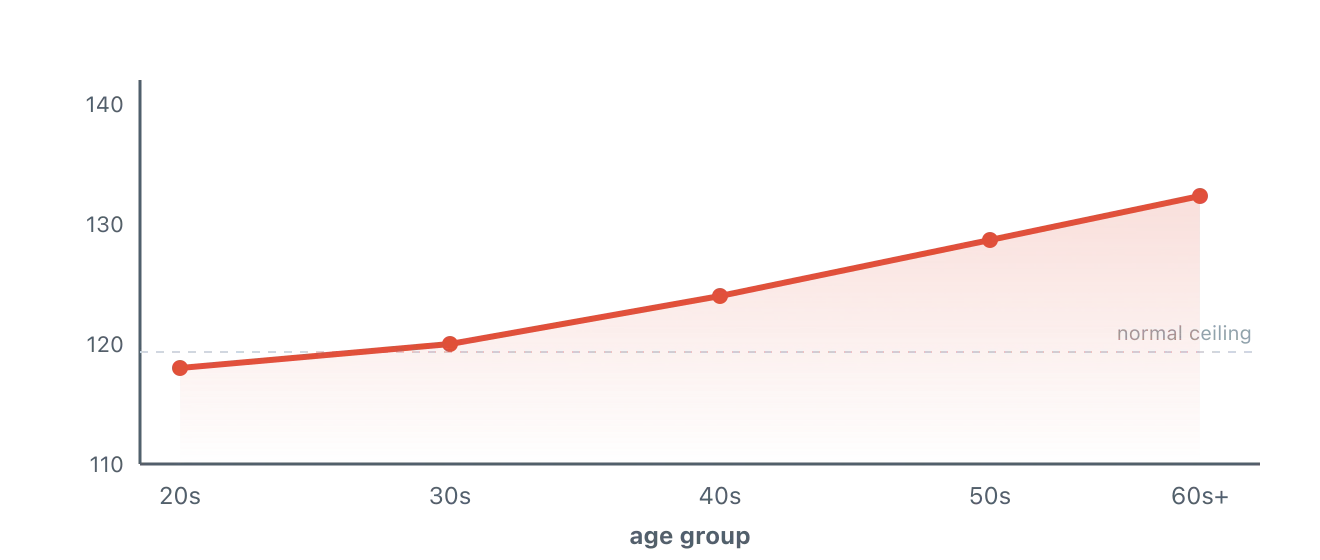
The diastolic number behaves differently. It often rises until around middle age and then plateaus or even drifts down, partly because of that same arterial stiffening. The practical upshot is that in older adults, high blood pressure is frequently a matter of the top number alone, a pattern called isolated systolic hypertension, which is why the systolic reading gets so much attention with age.
It is worth pausing on what a normal reading does and does not promise. Normal blood pressure meaningfully lowers your long-term risk of heart attack, stroke, and kidney problems, which is why it is worth aiming for. But it is not a guarantee of heart health on its own, any more than a single raised reading is a certainty of trouble. Blood pressure is one important thread in a larger fabric that includes your weight, your activity, your cholesterol, your blood sugar, and your family history, and it is read best alongside them.
How to measure it properly
A blood pressure reading is only as good as the conditions it is taken in, and small details make a real difference. Sit quietly for about five minutes first, with your back supported, feet flat on the floor, and legs uncrossed. Rest your arm on a table so the cuff is at roughly heart height. Avoid caffeine, exercise, and smoking for at least half an hour beforehand, and do not talk during the measurement.
Because a single reading can mislead, take two or three a minute apart and record the average. Measuring at the same time of day, over several days, gives a far more honest picture than one clinic snapshot. If you use a home monitor, an upper-arm cuff is generally more reliable than a wrist device, and it is worth occasionally checking that it agrees with a professional measurement.
What affects a reading
Blood pressure is genuinely dynamic, rising and falling through the day in response to activity, stress, meals, temperature, and sleep. Caffeine and a full bladder can push it up in the short term, as can anxiety about the measurement itself. Over the longer term, weight, physical activity, salt intake, alcohol, smoking, stress, and where you carry fat all shape your typical numbers, which is why central fat and blood pressure often travel together.
This variability is exactly why one reading rarely tells the whole story, and why lifestyle has such a strong influence. The same everyday habits that help the rest of your cardiovascular system, moving regularly, sleeping well, going easy on salt and alcohol, tend to nudge blood pressure in a healthier direction over time.
Home monitoring, done well, is one of the most useful habits for anyone whose readings sit near a boundary. Because blood pressure varies so much, a record built from many calm measurements at home often reflects your true pressure better than the occasional clinic visit, and it can reveal the white-coat effect for exactly what it is. Bring that record to your appointments; it gives a provider far more to work with than a single number taken in a hurry, and it turns you into an active partner in your own care.
When a reading needs attention
Most raised readings are managed calmly over time, but some need prompt action. A reading above 180 over 120 is a hypertensive crisis and warrants urgent medical care, especially alongside symptoms such as chest pain, shortness of breath, severe headache, or vision changes. That is not a situation to re-measure and wait out.
Short of that, consistently elevated or stage 1 and stage 2 readings across several careful measurements are a clear prompt to see a healthcare provider, who can confirm the pattern, look for causes, and discuss what, if anything, to do about it. Blood pressure is a screening number in the truest sense: valuable precisely because catching a raised reading early gives you the most options. Knowing what the numbers mean is the first step toward using them well.