Your resting heart rate is one of the simplest windows into your cardiovascular health, and you can read it with nothing more than two fingers and a clock. It is the number of times your heart beats per minute when you are calm and still, and it quietly reflects how hard your heart has to work to keep you ticking over. A normal range is well established, but the more interesting story is what a lower number means, how age fits in, and when a reading is worth a second look.
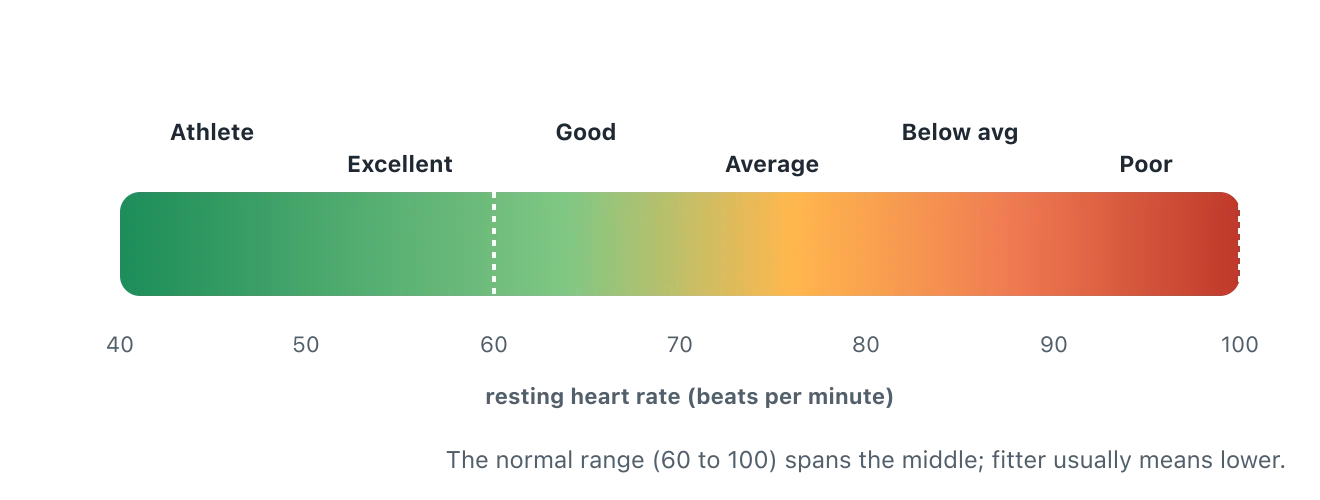
A normal resting heart rate is 60 to 100 beats per minute. Fitter people are often lower, sometimes 40 to 60. Resting rate stays fairly steady with age, while your maximum heart rate is what declines over the years.
What resting heart rate is
Resting heart rate is exactly what it sounds like: how many times your heart beats in a minute while you are at complete rest, ideally not long after waking and before you have had coffee or gotten out of bed. Because it is measured when nothing else is going on, it reflects the baseline workload of your heart rather than the demands of activity, stress, or digestion.
Why does it matter? A lower resting rate often means your heart is efficient, pumping more blood with each beat and needing fewer beats to do the same job. That efficiency tends to come with cardiovascular fitness. A persistently high resting rate can be a sign that the heart is working harder than it should at rest, which is why the number is worth knowing and worth watching over time.
What counts as normal
For the general adult population, a resting heart rate between 60 and 100 beats per minute is considered normal. That is a wide band, and where you sit within it says something about your fitness and health. Many healthy, active adults sit comfortably in the 60s or even 50s, while a resting rate up near the top of the range, or consistently above it, is more often associated with lower fitness or other factors worth exploring.
Well-trained endurance athletes are a special case. Their hearts are so efficient that resting rates of 40 to 60 beats per minute are common and perfectly healthy for them. A number that would be a concern in a sedentary person can be a badge of fitness in a runner, which is a good reminder that context always matters.
Fitness bands
The chart at the top of this article sorts resting heart rate into rough fitness bands, and it is a useful way to see where you land. The lowest bands, athlete and excellent, reflect strong cardiovascular conditioning. The middle bands are typical for the general population. The higher bands, below average and poor, are where a resting rate suggests there may be room to improve fitness or something else worth checking.
Treat these bands as a guide rather than a grade. They vary between sources and shift a little with age and sex, and a single reading can be nudged by a poor night's sleep or a stressful morning. The value is not in pinning down your exact category but in seeing the broad direction and, especially, in watching how your own number changes as your habits change.
Does it change with age?
Here is a common surprise: resting heart rate does not change dramatically with age in the way many people expect. Across adulthood it stays relatively stable, influenced far more by fitness, health, and lifestyle than by birthdays alone. A fit sixty-year-old can easily have a lower resting rate than an unfit twenty-five-year-old.
What does change clearly with age is your maximum heart rate, the fastest your heart can beat during all-out effort. That declines steadily, by roughly one beat per minute per year, which is why the familiar estimate of maximum heart rate subtracts your age from 220. This distinction matters: resting rate reflects your current fitness and can improve at any age, while maximum rate is a ceiling that gently lowers over time and feeds into the training zones we cover separately.
How to measure yours
Measuring resting heart rate is refreshingly low-tech. The best time is first thing in the morning, before you get up, when you are as rested as you will be all day. Find your pulse either on the inside of your wrist, below the thumb, or gently at the side of your neck. Using your index and middle fingers rather than your thumb, count the beats for 30 seconds and multiply by two, or count for a full 60 seconds for a little more accuracy.
Because a single morning can be thrown off by a bad night or a vivid dream, the most reliable figure comes from averaging several mornings. Many fitness trackers and smartwatches now estimate resting heart rate automatically overnight, which makes tracking the trend effortless, though the manual method costs nothing and works just as well for spotting change.
What affects it
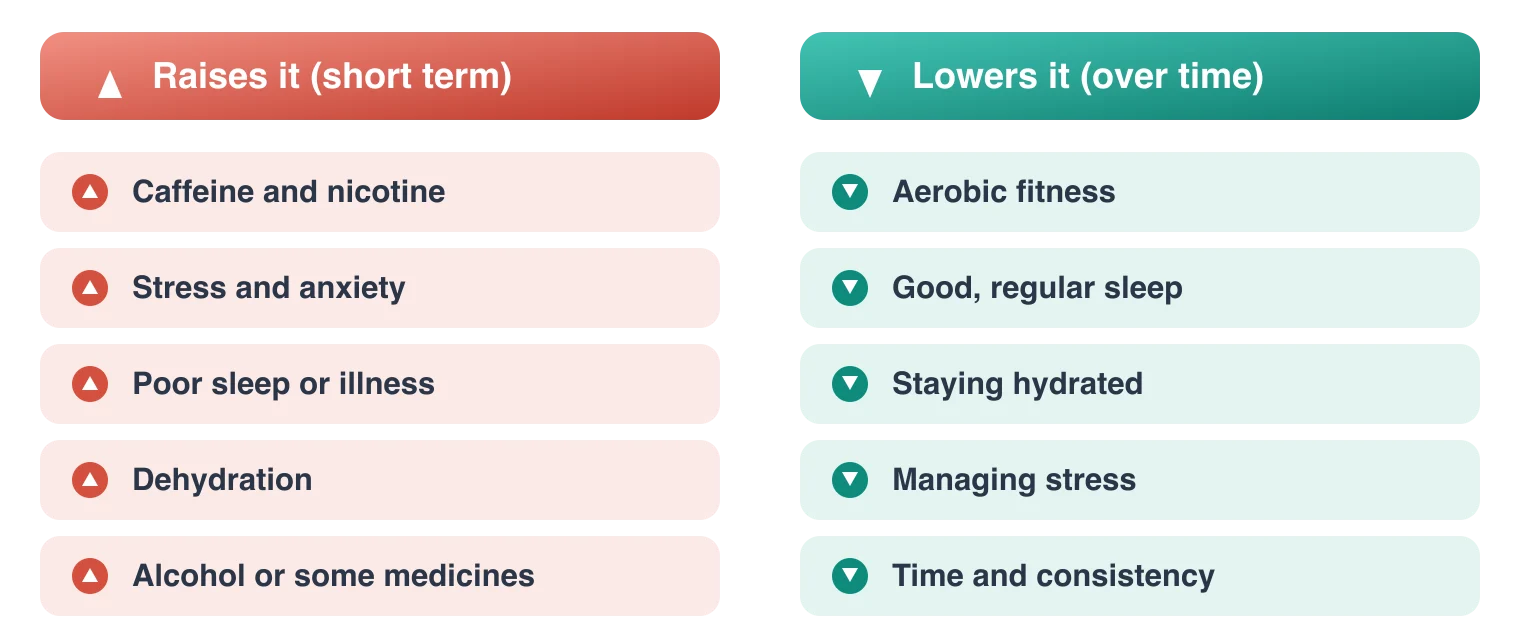
Plenty of everyday things nudge your resting heart rate up or down. Caffeine, nicotine, stress, anxiety, dehydration, a poor night's sleep, and illness all tend to raise it, sometimes noticeably. Certain medications can push it either way. On the other side, improving cardiovascular fitness through regular aerobic activity is the most reliable way to bring a resting rate down over time.
This sensitivity is part of what makes the number useful. A resting rate that suddenly climbs and stays up can be an early hint that you are run down, coming down with something, or under more strain than you realised. Read as a trend, it becomes a gentle daily readout of how your body is coping.
There is a bigger reason to bother tracking resting heart rate: it is one of the few health numbers that responds visibly to your own efforts. Start walking or cycling regularly for a couple of months and, for many people, the resting rate drifts downward, a quiet confirmation that the heart is growing more efficient. Few measurements offer such direct, encouraging feedback for so little cost, which is exactly what makes it worth building into an occasional morning routine and watching over the seasons rather than the days.
When to see a doctor
Most resting heart rates in the normal range, and even a naturally low one in a fit person, are nothing to worry about. But some patterns deserve professional attention. A resting rate consistently above 100 beats per minute, or below 60 in someone who is not athletic and who feels unwell, is worth discussing. So is a low rate accompanied by symptoms such as dizziness, breathlessness, fainting, or unusual fatigue, and any sensation of a racing, pounding, or irregular heartbeat.
None of this is cause for alarm at a single odd reading, which can have countless harmless explanations. The signal to act is a persistent pattern, or a number paired with symptoms. When in doubt, a healthcare provider can put your resting heart rate in the context of your wider health, which is exactly where a screening number like this belongs.