Heart rate zones sound like something only serious athletes need, but they are really just a simple way to answer an everyday question: am I working hard enough, or too hard? By tying your effort to a percentage of your maximum heart rate, zones turn a vague feeling into a number you can aim for. And the maths behind them is about as easy as health maths gets. Here is how the zones work, how they shift with age, and how to use them even without a fancy monitor.
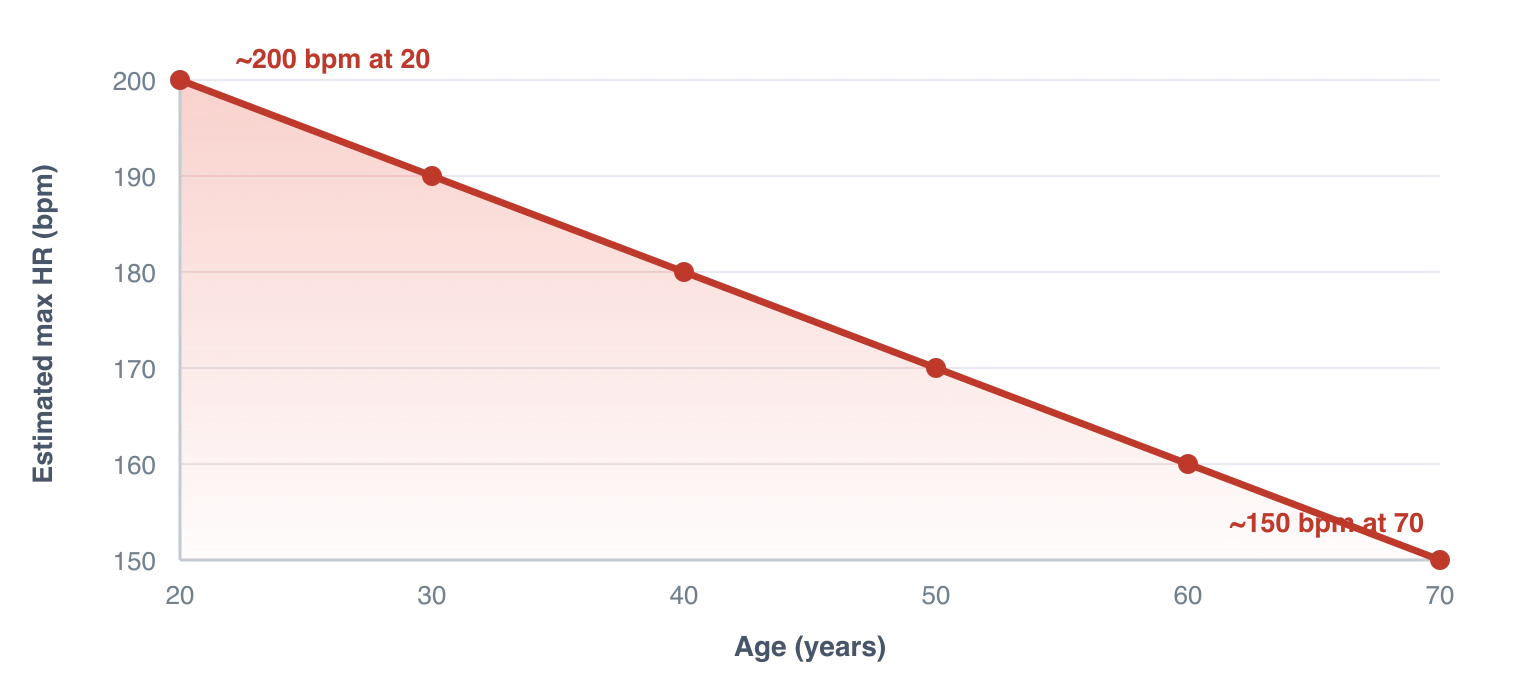
Your maximum heart rate is roughly 220 minus your age. Moderate exercise sits around 64 to 76% of that, and vigorous around 77 to 93%. As your estimated maximum falls with age, the target beats-per-minute come down too.
What target zones are
A target heart rate zone is simply a range of beats per minute that corresponds to a certain level of effort. Because a fitter or harder effort makes your heart beat faster, your heart rate is a convenient live readout of how intensely you are working. Zones divide that readout into bands, so instead of guessing whether a walk or a run is doing what you want, you can check whether you are in the intended range.
The reference point for every zone is your maximum heart rate, so that is where any zone calculation starts. Everything else is just a percentage of that ceiling.
Your maximum heart rate
The most widely used estimate of maximum heart rate is beautifully simple: 220 minus your age. A twenty-year-old has an estimated maximum of about 200 beats per minute, a fifty-year-old about 170. This is the number that declines with age, which is why every zone shifts downward over the years even as your resting heart rate stays put.
It is worth stressing the word estimate. The 220-minus-age formula is a population average, and real individuals can sit a fair bit above or below their predicted maximum. It is perfectly good for setting everyday training zones, but it is not a precise personal ceiling, and you should never chase your calculated maximum as a target. It is a reference for the percentages, nothing more.
The five zones
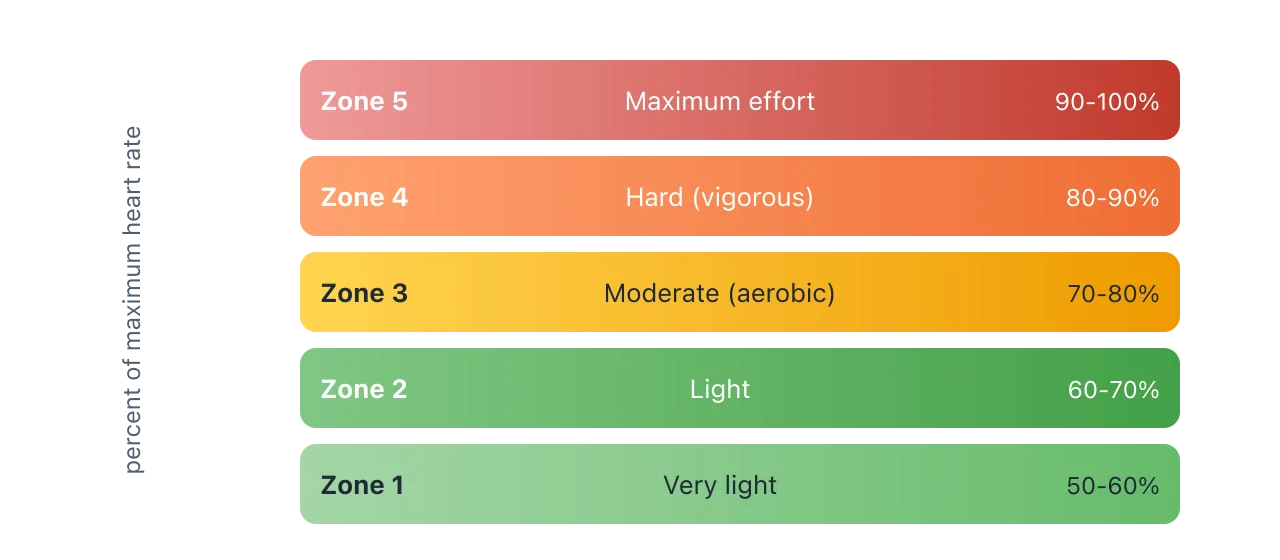
The zone ladder at the top of this article shows the five standard bands. Zone 1, very light, is gentle warm-up and recovery territory. Zone 2, light, is a comfortable, sustainable pace where you could chat easily. Zone 3, moderate, is where most general fitness guidance lives, brisk and purposeful but not exhausting. Zone 4, hard, is vigorous work that leaves you breathing heavily. Zone 5 is all-out maximum effort you can only hold briefly.
Public-health advice usually frames things a little more simply, in terms of moderate and vigorous activity. Moderate roughly corresponds to about 64 to 76 percent of maximum heart rate, and vigorous to about 77 to 93 percent. If you match those to the ladder, moderate sits around Zone 3 and vigorous around Zone 4. The exact boundaries vary between systems, so treat them as guiding bands rather than hard lines.
Zones by age
One practical note before the table: these percentages are of your maximum heart rate, not of some fixed number, so your zones are personal to your age. That is why two people doing what looks like the same workout can be at genuinely different intensities, and why copying someone else's target beats-per-minute rarely makes sense.
Because the zones are percentages of a maximum that falls with age, the actual beats-per-minute targets come down as you get older. The table below shows estimated maximum heart rate and the moderate and vigorous ranges for a span of ages.
| Age | Est. max (bpm) | Moderate (64-76%) | Vigorous (77-93%) |
|---|---|---|---|
| 20 | 200 | 128 - 152 | 154 - 186 |
| 30 | 190 | 122 - 144 | 146 - 177 |
| 40 | 180 | 115 - 137 | 139 - 167 |
| 50 | 170 | 109 - 129 | 131 - 158 |
| 60 | 160 | 102 - 122 | 123 - 149 |
| 70 | 150 | 96 - 114 | 116 - 140 |
Find the row nearest your age to get a ballpark for your own zones. Because the underlying maximum is an estimate, treat these as approximate targets to aim around rather than exact thresholds to hit.
Using zones in practice
In real life, you do not need to live inside these numbers. For general health, the goal is simply to spend a decent amount of time in the moderate-to-vigorous range each week, and the zones just help you tell whether a given activity qualifies. A brisk walk that lifts you into your moderate range is doing its job; a run that pushes you into the vigorous range is doing more per minute.
If you use a smartwatch or chest strap, you can watch your zone live and adjust your pace to stay where you intend. If you prefer to keep it simple, you can estimate effort by feel, which turns out to be surprisingly reliable and needs no gadget at all.
Matching zones to your goal
Different zones suit different goals, which is really the point of dividing effort up in the first place. The lower zones, light and very light, are ideal for warming up, cooling down, and easy recovery days that build a base without much strain. The moderate zone is the workhorse for general health and endurance, the range most public-health guidance points you toward for the bulk of your weekly activity. The harder zones improve performance and fitness faster, but they are demanding and best used in smaller doses.
A common misunderstanding is the idea of a single magic fat-burning zone. It is true that lower-intensity exercise draws a higher proportion of its energy from fat, but higher-intensity work burns more total energy in the same time, which usually matters more. Rather than fixating on one zone, most people do best mixing easier and harder efforts across the week and simply accumulating time in the moderate-to-vigorous range.
The best zone, in the end, is the one that fits your day and keeps you consistent. A gentle session you actually do beats a punishing one you skip, and every zone contributes something. Use the numbers to guide your effort, not to rule it.
Caveats and the talk test
A few cautions keep zones useful rather than misleading. The maximum-heart-rate formula is an average, so your true zones may differ. Some medications, notably beta blockers, deliberately lower heart rate and make the percentages meaningless, in which case perceived effort is the better guide. And if you are new to exercise, returning after a long break, or managing a health condition, it is worth checking with a healthcare provider before targeting the higher zones.
For a monitor-free intensity check, use the talk test. If you can hold a conversation but not sing, you are roughly in the moderate range. If you can only get a few words out between breaths, you are in the vigorous range. If you can chat away comfortably, you are in the light zones. It is low-tech, it needs nothing, and it tracks the effort that actually matters to your heart. Whichever method you use, remember that any movement counts, and the best zone is the one that keeps you coming back.