Ten thousand steps a day has become the number everyone chases, glowing on watches and fitness apps as the daily finish line. It feels scientific, precise, and official. It is none of those things. The real story of how much walking benefits your health is more encouraging than the round number suggests, because meaningful gains start far lower than 10,000 and the target you actually need depends on your age and your starting point. Here is what the evidence really says.
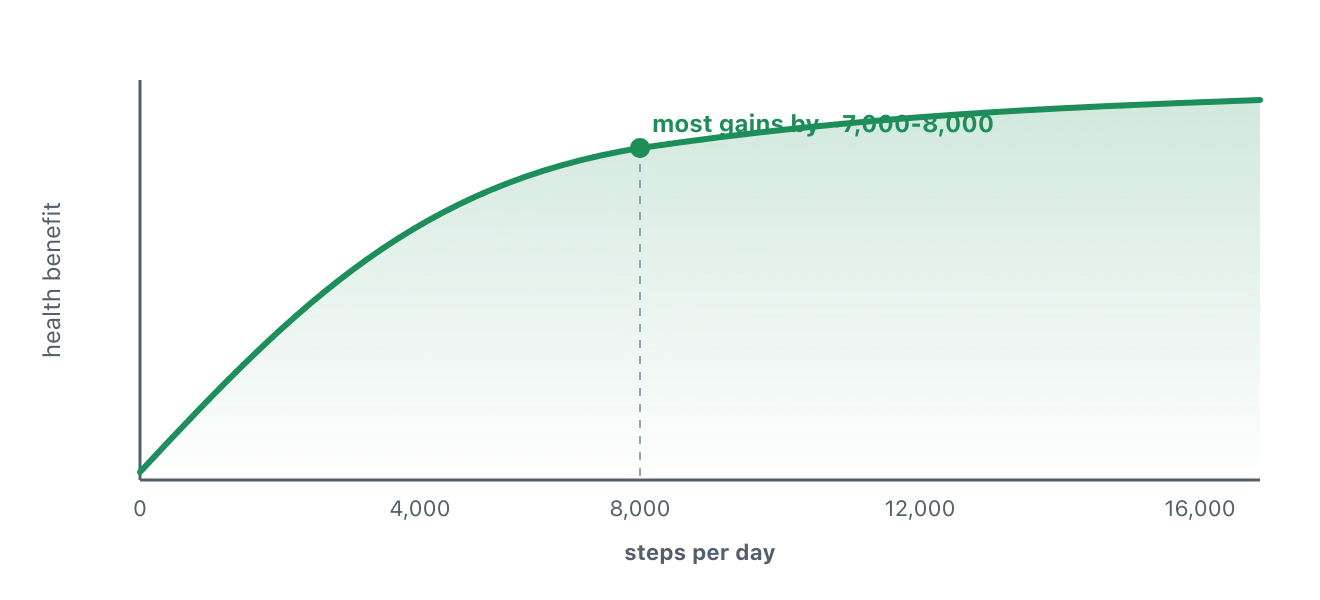
Health benefits build from around 4,000 steps a day and much of the gain levels off near 7,000 to 8,000 for many adults, lower for older adults. The famous 10,000 target is a marketing figure, not a medical one. Any increase helps.
Where 10,000 came from
The 10,000-steps goal has a surprisingly unscientific origin. It traces back to a Japanese pedometer launched in the 1960s, marketed under a name that translated roughly to "10,000-step meter." The figure was chosen because it was catchy and round, not because a study had shown it to be the threshold of good health. Decades later, it has become so embedded in fitness culture that most people assume it rests on solid research.
That does not make 10,000 a bad goal, and if you comfortably hit it, wonderful. The problem is the flip side: the way the round number can make people who walk 6,000 or 7,000 purposeful steps a day feel like they are failing, when in fact they are capturing most of the health benefit walking has to offer. Knowing where the number came from frees you from treating it as a pass-or-fail line.
What the research shows
When researchers actually measure health outcomes against step counts, a consistent shape appears, and it is the curve at the top of this article. Benefits, including a lower risk of early death, begin to accumulate from surprisingly low counts, around 4,000 steps a day and sometimes less, compared with being very sedentary. From there the benefit climbs steeply as steps increase.
The important part is what happens next. The curve does not keep rising in a straight line; it flattens. Much of the measurable benefit is captured somewhere in the region of 7,000 to 8,000 steps a day for many adults, after which each additional thousand steps adds less and less. Extra steps are not harmful and can bring some further gains, but the dramatic returns are front-loaded into the earlier steps. In other words, going from 2,000 to 6,000 steps matters far more than going from 8,000 to 12,000.
Steps by age
The right target also shifts with age, mostly in where the benefit levels off. For older adults, studies suggest the plateau arrives at a lower count, often around 6,000 to 8,000 steps, beyond which extra walking adds little to longevity. That is genuinely reassuring, because it means older adults do not need to chase the same high numbers to capture most of the benefit.
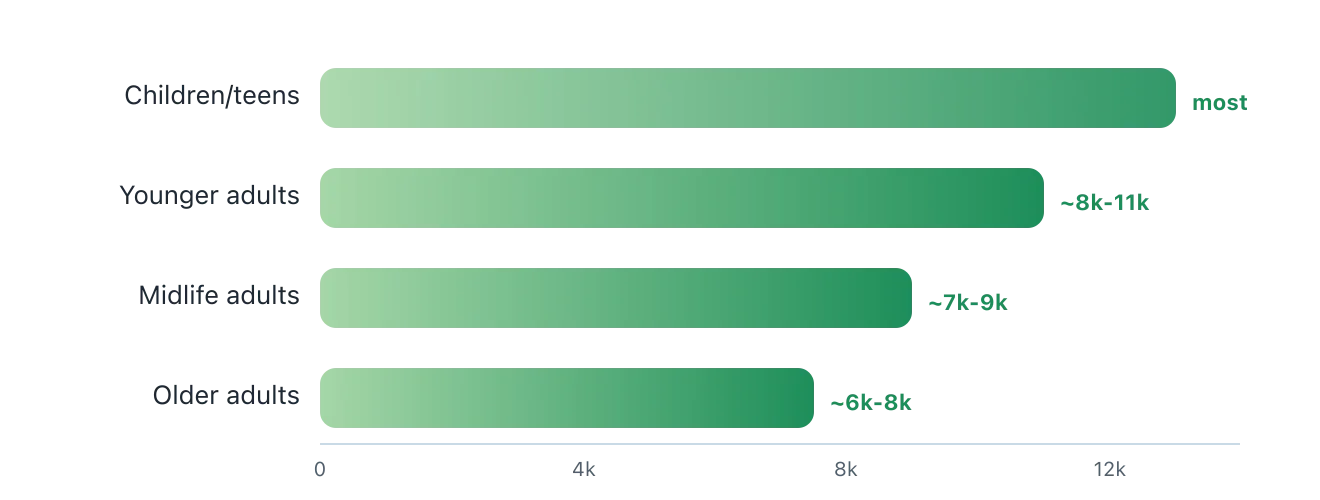
Children and teenagers are a different case again: they are naturally more active and benefit from a good deal of movement, so daily activity guidance for young people is framed around at least an hour of moderate-to-vigorous activity rather than a step target. For every age, though, the underlying message is the same: more movement than you do now is almost always the useful direction, and the first steps count the most.
Steps are not the whole story
Counting steps is convenient, but it flattens some important nuance. Two people can both hit 8,000 steps while getting quite different benefits, because pace and intensity matter. A stretch of brisker walking that lifts your breathing and heart rate delivers extra cardiovascular benefit that a slow amble does not, which is why guidance often talks about moderate-to-vigorous activity rather than raw step counts alone.
Steps also say nothing about strength. Walking does wonderful things for your heart, mood, and metabolism, but it does little to maintain muscle, which becomes increasingly important with age. A well-rounded week pairs plenty of walking with a couple of sessions of something that challenges your muscles, whether that is bodyweight exercises, resistance bands, or weights. Steps are a brilliant foundation, not the entire building.
What counts as a step
It is worth a quick word on measurement, because a step count is only as meaningful as the device counting it. Phones, watches, and dedicated pedometers all estimate steps from motion, and they do not always agree. A phone left on a desk misses the steps you take without it, while a wrist tracker can log phantom steps from hand movements like washing up or gesturing. Differences of ten or twenty percent between devices are common, which is why comparing your count to a friend's rarely means much.
This does not undermine the value of tracking, but it does mean you should compare like with like. Your own device, used consistently, is an excellent gauge of whether you are moving more or less than usual, even if its absolute number is a little off. As with most of the measurements on this site, the trend you see over weeks matters far more than the precise figure on any single day, so pick one tracker and watch its direction rather than chasing an exact total.
How to use a step goal
Given all this, the best way to use steps is as a gentle, motivating gauge rather than a strict quota. The number's real strength is that it is easy to measure and responds immediately to your choices, so it nudges you to take the stairs, park further away, or add a short walk after dinner. Those nudges are where its value lies, not in any particular round total.
A sensible approach for most people is to note your current daily average, then aim to add a modest amount, perhaps a thousand or two thousand more, and let that become your new normal before nudging it up again. That beats fixating on 10,000 from a standing start, which can feel so far off that it discourages rather than motivates.
Starting from where you are
The single most encouraging finding in all the step research is that the people with the most to gain are those who currently move the least. Because the benefit curve is steepest at the bottom, someone going from 2,000 to 5,000 steps a day is likely capturing a larger share of walking's health benefit than someone pushing from 9,000 to 12,000. If you are starting low, you are not behind; you are standing on the part of the curve where effort pays off most.
So wherever you are today is a fine place to begin. Forget the round number on the marketing, add a little more movement than yesterday, and let it build. This is general guidance rather than a personal prescription, and anyone with a health condition should check with a provider before ramping up, but for most people the honest advice is simply this: walk a bit more, and let the first steps do the heavy lifting.