"How many calories does walking a mile burn?" sounds like it should have one clean answer, and you will often see the tidy figure of 100 calories quoted. It is a decent rule of thumb, but it hides the fact that the real number depends heavily on you, especially how much you weigh, and on the ground under your feet. Understanding what moves the figure, and what does not, helps you use walking wisely without over-counting or under-counting what it does.
Walking a mile burns roughly 80 to 100 calories for many adults, but body weight is the biggest factor. A rough estimate is your weight in pounds times about 0.5. Hills raise it a lot; pace changes it only a little.
The rough rule
The familiar shortcut, about 100 calories per mile, is close enough for a quick mental estimate for an average-sized adult. It is popular because it is easy to remember and lands in the right ballpark. But it is an average dressed up as a fact, and treating it as exact leads people astray, because two different people walking the same mile can burn quite different amounts.
A slightly better rule ties the number to your body weight: roughly your weight in pounds multiplied by 0.5 gives a reasonable estimate of the calories burned walking a mile. So a 150-pound person lands near 75 to 80 calories, while a 200-pound person is closer to 100. Even this is an approximation, but it captures the one factor that matters most, which the flat "100 calories" rule ignores entirely.
Weight is the big factor
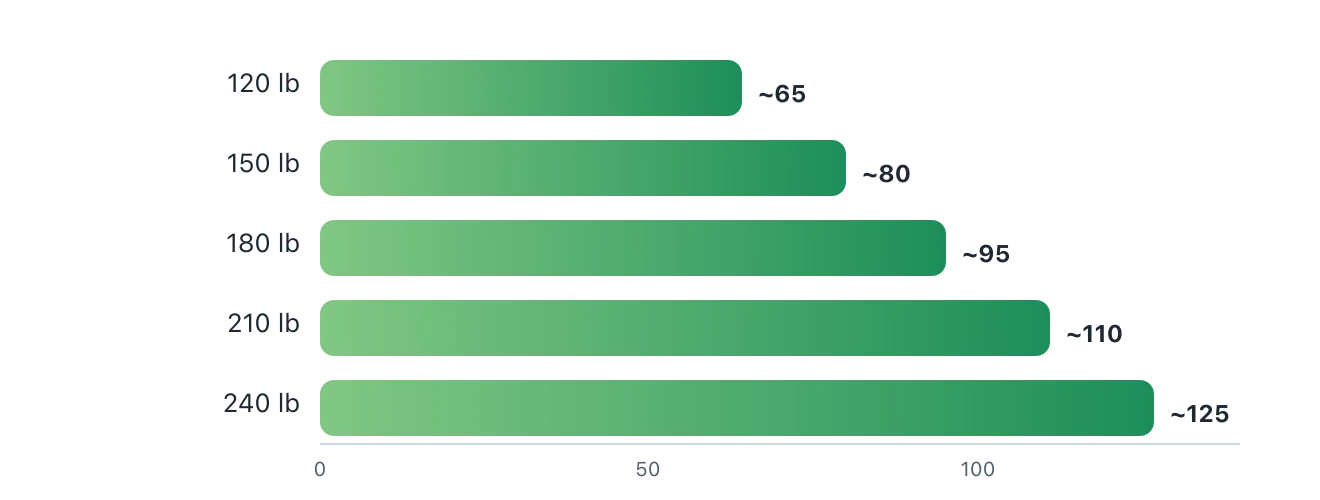
The reason body weight dominates is simple physics. Walking is the work of moving your body over a distance, and a heavier body takes more energy to move the same mile than a lighter one. This is why the bars in the chart above climb steadily with weight: the distance is fixed at one mile, so the main thing changing is how much mass is being carried along it.
There is a slightly counterintuitive consequence worth noting. As people lose weight, the calories they burn walking the same distance gradually fall, because there is less body to move. It is a small effect over short periods, but it is one reason why exercise alone becomes a less powerful lever over time, and why walking is best thought of as one supportive habit rather than a calorie-burning machine.
Calories per mile by weight
The table below turns the weight rule into concrete figures. Find the weight closest to yours for a reasonable estimate of what a flat, steady mile burns.
| Body weight | Approx. calories per mile |
|---|---|
| 120 lb (54 kg) | about 65 |
| 150 lb (68 kg) | about 80 |
| 180 lb (82 kg) | about 95 |
| 210 lb (95 kg) | about 110 |
| 240 lb (109 kg) | about 125 |
These are estimates for level ground at a comfortable pace. Treat them as a guide rather than a precise readout, since real bodies and real walks vary, and no simple table can capture every individual.
What else changes it
After body weight, the ground and how you move over it make the biggest difference, and the picture below sketches the main levers. Incline is the powerful one: walking uphill, up stairs, or on a steep trail forces your body to work against gravity, which can raise the calories burned well above the flat-ground figure. Soft or uneven terrain, like sand or a rough path, adds a little too, and carrying a load, such as a heavy backpack, increases the effective weight being moved.
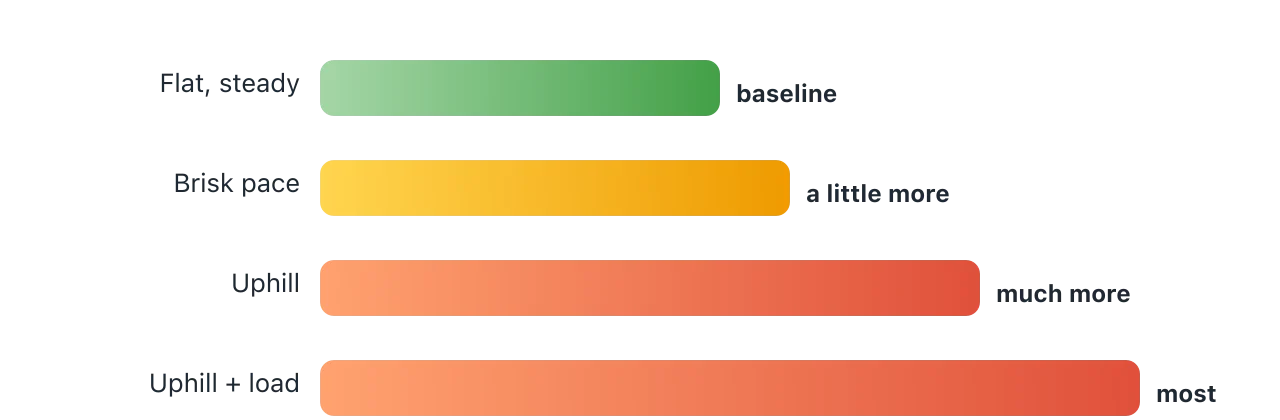
Pace, by contrast, matters less than people assume over a fixed distance. Walking faster burns more calories per minute, but because you also finish the mile sooner, the extra burn per mile is fairly small until you approach a near-jog. If your goal is more calories from the same route, adding some hills does far more than simply speeding up on the flat.
Net versus gross calories
There is a subtle point hidden in every calories-burned figure that is worth understanding, because it explains why estimates vary so much. The numbers in the table above are roughly gross calories: the total energy your body uses during the walk. But your body was always going to burn some energy in that time just by being alive, even sitting still. The extra energy the walk actually adds, the net calories, is a little lower than the gross figure.
For everyday purposes this distinction rarely matters, and gross figures are what most calculators and trackers report. But it is one more reason not to treat any single calories-burned number as precise, or to carefully eat back exactly what a device says you burned. The measurement has real uncertainty baked into it from several directions at once, so a relaxed, approximate view serves you far better than false precision.
The practical takeaway is simple: use these figures to get a feel for the scale of things, not to balance a ledger. Walking earns its place in your week for reasons that dwarf the exact calorie count, and reading the number loosely keeps it a helpful bonus rather than a source of anxious accounting.
Walking versus running
A natural question is whether running a mile burns dramatically more than walking it. The answer is that running burns somewhat more, but the gap is smaller than most people expect, precisely because both cover the same one-mile distance. Running's real advantages are that it packs the effort into less time and pushes you into higher intensities, which brings extra cardiovascular benefit, not that it burns wildly more calories per mile.
This is genuinely good news for anyone who prefers walking or cannot run. Mile for mile, a walk delivers a respectable share of the calorie burn of a run, with far less strain on the joints and a much lower barrier to doing it consistently. For most people, the exercise they will actually keep doing beats the one that burns marginally more on paper.
Keeping it in perspective
It is worth ending with a reality check, because calorie counting for exercise can quietly mislead. A mile of walking burns modest calories, often less than a single snack contains, which is why the old saying that you cannot out-walk a poor diet holds true. Walking is a wonderful habit, but as a calorie-burning tool alone it is easy to overestimate, and treating every mile as a licence to eat more can undo its benefits.
The better way to value walking is to look past the calorie figure entirely. Its benefits for your heart, mood, blood pressure, blood sugar, sleep, and longevity are large and well established, and they do not depend on burning a big number. Enjoy the calories a mile burns as a small bonus, and let the real reasons to walk, which have little to do with arithmetic, do the persuading. As with all of this, it is general information rather than a personal plan.