When you apply for life insurance, one of the very first things the insurer does with your height and weight is turn them into a single number - your BMI - and use it to help decide how much you will pay. It is one of the few places where BMI has a direct, measurable effect on your wallet rather than just your health chart. This guide explains how insurers use the number, roughly how the bands work, and, most usefully, what you can actually do about it. (It is general information, not insurance or financial advice.)
Insurers use your BMI to help set a rate class, which sets your premium. Healthy-range BMIs tend to reach the cheapest classes; higher BMIs cost more, and the extremes may be rated or declined. Thresholds differ by insurer - which is why shopping around pays.
How life insurers use your weight
Life insurance is priced on risk, and one of the cheapest, fastest signals of long-term health risk an insurer can collect is your build - your height paired with your weight. Historically this lived in a "build chart," a table showing the maximum weight allowed at each height for each price tier. Today that is often expressed as a BMI, but the idea is identical: the further your weight sits from the range an insurer considers low-risk, the higher the price tier you tend to land in.
This matters because premiums are not set by a smooth dial but by discrete rate classes with names like "Preferred Plus," "Preferred," "Standard," and various "rated" or "table" categories above them. Your BMI helps decide which of those buckets you fall into, and the jump from one bucket to the next can be worth a meaningful amount of money over the life of a policy.
BMI bands and rate classes
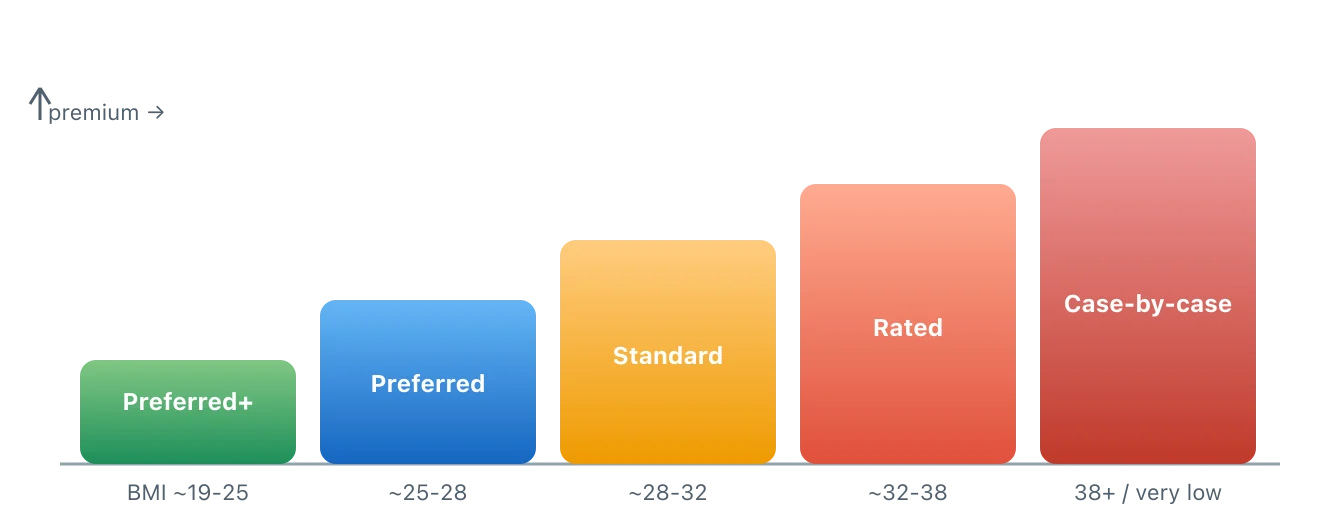
There is no single industry-wide table - each insurer guards its own - but the pattern below is a fair, illustrative sketch of how BMI tends to line up with rate classes. Treat the numbers as directional, not definitive.
| Approx. BMI | Typical rate class | What it usually means |
|---|---|---|
| ~19-25 | Preferred Plus | Best available rates, all else equal |
| ~25-28 | Preferred | Very competitive, slightly above the best |
| ~28-32 | Standard | Average pricing for the general population |
| ~32-38 | Rated / Table | A premium loading applied on top of standard |
| 38+ or very low | Case-by-case | Individual review; may be rated or declined |
Notice that the healthiest-priced band roughly mirrors the medically healthy BMI range, which is no coincidence: insurers are ultimately proxying for mortality risk, and the health evidence and the actuarial tables point in the same direction.
How much it can cost
The gap between rate classes is where BMI quietly touches your budget. Moving from a preferred class to a standard class, or from standard to a rated class, raises the premium - sometimes modestly, sometimes substantially, depending on your age, the policy size, and the insurer.

Why insurers care about BMI
From the insurer's point of view, the logic is coldly statistical. Across large groups, higher BMI is associated with higher rates of conditions like type 2 diabetes, heart disease, and high blood pressure - and therefore, on average, with higher mortality over the term of a policy. An insurer is not diagnosing you; it is pricing a large pool of people, and BMI is a cheap, standardised input that improves its estimate for that pool.
That population-level view is also BMI's weakness as an individual measure, which is why the number that lands you in a pricier class may not reflect your personal health at all. The insurer is playing the averages; you are a single person who may sit well off the average.
What else they look at
BMI is rarely the whole story. Most fully-underwritten policies also weigh your blood pressure, cholesterol and blood-sugar results from a medical exam, your family and personal medical history, whether you smoke, and your lifestyle. This is good news if your BMI is high for a benign reason: a very muscular applicant, for instance, may be flagged by the build chart yet cleared once blood work and an exam show a healthy profile. It is always worth asking how an insurer treats build for someone with your body type rather than assuming the raw number decides everything.
What you can do
Several practical moves can soften BMI's impact on your premium. Shop around, ideally through an independent broker: because build charts and flexibility differ between insurers, the same applicant can be quoted quite different prices. Ask about evidence - if your BMI overstates your risk, a medical exam or a note about your build may help. Consider timing: if you are in the middle of a sustained, healthy change, it may be worth applying once it stabilises, or asking about a reconsideration later. And never fudge the figures - misrepresenting your height or weight can jeopardise a future claim, which defeats the entire purpose of the policy.
Above all, remember that the BMI an insurer starts from is the same one you can check yourself in a few seconds. Knowing your number, and the healthy weight range for your height, means you walk into the process informed rather than surprised - and better able to ask the right questions.
Does the type of policy change things?
To some extent, yes. Fully-underwritten term and whole-life policies look hardest at your build, because they price your risk in detail and often involve a medical exam - which is exactly where BMI enters the picture. Other products are structured differently. "Simplified issue" policies skip the exam but still ask health questions, and may well ask your height and weight. "Guaranteed issue" policies ask no health questions at all, but they charge more and usually cap the payout for the first couple of years, because the insurer is accepting risk it cannot see. In other words, avoiding a BMI question rarely means avoiding its effect on price; it usually just moves the cost somewhere less visible.
The practical upshot is that if your BMI is working against you on a fully-underwritten policy, the answer is not automatically to leap to a no-questions product. Comparing a fully-underwritten quote from a lenient insurer against a simplified-issue alternative - ideally with a broker who knows which insurers are friendlier to your particular profile - is often the cheaper route in the end.
It is also worth remembering that a policy is a long-term commitment, and your build today is not necessarily your build for the whole term. Locking in cover while you are healthy can make sense, and some insurers will revisit your rating if your circumstances genuinely improve later. The number that prices your policy is a snapshot, not a life sentence.
This article is general information about how insurers commonly use BMI. It is not insurance, financial, or medical advice, and it does not describe any specific insurer's rules. For decisions about cover, speak to a licensed insurance professional.