A new generation of weight-management treatments has put one number under the spotlight like never before: your BMI. Prescribing guidelines and surgical criteria both lean on specific BMI cut-offs to decide who a treatment might suit. If you have typed "what BMI do I need for weight-loss injections" into a search box, this page lays out those numbers plainly - and, just as importantly, explains why the figure is only where the conversation begins, not where it ends. Think of it as preparation for a good appointment, not a replacement for one.
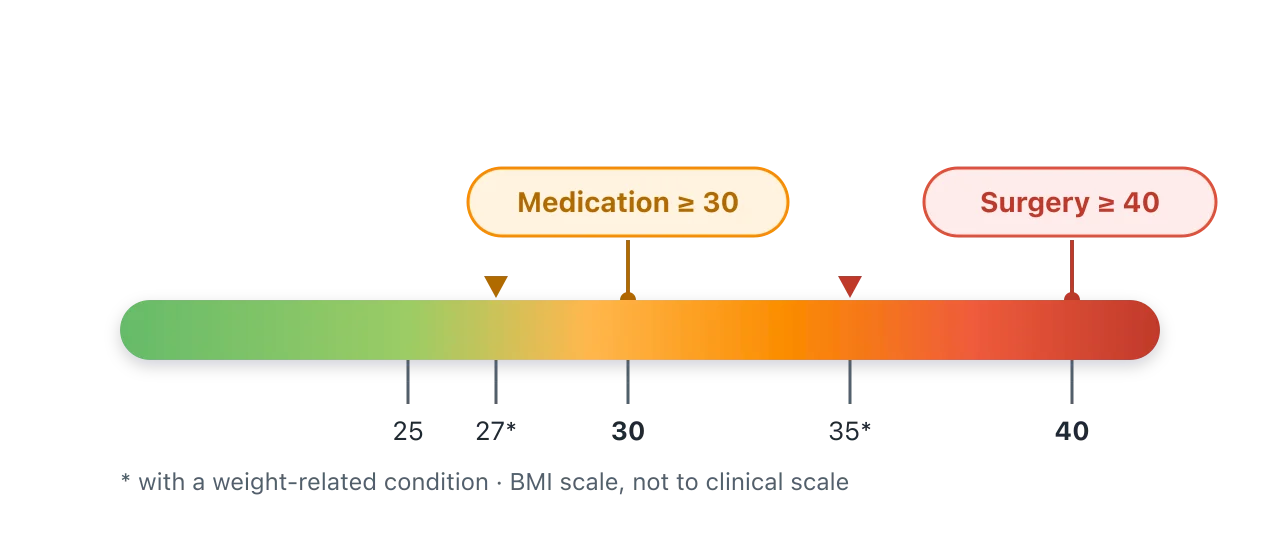
Medication is generally considered from a BMI of 30, or 27 with a weight-related condition. Surgery is generally considered from 40, or 35 with one. Eligibility is always a clinical decision - this page is background, not medical advice.
The thresholds at a glance
These are the BMI figures that appear most often in weight-management guidelines. Exact criteria differ by treatment, country, and individual health, so treat them as a map, not a rulebook.
Where do the numbers come from? They trace back to long-standing clinical guidance. Bodies such as the U.S. National Institutes of Health and the UK's National Institute for Health and Care Excellence have used a BMI of 30 as the point at which obesity-related risk is high enough that the benefits of treatment may outweigh its costs and side effects. The lower figure of 27 recognises that someone carrying a little less weight, but already living with a related illness, may benefit sooner. Because these lines are reviewed as new evidence arrives, individual programmes and newer medicines sometimes phrase them slightly differently - which is one more reason the final call belongs with a clinician.
| Route | BMI on its own | BMI with a related condition |
|---|---|---|
| Weight-management medication | 30 and above | 27 and above |
| Bariatric (weight-loss) surgery | 40 and above | 35 and above |
"A weight-related condition" usually means something like type 2 diabetes, high blood pressure, high cholesterol, or obstructive sleep apnea.
Notice that the two rows are not simply "medication is easier than surgery." They describe different levels of risk and different kinds of intervention. Medication and surgery are considered at different points because they carry very different trade-offs - and neither is a first step you reach for before everyday changes to food, movement, sleep, and stress have been part of the plan.
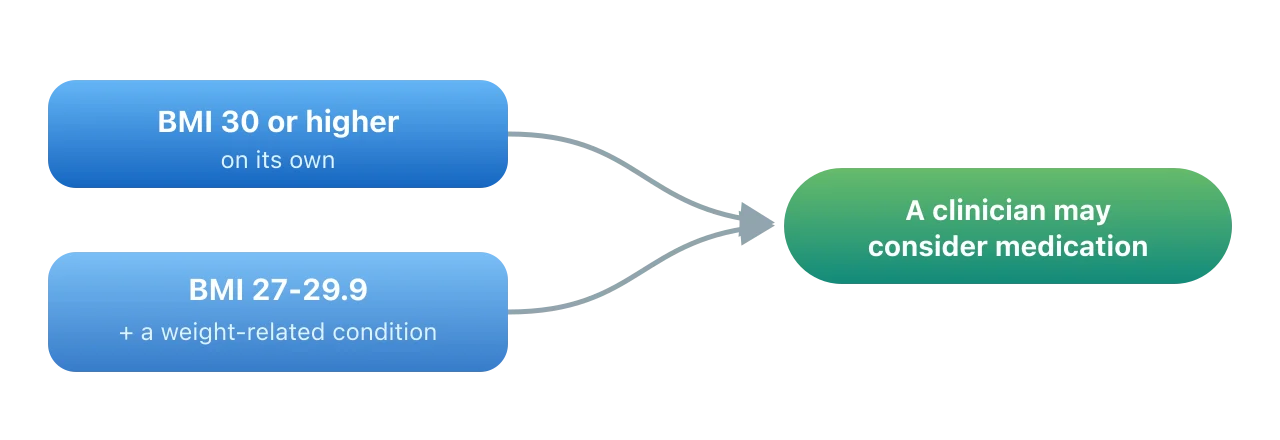
Two ways to reach the medication line
There are two common routes to the medication threshold, and you do not need both - either one may open the conversation with a clinician. The first route is BMI alone: a reading of 30 or above. The second route is a slightly lower BMI, between 27 and 29.9, combined with a weight-related health condition. The logic is that risk stacks: the same amount of extra weight is more concerning in a body that is already managing, say, type 2 diabetes.
What counts as a "weight-related condition"?
This phrase does a lot of quiet work in the guidelines, so it is worth unpacking. A weight-related condition is generally a health problem that is caused or worsened by excess weight and that is expected to improve if some weight is lost. The common examples include type 2 diabetes or prediabetes, high blood pressure, high cholesterol and other lipid problems, obstructive sleep apnea, non-alcoholic fatty liver disease, osteoarthritis in weight-bearing joints, and polycystic ovary syndrome (PCOS).
The presence of one of these conditions is what shifts the threshold from 30 down to 27 for medication, and from 40 down to 35 for surgery. It is not about ticking a box to "unlock" a treatment; it is a genuine signal that the balance of benefit and risk has changed. Someone with a BMI of 28 and well-controlled blood pressure is in a different situation from someone with a BMI of 28 and poorly-controlled type 2 diabetes, even though the number on the scale is identical. That is precisely the nuance a fixed BMI cut-off cannot capture on its own.
How BMI fits into a real clinical assessment
In an actual appointment, your BMI is the opening line, not the whole story. A thorough clinician will usually look at your weight history and any previous attempts to change it, your other medical conditions and the medicines you already take, blood tests such as blood sugar and cholesterol, your blood pressure, and often your waist measurement as a read on where fat is stored. They will also ask about the things that rarely fit on a chart: your sleep, your stress, your relationship with food, and what you actually want out of treatment.
From there, good care is a shared decision. The question is not merely "does this person clear a BMI line?" but "is this particular treatment likely to help this particular person more than it harms them, and does it fit their life?" That is why two people with the same BMI can reasonably be given different advice. It is also why arriving with your own number in hand is so useful: it lets you skip straight to the meaningful part of the conversation instead of the arithmetic.
Why BMI alone doesn't decide
BMI is used as a first filter because it is quick, cheap, and consistent. But it cannot see inside the body. It does not separate muscle from fat, does not show where fat sits, and reads the same for two people with very different health. That is why guidelines pair the BMI number with the rest of the clinical picture - history, other measurements, and lab results.
A very muscular person can cross a BMI threshold while carrying little excess fat; an older adult can sit "in range" while carrying more. Measures like your waist-to-height ratio add the context BMI misses.
Background matters too. Some health authorities use lower BMI cut-offs for people of South and East Asian descent, because weight-related risks such as type 2 diabetes can appear at a lower BMI. If that applies to you, a clinician may act on a number below the figures in the table above. You can read more in our guide to the Asian BMI scale, which explains why the same BMI can mean different things for different populations.
Children, teens, and older adults
For anyone under 18, BMI is not read against the adult numbers on this page at all. It is interpreted as an age- and sex-specific percentile, and any decision about weight-management treatment is made by a specialist team with the family involved. At the other end of life, BMI can quietly under-read risk: older adults naturally lose muscle, so a "healthy" BMI can sit on top of a higher proportion of body fat than the number suggests. In both cases the fixed adult thresholds are a prompt for a specialist conversation, not a self-service rule you can apply at home.
Questions worth asking a clinician
If you are exploring treatment, walking in with a few questions turns a rushed appointment into a useful one. You might ask:
- Given my full health picture - not just my BMI - is a weight-management treatment a reasonable option for me right now?
- What benefits and side effects should I realistically expect, and over what timeframe?
- How will we measure whether it is working, and what is the plan if I stop?
- Are there lower-risk steps worth trying first, or at the same time?
- What will this cost, and is it actually available where I live?
Check your BMI first, then talk to a professional
Knowing your BMI is a useful starting point for a conversation, not a verdict. If you are exploring treatment, bring your number - and your questions - to a qualified healthcare provider, who can look at the whole picture with you.