Few numbers during pregnancy attract as much attention, or as much quiet worry, as the ones on the scale. Friends offer opinions, apps draw curves, and it can feel as if a single figure is being judged at every appointment. The reality is calmer and kinder than that. Recommended pregnancy weight gain is a broad, flexible range that starts from where your body began, and it exists to support you and your baby rather than to grade you. This guide walks through the ranges tied to pre-pregnancy BMI, the pattern that gain tends to follow across the trimesters, and why the whole thing is something you and your provider shape together.
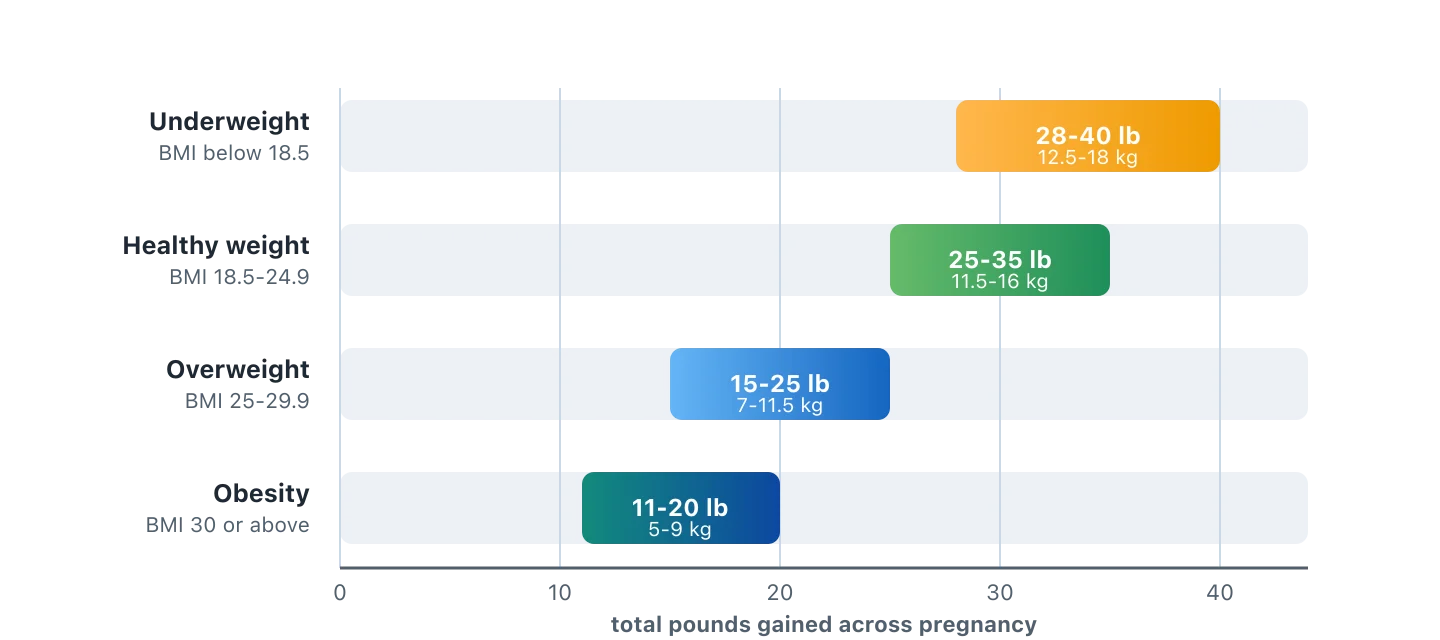
Guidance from the Institute of Medicine and the CDC ties recommended total gain to your pre-pregnancy BMI: roughly 28 to 40 lb if you started underweight, 25 to 35 lb at a healthy weight, 15 to 25 lb if you were overweight, and 11 to 20 lb with obesity, for a single baby. These are starting points for a conversation with your provider, not targets to hit on your own. This is general information, not medical advice.
Why pregnancy weight gain matters
Weight gain during pregnancy is not an unfortunate side effect to be minimised. It is a sign that your body is building the environment a baby needs to grow. A developing baby needs a larger uterus, a working placenta, a cushion of amniotic fluid, and a much bigger supply of blood to carry oxygen and nutrients back and forth. All of that has weight, and almost none of it is body fat. Gaining within a sensible range is one of the clearest early signs that this quiet construction project is going to plan.
The range matters because both ends of the scale carry real considerations. Gaining too little across a pregnancy is linked, on average, with a higher chance of a baby who is smaller than expected and with earlier birth. Gaining a great deal more than recommended is linked with a larger baby, a harder delivery, more weight kept afterward, and a higher chance of conditions such as gestational diabetes and raised blood pressure. None of these outcomes is certain for any one person, and plenty of pregnancies that sit outside the tidy ranges are perfectly healthy. Still, the ranges exist because staying near them tips the averages in a helpful direction.
It helps to picture the recommended range as a broad, comfortable lane rather than a tightrope. There is a lot of room inside it, and the goal is a steady, gradual trend over many months, not a specific figure on any given week. Bodies are not machines. The scale bounces around with fluid, food, and the time of day, and a single reading tells you very little on its own. What your provider watches is the direction of travel over time, and even that is only one part of a much larger picture of how you and your baby are doing.
The recommended ranges by pre-pregnancy BMI
The most widely used guidance comes from the Institute of Medicine, now part of the National Academies, and it is echoed by the CDC. It sorts recommended total gain by your body mass index before pregnancy, because that starting point shapes how much extra weight is helpful. The figures in the table below are for a single baby across the whole pregnancy, from conception through to delivery.
| Pre-pregnancy category | BMI range | Total gain (lb) | Total gain (kg) |
|---|---|---|---|
| Underweight | below 18.5 | 28-40 lb | 12.5-18 kg |
| Healthy weight | 18.5-24.9 | 25-35 lb | 11.5-16 kg |
| Overweight | 25-29.9 | 15-25 lb | 7-11.5 kg |
| Obesity | 30 or above | 11-20 lb | 5-9 kg |
Reading across the table, the pattern is straightforward: the lower your pre-pregnancy BMI, the more you are encouraged to gain, and the higher it was, the less. Someone who began underweight is guided toward roughly 28 to 40 pounds, which is 12.5 to 18 kilograms, while someone who began with obesity is guided toward roughly 11 to 20 pounds, or 5 to 9 kilograms. The two middle groups sit in between, with healthy-weight pregnancies aiming for about 25 to 35 pounds and those who began overweight for about 15 to 25.
Notice how wide each band is. Even the narrowest of them spans nine or ten pounds, and that width is deliberate. The guidance is built to fit an enormous variety of people, and it leaves your provider room to nudge the target up or down for your particular situation. A number a little outside the band is a reason to check in, not a mark of failure, and a number sitting comfortably inside it is reassurance rather than a finish line to sprint for.
One more point is worth making early. These are population-level recommendations drawn from large studies, and they describe what tends to work well on average. They are not a personal prescription, and they were never meant to be followed to the decimal. Your own healthy range is the one you and your provider agree on together, taking your health, your history, and the way this particular pregnancy is unfolding into account.
The trimester pattern
Total gain is only half the story, because when it happens matters too. For most people who start at a healthy weight, very little gain shows up in the first trimester. A common figure is somewhere around one to four pounds across those first twelve or thirteen weeks, and some people gain nothing at all, especially if nausea has taken the shine off eating. That is normal and not a cause for concern on its own.
The steadier climb usually begins in the second trimester. From around the middle of pregnancy onward, a rate of roughly one pound a week is a typical and healthy pace for someone in the healthy-weight group. That same gentle weekly rhythm tends to continue through the third trimester, right up until the final weeks, when gain often slows again by itself. Added together across the second and third trimesters, that steady pound-a-week pace is what carries most people into their recommended total.
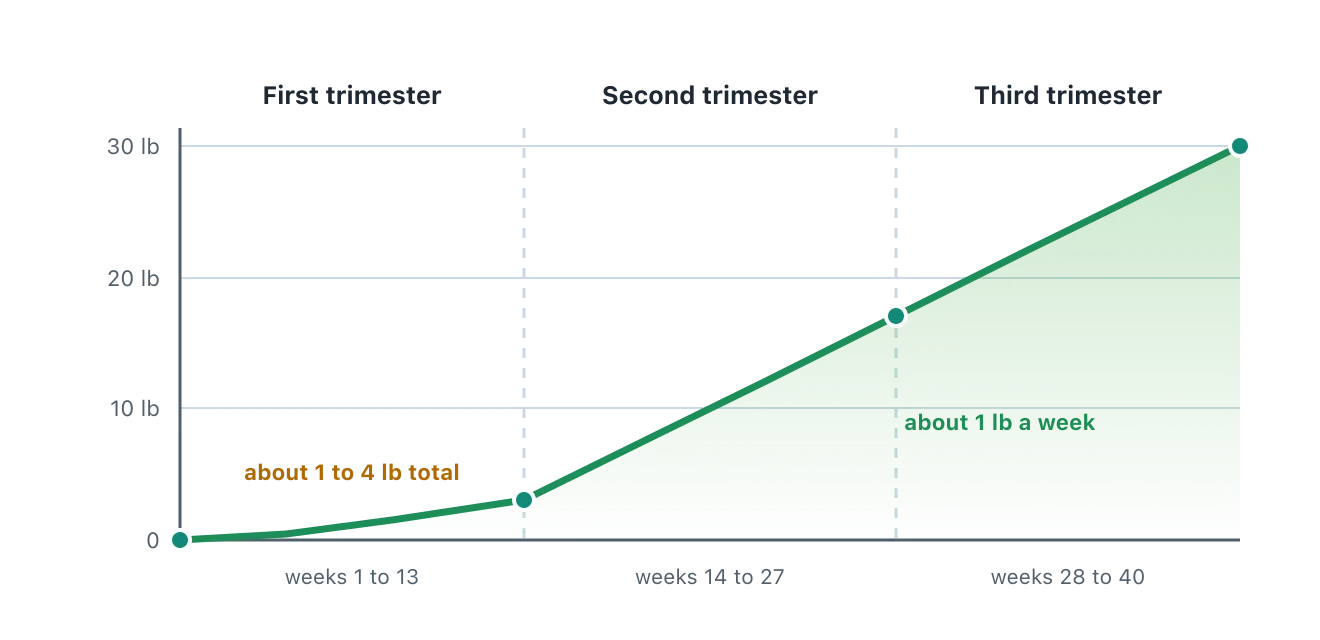
The exact weekly pace shifts with your starting point. If you began underweight, the guidance leans toward slightly more than a pound a week during the second and third trimesters, in keeping with the larger total. If you began overweight or with obesity, the recommended weekly pace is a little slower, closer to half a pound a week, which matches the smaller total. The shape of the curve is the same for everyone, flat at first and then rising steadily, and only the steepness of that rise changes from person to person.
Because week-to-week weight is noisy, providers care far more about the trend than about any single weigh-in. A pound that seems to appear overnight is almost always water and food rather than a real change in your body, and a flat week here or there means little. The gently rising line in the figure above is an average, drawn smooth. A real pregnancy zigzags around it from week to week, and that is entirely expected rather than a sign that anything has gone wrong.
Why the range depends on your starting BMI
At first glance it can seem backward that someone who weighed less before pregnancy is encouraged to gain more. The logic makes sense once you think about what the extra weight is for. A person who began underweight has smaller energy reserves and often less of the tissue that a pregnancy draws on, so a larger gain helps build a healthy birth weight and gives both bodies a fuller cushion to work with through the months ahead.
At the other end, a person who began with a higher BMI already carries larger stores of energy that a pregnancy can tap into. Their body does not need to add as much for the baby to grow well, so the recommended gain is smaller. Importantly, this does not mean that losing weight or holding it flat is the aim. Even in the highest-BMI group the guidance still recommends a positive gain, because the baby, the placenta, and all the supporting fluid and tissue still have to be built, and building them always adds weight.
This is the point where a gentle but firm reminder belongs: pregnancy is not the time to diet or to try to lose weight, whatever your starting BMI. The lower ranges for higher-BMI pregnancies are about gaining a bit less, not about restriction, skipped meals, or cutting the nourishment that you and your baby both rely on. Deliberately cutting calories during pregnancy can shortchange the baby's growth, and it is not something to attempt on your own. If weight feels like a worry, that is a conversation to have with your provider.
If your pre-pregnancy BMI happened to sit near a boundary between two categories, do not agonise over which band you fall into. The categories are convenient lines drawn across a smooth range, and the difference between the top of one band and the bottom of the next is small. Your provider can tell you which range fits you best, and can adjust it as the pregnancy progresses. The category is a starting assumption to reason from, not a rule carved in stone.
Where the weight actually goes
One of the most reassuring things to understand is that pregnancy weight is not simply fat, and the baby is only a modest slice of the total. By the end of a typical pregnancy the baby itself often accounts for something in the region of a quarter to a third of everything gained. The rest is the remarkable support system your body assembles to grow and protect that baby over nine months.
Consider how it is spread out. The placenta, the organ that feeds the baby, has a weight of its own. So does the amniotic fluid that cushions the baby, and the uterus itself, which grows from about the size of a pear to something that can fill much of the abdomen. The breasts enlarge as they prepare to feed. On top of all that, the body dramatically increases its blood volume and holds on to extra fluid to keep everything supplied, and that added blood and water carries real, measurable weight.
Then there are the fat stores. The body lays down a reserve of fat during pregnancy, and while it is tempting to see that as the unwelcome part, it has a genuine job to do. Those stores are an energy buffer for the demanding final stretch of pregnancy and, for many people, for breastfeeding in the months afterward. They are a feature of the design rather than a flaw in it, and they are one reason the number on the scale keeps climbing even when the visible bump seems to have settled for a while.
Seeing the breakdown this way can take some of the sting out of watching the scale move. A large share of pregnancy gain is fluid, blood, and tissue that the body sheds or reabsorbs in the weeks and months after birth. The gain is temporary infrastructure, built for a clear purpose and largely taken down again once its job is finished. That is worth holding on to on the days when the total starts to feel like a lot.
Twins and individual circumstances
Everything so far assumes a single baby. Carrying twins or more changes the arithmetic, because there is simply more to build: more babies, often more than one placenta, and more fluid and tissue to support them. Recommended total gain for a twin pregnancy is meaningfully higher than for a single baby across every starting category. The specific numbers are best set with your provider, because multiple pregnancies are followed more closely and the targets are individualised, so the honest guidance here is that the range is higher and your care team will tell you what it looks like for you.
Plenty of other circumstances shift the picture too. Age, height, and overall health all play a part. So do conditions that predate pregnancy, such as diabetes or thyroid conditions, and conditions that can arise during it, such as gestational diabetes or raised blood pressure. Someone who is very physically active, someone carrying a baby measuring large or small, and someone who had certain surgeries in the past may each be guided toward a range that differs from the textbook band for their BMI.
Severe nausea and vomiting can make early gain slow or even reverse, while a sudden jump in weight later in pregnancy can occasionally point to fluid retention that is worth mentioning promptly. None of this is meant to be a checklist to diagnose yourself from. It is simply a reminder that the printed ranges describe a healthy, uncomplicated, single pregnancy, and that real life often adds wrinkles a table on a page cannot show.
This is exactly why the ranges are a starting point rather than a verdict. They are the opening line of a conversation that your provider tailors to you, using information that a chart on a website can never have. If your situation turns out to be more complicated than the average, that does not mean something is wrong; it means the general numbers matter a little less and your provider's individual guidance matters a good deal more.
Your provider guides this
The single most important message in this article is that your healthcare provider, whether that is an obstetrician, a family doctor, or a midwife, is the person who should guide your weight gain. Prenatal care exists precisely to keep an eye on how you and your baby are doing, and weight is one small part of what those visits track, alongside blood pressure, growth, movement, and how you feel from week to week. Nothing on this page can replace that individual care, and it is not meant to.
If you are worried that you are gaining too much or too little, the right next step is not to change what you eat on your own or to hunt for stricter rules. It is to raise it at your next appointment, or sooner if something feels off. Your provider can look at your trend rather than a single reading, weigh up everything they know about you, and either reassure you or adjust the plan as needed. Very often the reassurance is the whole answer, because so much of what looks alarming on the scale is ordinary variation.
It is also worth saying plainly what this guidance is not. It is not permission to diet, to restrict, or to chase a particular number while you are pregnant, and it is not a reason to feel judged if your body is not tracking the average curve. Pregnancy is a season for nourishment and support, not for weight-loss goals. If your relationship with food or with the scale feels difficult during this time, that is something your provider will want to know about and can help with gently and without judgement.
So use the ranges here for what they are: general, educational background that helps the conversations with your care team make more sense. They can help you understand why the recommended gain is what it is, and what the usual pattern tends to look like, so the advice you receive feels less mysterious and easier to trust. This article is general information and is not medical advice, and every pregnancy is different. Let the ranges inform your questions, and let the people looking after you set your target.