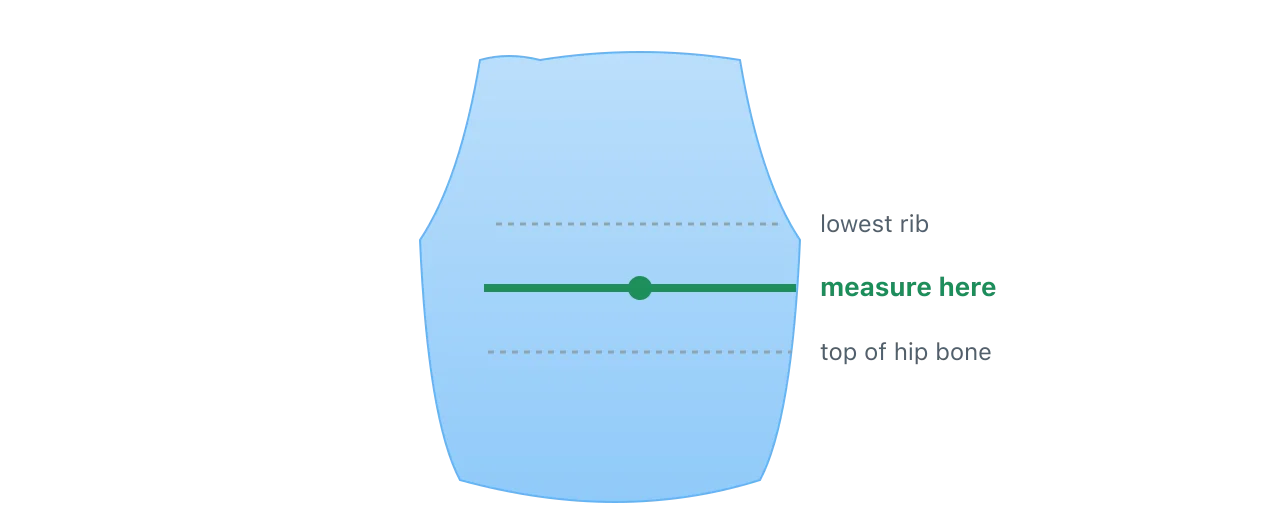
A waist measurement is one of the most informative numbers you can collect about your body, and one of the easiest to get slightly wrong. Placed a few centimetres too high or too low, pulled a little too tight, or taken over a bulky jumper, the tape can hand you a number that looks reassuring or alarming for no real reason. The good news is that measuring well takes under a minute once you know the landmarks. Here is exactly how to do it, and how to make your number trustworthy over time.
Why the waist is worth measuring
Of all the simple measurements you can take at home, the waist punches above its weight. It is a strong everyday clue to central fat, and especially to visceral fat, the deep fat around the organs that is most closely tied to health risk. That is something the scale and BMI simply cannot see, which is why a tape around your middle adds so much for so little effort.
Compared to your height, the waist becomes even more useful. Keeping your waist under half your height is a simple, evidence-backed screen that works across different body sizes. But all of that value depends on one thing: measuring the waist consistently and correctly. A sloppy measurement is worse than none, because it can mislead you with false confidence or needless worry.
It is worth appreciating just how much information hides in this one number. Two people with the same weight, height, and BMI can have very different waists, and therefore very different amounts of the risky central fat. The tape, in effect, sees straight past the averages that BMI relies on and reports something specific to you. For a tool that costs almost nothing and takes under a minute, that is a remarkable amount of signal.
What you need
Almost nothing. A flexible tape measure, the kind used for sewing, is ideal, because it wraps smoothly around the body. If you only have a rigid measuring tape, a length of string marked and then held against a ruler will do. Beyond that, you want a mirror or a moment of care to keep the tape level, and ideally the same quiet time of day each time you measure. That is the entire kit.
Step by step
Pick a consistent time
Measure first thing in the morning, before eating or drinking. Your waist naturally changes through the day with meals and bloating, so a fixed time removes most of that noise.
Find the landmark
Feel for the bottom of your lowest rib and the top of your hip bone. The midpoint between them is the standard spot, and it often sits near the navel. Whatever you choose, use it every time.
Measure against skin
Place the tape directly on your skin, not over clothing, which adds bulk and varies from day to day. Stand relaxed with your feet together and your weight even.
Keep the tape level
Wrap it around so it sits parallel to the floor all the way around, not sloping up or down at the back. A mirror helps you check the rear of the tape.
Breathe out gently
Exhale normally and take the reading at the end of a relaxed breath. Do not suck in your stomach or hold your breath, which both shrink the number artificially.
Read, then repeat
Note the number where the tape meets, snug but not compressing the skin. Take the measurement two or three times and use the average to smooth out small wobbles.
Common mistakes to avoid
Most waist-measuring errors come from a handful of habits, and the illustration below shows the big ones. The most common is measuring in the wrong place, usually too high, up near the narrowest part of the torso, because it gives a flattering number. That defeats the purpose; the point is a consistent, honest landmark, not the smallest reading you can find.
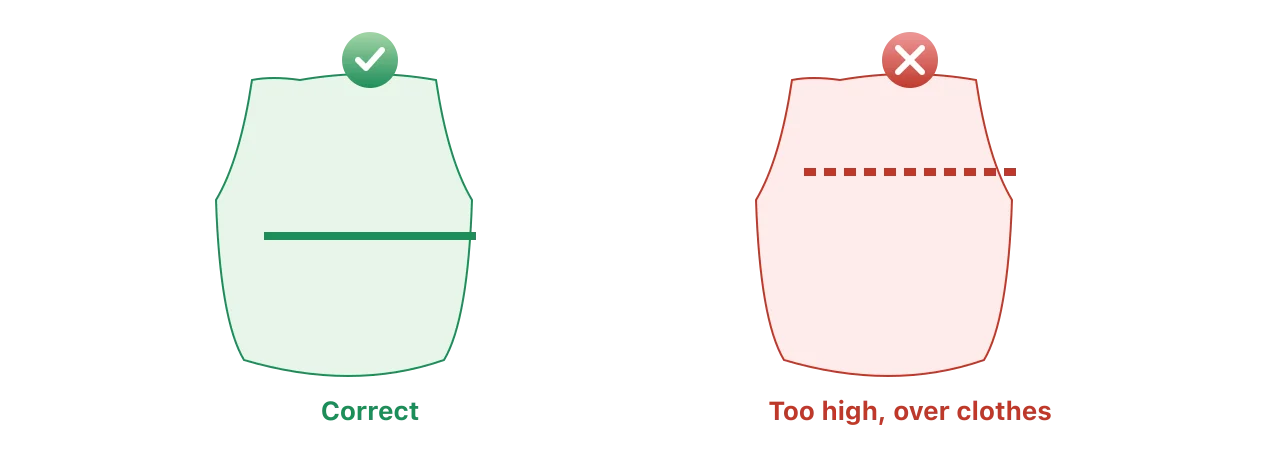
The other frequent slips are all variations on the same theme of accidentally shrinking the number: measuring over clothing, pulling the tape tight enough to dent the skin, holding your breath, or sucking your stomach in. Each feels harmless, and each makes your waist look smaller than it is. Since the whole value of the measurement is honesty over time, these shortcuts quietly rob you of the very thing you are trying to track.
What the number means
On its own, a waist measurement is just a length, so give it meaning by comparing it to your height. Divide your waist by your height, and aim to keep the result under 0.5, which is the same as keeping your waist less than half your height. That simple rule works across a wide range of body sizes and is a well-supported screen for the central fat that matters most.
A number above that line is not a diagnosis; it is a prompt to look closer and, if it persists, to raise it with a healthcare provider. Equally, a waist within the healthy range is reassuring but not a guarantee, since it is one screen among several. Read alongside your BMI, it fills in exactly the gap that BMI leaves open.
Why consistency beats the perfect spot
People often worry about finding the one true, official place to measure, as though a centimetre of difference will ruin everything. In practice, the exact landmark matters far less than picking one and sticking to it. Whether you measure at the natural narrowest point, at the navel, or at the midpoint between rib and hip, what makes your record trustworthy is that every future measurement uses the same spot under the same conditions.
This is because the most valuable thing a waist measurement gives you is not a single perfect reading but a trend you can trust. If your landmark is always the same, then any change you see is a change in your body, not in your method. If it wanders, you lose the ability to tell those two apart, and the whole exercise quietly turns into noise. Consistency, in other words, is what converts a rough measurement into reliable information.
So do not agonise over millimetres. Choose a landmark you can find easily and repeat, measure at the same time of day in the same relaxed way, and let the trend do the talking. A slightly imperfect spot measured faithfully beats the textbook-perfect spot measured differently each time.
Tracking over time
The real power of a waist measurement shows up when you track it. Because you are comparing your own waist to itself, small inaccuracies matter less as long as you measure the same way each time. A waist that is slowly shrinking is encouraging even if the scale is stubborn, and a waist that is quietly expanding despite a stable weight is an early warning worth heeding.
Keep it simple: measure every couple of weeks, at the same time, using the same landmark, and note the number somewhere you can look back on. Over months, that little record will often tell you more about your health trajectory than the bathroom scale does, because it is tracking the fat that carries the most weight for your future. And if a private history feels useful, our tools let you keep one entirely on your own device.