Two people can share the same weight, the same height, and the same BMI, and still face different health odds, because of one thing that BMI cannot see: where their body stores its fat. Waist-to-hip ratio is one of the oldest and simplest ways to capture that. By comparing the size of your waist to the size of your hips, it turns your body shape into a single number that says something meaningful about risk. Here is how to measure it, what the thresholds mean, and how it fits alongside the other numbers you might track.
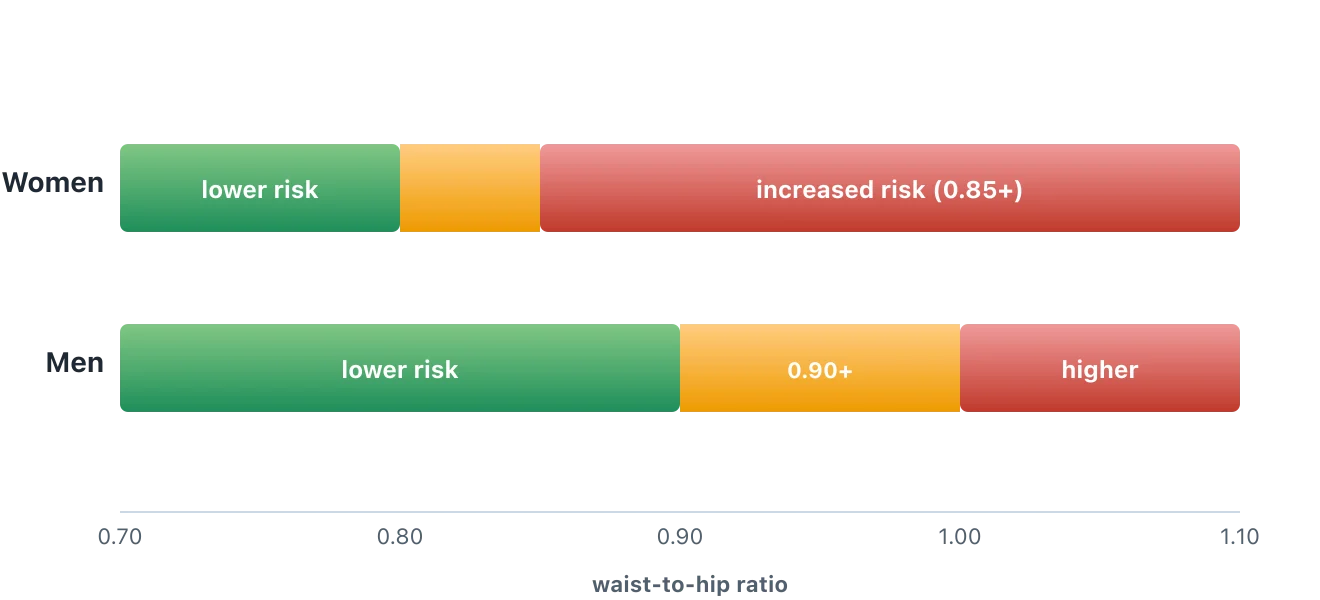
Waist-to-hip ratio is your waist measurement divided by your hip measurement. Risk generally rises above about 0.85 for women and 0.90 for men, because fat carried around the waist matters more for health than fat on the hips.
What waist-to-hip ratio is
Waist-to-hip ratio is exactly what it sounds like: the circumference of your waist divided by the circumference of your hips. If your waist is 80 centimetres and your hips are 100, your ratio is 0.80. The number is always relative, so it does not matter whether you measure in centimetres or inches, as long as both measurements use the same units.
What makes the ratio useful is that it describes fat distribution rather than fat quantity. A high ratio means your waist is large relative to your hips, which signals more fat stored around the middle. That central fat, especially the deep fat around the organs, is the kind most strongly linked to conditions like type 2 diabetes and heart disease, which is why the ratio can flag risk that weight alone misses.
How to measure it
Accuracy depends on measuring in the right places. For the waist, find the narrowest part of your torso, usually around the level of your navel or just above it, and wrap a flexible tape around it snugly without pulling it tight or holding your breath. For the hips, measure around the widest part of your buttocks. Take each measurement two or three times and use the average, standing relaxed with your feet together.
Then divide the waist figure by the hip figure. The result will usually fall somewhere between about 0.70 and 1.00. Because small differences in where you place the tape can move the number, the single most important habit is to measure at the same points each time, so any change you see reflects your body rather than your technique.
One practical tip: measure over bare skin or a single thin layer, never over bulky clothing, and stand relaxed rather than braced. If you are measuring yourself, a mirror makes it much easier to keep the tape level at the back, where it tends to ride up or sag without you noticing. Small habits like these are what separate a number you can trust from one that quietly drifts with your technique from one week to the next.
The thresholds by sex
Like body fat percentage, waist-to-hip ratio is read against different thresholds for women and men, because healthy fat distribution differs between the sexes. The table below summarises the commonly cited bands.
| Category | Women | Men |
|---|---|---|
| Lower risk | below 0.80 | below 0.90 |
| Moderate | 0.80 to 0.84 | 0.90 to 0.99 |
| Increased risk | 0.85 and above | 1.00 and above |
Health bodies such as the World Health Organization treat a ratio at or above roughly 0.85 in women and 0.90 in men as a marker of increased health risk. Different guidelines draw the lines slightly differently, so treat these as screening bands rather than precise cut-offs, and read a number near a boundary as a prompt to look closer, not a verdict.
Apple and pear shapes
Waist-to-hip ratio is the number behind the familiar apple and pear metaphor. An apple shape carries more fat around the middle, producing a higher ratio, while a pear shape carries more around the hips and thighs, producing a lower one. The distinction is not about appearance for its own sake; it is that apple-shaped, waist-heavy fat is more metabolically active and more closely tied to health risk than the hip-and-thigh fat of a pear shape.

How it compares to BMI
Waist-to-hip ratio and BMI answer different questions and work best together. BMI tells you whether your weight is high for your height; waist-to-hip ratio tells you where that weight sits. Someone can have a perfectly normal BMI and a high ratio, which is a meaningful warning that BMI on its own would miss, and the reverse can happen too.
Compared with waist-to-height ratio, its close cousin, waist-to-hip has one practical drawback: it needs two careful body measurements instead of one, and the hip measurement in particular can be fiddly. That is why many people and guidelines lean toward waist-to-height for simple self-screening, while waist-to-hip remains valued for describing fat distribution more directly. There is no need to choose a single champion; each adds a slightly different angle.
Reading a borderline number
What if your ratio lands right on a threshold, say 0.84 or 0.86 for a woman? The honest answer is that a single point either side of a cut-off is not a meaningful difference. These thresholds are lines drawn across a smooth gradient of risk, chosen to be useful on average across large groups, not sharp cliffs where health suddenly changes. A ratio a whisker over the line is not categorically worse than one a whisker under it.
So treat a borderline result as an invitation to look at the trend and the wider picture rather than to fixate on the exact figure. Is your ratio drifting up or down over the months? What do your BMI and waist-to-height say? How do you feel, and what does your family history suggest? A number near a boundary is most useful as one input into that broader conversation, ideally with a healthcare provider, not as a verdict delivered by a tape measure to two decimal places.
It also helps to remember that you can influence the ratio mainly through the waist, not the hips. The hip measurement reflects your frame and where you naturally carry lower-body fat, which is largely fixed. The waist, and especially the visceral fat behind it, is the more changeable part, and it tends to respond to the same everyday habits that help your health generally.
Limits and what to do
No single ratio is a diagnosis, and waist-to-hip has real limits. It can be thrown off by build and by measurement technique, it does not apply in the same way during pregnancy, and like every screen it describes risk across groups better than it predicts any one person's future. It is a useful flag, not a fortune teller.
The sensible way to use it is as part of a small set. Read your waist-to-hip ratio alongside your BMI and, ideally, your waist-to-height ratio, and treat any of them landing in a higher-risk band as a reason to pay attention rather than to panic. If several point the same way, that is worth raising with a healthcare provider, who can look at the fuller picture that a tape measure can only hint at.