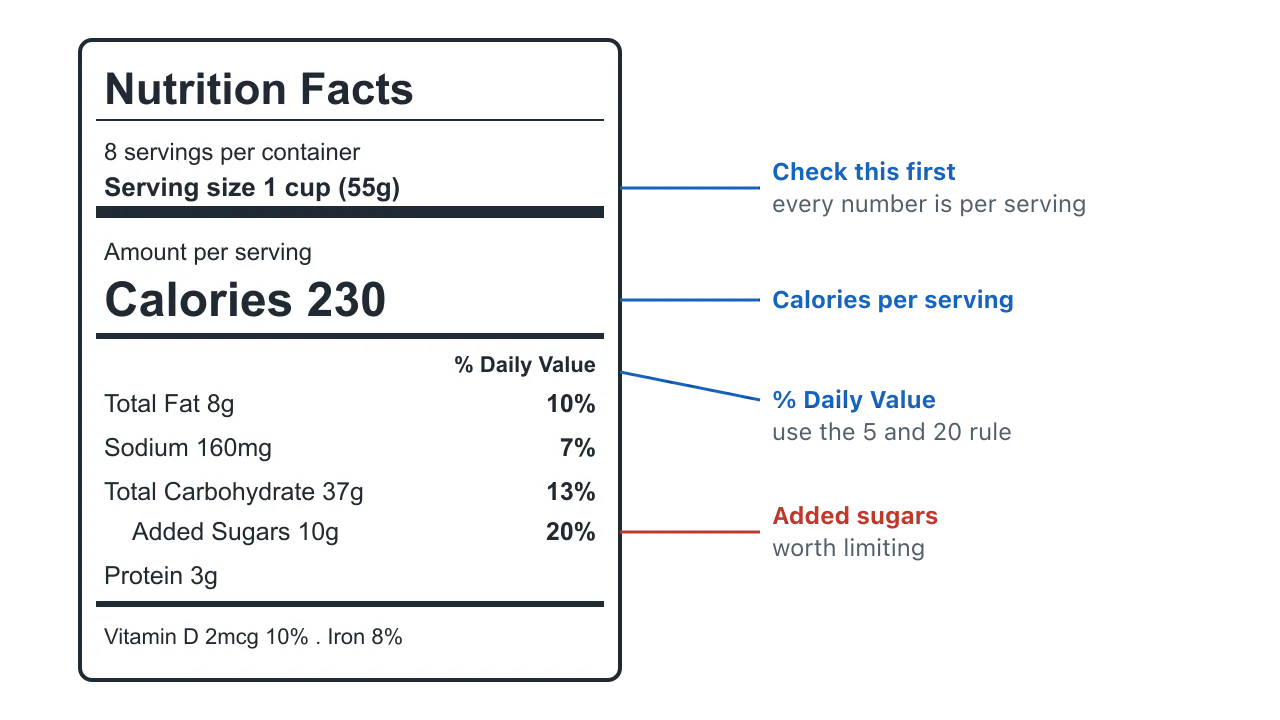
A nutrition label is one of the most useful tools in any kitchen, and one of the most quietly misread. It packs a surprising amount of information into a small box, but only if you know the order to read it in and the couple of traps to watch for. Once you do, you can size up a product in seconds and stop being fooled by friendly-looking packaging. Here is how to read a label the way it is meant to be read, from the top down.
Read the serving size first, because every number depends on it. Then use the 5-and-20 rule for the percent Daily Value: 5% or less is low, 20% or more is high. Watch the added sugars line and the ingredients order.
Start with serving size
The single most important number on the label is the one people skip: the serving size. Every other figure, the calories, the fats, the sugars, all of it, refers to one serving, not the whole package. If a small bag of chips says it contains three servings and you eat the whole bag, you have eaten three times everything on the label. Miss the serving size and you misread the entire panel.
So always check two things at the top: how big one serving is, and how many servings are in the container. Manufacturers sometimes set serving sizes smaller than what people realistically eat, which makes the calories and sugars look more modest at a glance. Reading the serving size first inoculates you against that trick and puts every other number in its proper context.
Calories in context
Calories come next, and they tell you how much energy one serving provides. This is genuinely useful for understanding how a food fits into your day, but it is easy to over-rely on. Calories measure energy, not quality. A food can be low in calories yet loaded with sodium or added sugar, or higher in calories yet packed with protein, fibre, and nutrients that serve you well.
The healthiest way to use the calorie number is as one input among several, read alongside what those calories are actually made of. A handful of nuts and a handful of sweets can carry similar calories while doing very different things for your body. Calories start the conversation; the rest of the label finishes it.
The %DV 5-and-20 rule
Down the right side of the label runs the percent Daily Value, or %DV, which tells you how much a serving contributes to a day's worth of each nutrient, based on general guidelines. The clever shortcut for reading it is the 5-and-20 rule: about 5 percent or less per serving is low, and 20 percent or more is high.

The rule works in both directions. For nutrients you want more of, like fibre, aim for foods with a higher %DV. For nutrients you want less of, like sodium and saturated fat, aim for a lower %DV. It turns the whole right-hand column into a fast, intuitive judgement without any mental arithmetic.
Nutrients to limit
Health guidance flags a few nutrients most people get too much of, and the label makes them easy to spot. Saturated fat, sodium, and added sugars are the usual trio to keep an eye on, since diets high in them are linked to raised risks over time. Using the 5-and-20 rule, you are generally looking for these to sit toward the lower end, especially in foods you eat often.
Added sugars deserve special attention, because the label now separates them from total sugars. Total sugars include the natural sugars in things like fruit and milk, which come bundled with other nutrients. Added sugars are those stirred in during manufacturing, and they are the ones worth minimising. A product can look innocent on total sugars while carrying a hefty added-sugar load, so that dedicated line is one of the most useful additions to the modern label.
Nutrients to get enough of
The label is not only a list of things to avoid. It also highlights nutrients many people fall short on, including dietary fibre, vitamin D, calcium, iron, and potassium. For these, the goal flips: you want to choose foods that deliver a decent %DV, favouring the higher end where you can.
Fibre is a good one to actively seek out, since it supports digestion and helps you feel full, and many people do not get enough. Scanning for a healthy fibre %DV is a simple way to steer toward more filling, more nourishing choices, and it pairs naturally with keeping added sugars low.
The ingredients list
Below the numbers sits the ingredients list, and it follows one simple rule that makes it powerful: ingredients are listed by weight, from most to least. That means the first few ingredients make up the bulk of the product. If sugar, or one of its many aliases, appears near the top, the food is largely sugar, whatever the front of the pack claims.
A short list of recognisable ingredients is often, though not always, a reasonable sign of a less processed food. It is not a hard rule, since plenty of wholesome foods have longer lists and some short lists are not virtuous, but scanning the first three or four ingredients tells you quickly what you are really buying. It is the honest counterpart to the marketing on the front.
A quick word on where to find all this and how it varies. In many countries the panel is titled Nutrition Facts and looks much like the one above; elsewhere it may be called Nutrition Information and appear as a table, often with a per-100-gram column alongside the per-serving one. That per-100-gram column is quietly brilliant, because it lets you compare two products fairly regardless of their different serving sizes, sidestepping the serving-size trick entirely. When you are choosing between two similar items on a shelf, it is often the fastest honest comparison you can make.
Common label traps
A few tricks catch people out repeatedly. The serving-size trap, setting an unrealistically small serving to shrink the numbers, is the classic one, which is why serving size comes first. Front-of-pack claims like "low fat" or "natural" are marketing, not regulated nutrition facts, and a low-fat product can be high in added sugar to compensate. Words like "multigrain" or "made with real fruit" can dress up a product whose ingredients list tells a plainer story.
The defence against all of these is the same: ignore the front of the package and read the panel on the back in order. Serving size, then calories, then the %DV with the 5-and-20 rule, then the ingredients list. Do that for a week and it becomes automatic, turning the label from a wall of numbers into a quick, reliable read. As always, this is general education rather than personalised advice, and anyone with specific dietary needs should get guidance tailored to them.