Few pieces of health advice are as universal, or as fuzzy, as "drink eight glasses of water a day." It is printed on bottles, repeated by well-meaning friends, and treated as settled science, yet its origins are surprisingly murky and its one-size-fits-all promise does not survive contact with real bodies. The good news is that staying properly hydrated is simpler than any rigid rule suggests, once you understand where the numbers come from and which signals actually matter.
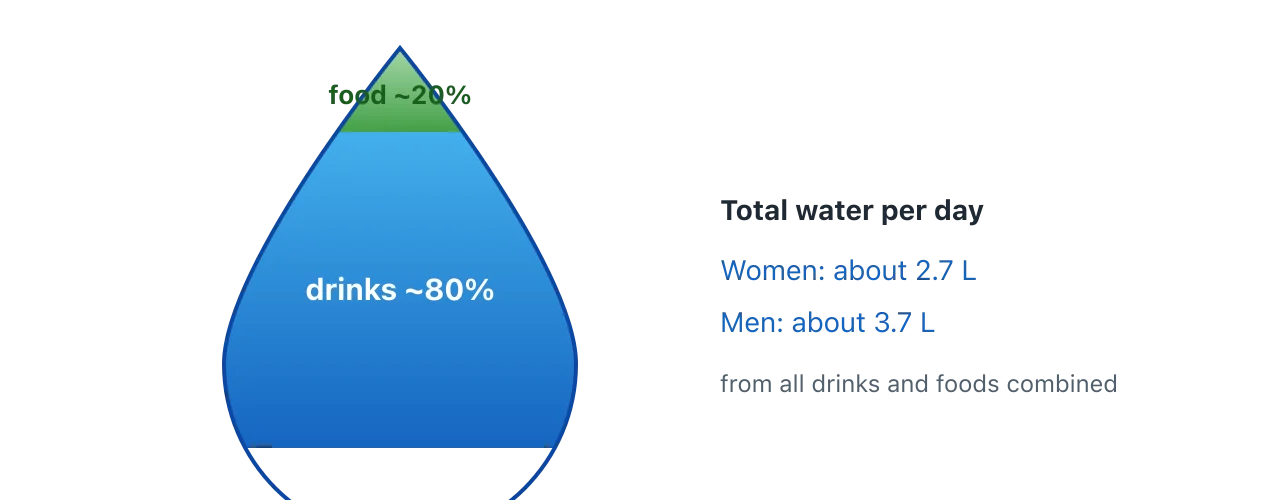
General guidance suggests a total of about 2.7 litres a day for women and 3.7 for men, from all drinks and foods. Food provides roughly a fifth. For most people, drinking to thirst and aiming for pale urine beats counting glasses.
The 8-glasses myth
Start with the rule everyone knows. "Eight glasses a day" is not wrong so much as oversimplified. Eight eight-ounce glasses add up to about 1.9 litres, which is a perfectly reasonable amount of fluid for many people, so the rule survives partly because it lands near a sensible ballpark. What it lacks is any acknowledgement that a small, sedentary person in a cool climate and a large, active one in the heat have genuinely different needs.
The rule also quietly ignores two important facts: that all your drinks count, not just plain water, and that food contributes a meaningful share of your fluid. Treated as a rough nudge to drink regularly, eight glasses is harmless. Treated as an exact prescription you must hit or fail, it creates needless anxiety and a lot of unnecessary clock-watching.
What the science says
Expert bodies that have reviewed the evidence put daily needs a little higher than the eight-glass rule, because they count total water from all sources. A widely cited set of figures suggests an adequate total water intake of roughly 2.7 litres a day for women and 3.7 litres for men. Crucially, those totals include the water in food as well as every drink, so the amount you need to actually drink is somewhat lower than the headline number.
These are averages for general guidance, not targets everyone must reach, and they come with wide individual variation. They are most useful as a sense of scale: they tell you that a couple of litres of fluid a day is in the right ballpark for many adults, while leaving plenty of room for the differences between one person and the next.
A useful way to hold all this: think in terms of a comfortable habit rather than a daily quota. Most people who drink regularly with meals, and reach for water when thirsty, land near these figures without ever measuring a thing. The numbers exist to reassure you that you are in the right ballpark, not to turn a glass of water into a chore to be logged and audited.
Food counts too
One of the most overlooked parts of hydration is that you eat a fair amount of your water. Fruits and vegetables are especially watery: cucumber, watermelon, oranges, tomatoes, and lettuce are largely water by weight, and even foods that do not seem juicy, like yogurt or cooked grains, carry plenty. Across a normal day, food typically supplies around a fifth of your total water intake.
This matters because it means hydration is not only about what is in your glass. A diet rich in fruits and vegetables does some of the work for you, which is one more quiet benefit of eating that way. It also explains why rigid drink targets can mislead: two people drinking the same amount can be hydrated differently depending on what is on their plates.
Two signals that beat a number
For the vast majority of healthy people, you do not need to count anything at all. Your body comes with two excellent built-in gauges. The first is thirst, an ancient and reliable signal that prompts you to drink before you are meaningfully short of fluid. Drinking when you are thirsty, and a little with meals, covers most of your needs without any arithmetic.
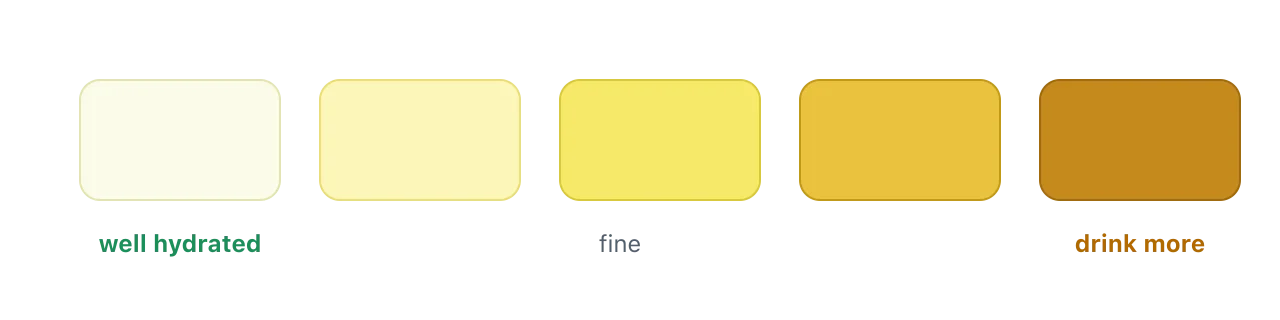
The second gauge is the colour of your urine, and it is the single most practical hydration check there is. Pale, light yellow generally means you are well hydrated. Dark yellow suggests you should top up. It is simple, immediate, and personal, adjusting automatically to your size, your activity, and the weather in a way no fixed number ever could.
What changes your needs
Your fluid needs are not fixed from day to day. Several things push them up. Exercise and heat both increase losses through sweat, sometimes dramatically, so a hot day or a hard workout calls for more. Illness with fever, vomiting, or diarrhoea raises needs too. Pregnancy and breastfeeding increase requirements, and larger bodies generally need more than smaller ones. Altitude and dry air can quietly add to losses as well.
The practical response is not to memorise adjustments but to let your built-in gauges do the work. On a hot day or after a long run, you will feel thirstier and your urine will tell you to drink more, and you simply respond. That responsiveness is exactly why thirst and colour outperform any static daily target for everyday life.
Simple ways to stay on track
If you find you often forget to drink, a few gentle habits do more than any target. Keeping a bottle or glass within sight is the simplest, since visibility is a surprisingly strong nudge. Pairing drinks with routines you already have, a glass with each meal, one when you wake, one mid-afternoon, builds hydration into your day without any counting. Flavouring water with a slice of fruit or a splash of juice helps people who find plain water boring.
It is also worth knowing that thirst can be blunted in some situations, notably in older age and during intense focus or exercise, where people sometimes forget to drink. In those cases a light routine helps bridge the gap that thirst alone might miss. None of this needs to be rigid; the aim is simply to make the healthy thing the easy thing, so that staying hydrated happens almost by default rather than by willpower.
Can you drink too much?
It is worth knowing that more is not endlessly better. In rare cases, drinking very large amounts of water in a short time can dilute the sodium in your blood to dangerous levels, a condition called hyponatraemia that occasionally affects endurance athletes who overdrink. For ordinary daily life this is very uncommon, and it is not a reason to be nervous about normal drinking.
The sensible takeaway is balance. You do not need to force down water to hit an arbitrary number, and you do not need to fear a normal glass. Drink when thirsty, keep an eye on that pale-yellow target, eat your fruits and vegetables, and drink a bit more when it is hot or you are active. That relaxed approach keeps almost everyone well hydrated, and if you have a medical condition that affects fluid balance, follow your provider's specific advice over any general rule.