Protein is the one nutrient almost everyone trying to build muscle asks about, and for good reason: it is the raw material your body uses to repair and grow muscle after training. But the advice out there ranges from "you barely need any" to "eat as much as humanly possible," which is not much help. The truth sits in a well-studied middle, and once you know the target, hitting it with ordinary food is easier than the supplement industry would have you believe.
To build muscle, aim for about 1.6 to 2.2 grams of protein per kilogram of body weight per day, paired with resistance training. Total daily protein matters far more than timing, and whole foods can cover it without any powder.
How much protein do you need?
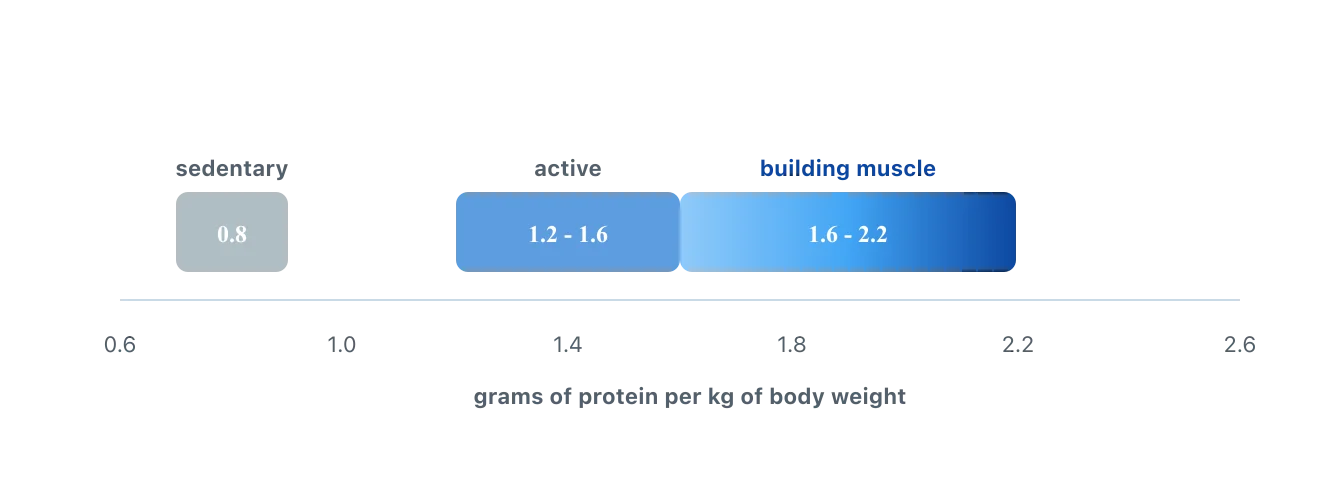
The basic requirement to avoid deficiency, the official recommended intake for a sedentary adult, is about 0.8 grams of protein per kilogram of body weight per day. That is enough to keep a still, untrained body functioning, but it is not the amount that supports building muscle. The moment you add regular training and a goal of gaining muscle, your needs climb well above that floor.
For general activity and fitness, something in the range of 1.2 to 1.6 grams per kilogram is a sensible target. For actively building muscle, the evidence points higher still. This is one of those rare areas where a lot of research converges on a fairly clear number.
The muscle-building range
Reviews of the research consistently land on roughly 1.6 to 2.2 grams of protein per kilogram of body weight per day as the sweet spot for building muscle, assuming you are also training. Below about 1.6, most people leave some muscle growth on the table. Above roughly 2.2, the extra protein does little additional good for muscle, so piling on more is not a better strategy, just a more expensive one.
Note that these targets are based on your body weight, not a flat number, which is why a larger person needs more than a smaller one. If you are carrying a lot of excess weight, some guidance suggests basing the calculation on a target or lean body weight instead, which is a good question for a professional if it applies to you.
A worked example
Numbers are easier with a real figure. Take a person weighing 70 kilograms who wants to build muscle. At 1.6 to 2.2 grams per kilogram, their daily target is roughly 112 to 154 grams of protein. A practical aim in the middle, say around 130 grams, is a sensible place to start. That sounds like a lot until you see it as food, which is where the cards below come in.
Good protein sources
Chicken breast
Around 31 grams of protein in a 100 gram cooked portion. Lean, versatile, and one of the most protein-dense everyday foods.
Greek yogurt
Roughly 17 grams in a 170 gram tub. An easy high-protein breakfast or snack, and a simple way to top up.
Eggs
About 12 grams in two large eggs. A complete protein that is cheap, filling, and endlessly adaptable.
Lentils and beans
Around 18 grams in a cooked cup. Excellent plant sources that also bring fibre, ideal in a mixed diet.
Tofu and tempeh
Roughly 15 to 20 grams per 100 grams for firmer types. Reliable plant proteins that soak up flavour.
Fish and tuna
A can of tuna has about 25 grams. Fish delivers plentiful protein and, in oily types, healthy fats too.
Glance back at those numbers and the daily target stops looking daunting. A couple of eggs at breakfast, a tub of yogurt as a snack, a chicken breast at lunch, and a portion of lentils or fish at dinner already clear well over a hundred grams. Building your target from ordinary meals is almost always easier, cheaper, and more satisfying than leaning on shakes.
Spreading it across the day
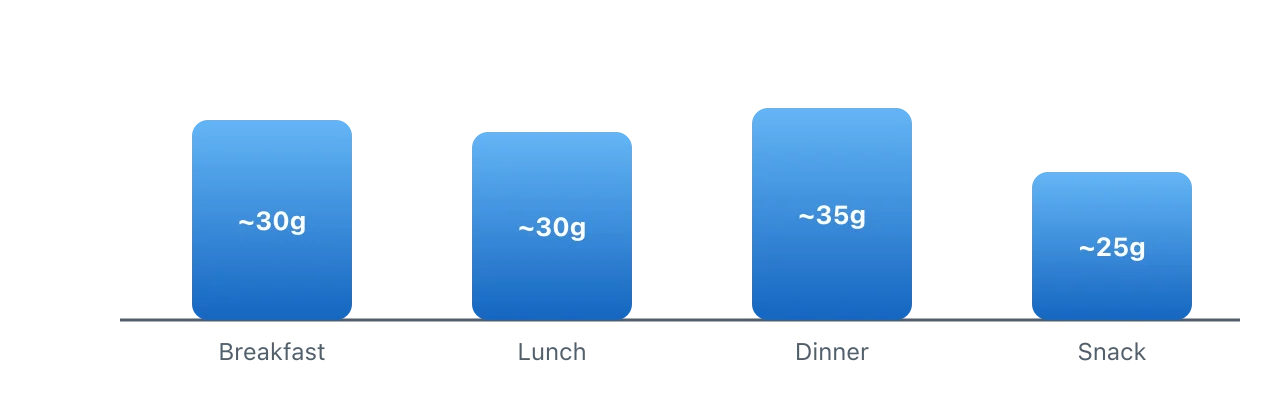
How you distribute protein matters a little, even if not as much as the total. Your body can only use so much protein for muscle building in one sitting, so spreading your intake across several meals, rather than piling almost all of it into dinner, tends to support muscle growth a touch better. A common, practical approach is to aim for a solid serving of protein, very roughly 20 to 40 grams, at each of your main meals.
Why more protein helps muscle
It helps to understand why the muscle-building range sits higher than the basic requirement. Resistance training creates tiny amounts of damage in muscle fibres, and your body repairs them slightly stronger and larger than before, a process that literally rebuilds you out of the protein you eat. Without enough protein coming in, the raw materials for that repair are in short supply, and you leave potential growth unclaimed no matter how hard you train.
This is also why protein and training are a package deal. Eating a lot of protein without lifting does not build much muscle, and lifting hard without enough protein blunts your results. The two work together: the training provides the signal to grow, and the protein provides the bricks. Getting either one badly wrong holds back the other, which is why the honest advice is always both, not one in isolation.
There is a bonus effect worth knowing. Adequate protein also helps by keeping you fuller, since protein is the most satisfying of the three macronutrients. Meals built around it tend to curb hunger better, which quietly supports whatever body-composition goal you are working toward, whether that is gaining muscle or trimming fat.
Timing and the anabolic window myth
You may have heard that you must slam a protein shake within minutes of finishing a workout or your session is wasted. This so-called anabolic window has been badly oversold. While eating protein around training is fine, the window is far wider and more forgiving than the myth suggests, spanning hours rather than minutes. Your total protein for the day, and getting enough of it consistently, dwarfs the importance of precise timing.
So if you train and then eat a normal protein-containing meal an hour or two later, you have not missed anything. Chasing the clock adds stress without adding results. Hit your daily target, spread it reasonably, and let go of the stopwatch.
Can you have too much?
For healthy people, protein intakes in and even somewhat above the muscle-building range are generally considered safe, and the long-standing worry that high protein harms healthy kidneys is not supported by the evidence. The real downside of very high intakes is simply that they do little extra for muscle while crowding out other useful foods, and they cost more.
There are exceptions worth naming. Anyone with existing kidney disease, or other specific medical conditions, should set protein targets with a healthcare professional rather than a general article. And as with every number on this site, this is educational guidance, not a personalised plan. Aim for the range, build it from good food, and let the training and consistency do the rest.