Sleep is one of the few habits that touches almost everything else about your health, from your mood and memory to your weight and your heart, yet it is also one of the easiest to shortchange. A fair and very common question is simply how many hours you actually need. The honest answer depends a great deal on your age, and it shifts steadily from the long, broken nights of a newborn to the lighter, shorter sleep of later life. This guide walks through the recommended ranges stage by stage, explains why they change, and looks at what enough sleep really means beyond the number on the clock.
Most adults need at least 7 hours of sleep and commonly do best on 7 to 9. Children and teenagers need more, and newborns need the most of all. The target falls gradually as you age, and the quality of your sleep matters just as much as the total.
What "how much sleep" means
When sleep experts talk about how much sleep you need, they mean the total amount of sleep across a full 24 hours, not simply the hours you spend in bed. For babies and young children, that total includes daytime naps, which is why the recommended figures for the youngest ages look so high. For older children and adults, it is mostly the single overnight block. The distinction matters, because time in bed and time asleep are rarely the same thing, and it is the sleep itself that counts.
It also helps to understand that these recommendations are ranges rather than fixed targets. Bodies differ, and two healthy adults of the same age can genuinely thrive on slightly different amounts. The ranges published by groups such as the National Sleep Foundation and the Centers for Disease Control and Prevention are drawn from large reviews of the evidence, and they are designed to describe what suits most people rather than to pin down a single perfect number for everyone. If you land comfortably within your age band and feel rested through the day, you are almost certainly getting what you need.
The reason the guidance is expressed as a band, and not a precise figure, is that "enough" is really defined by how you function. The clearest sign that your total is about right is waking feeling reasonably refreshed and staying alert without a constant fight against drowsiness. That is worth holding onto as you read the numbers below, because the hours are a guide to aim for, while your own daytime energy is the honest test of whether you are hitting the mark.
Recommended sleep by age
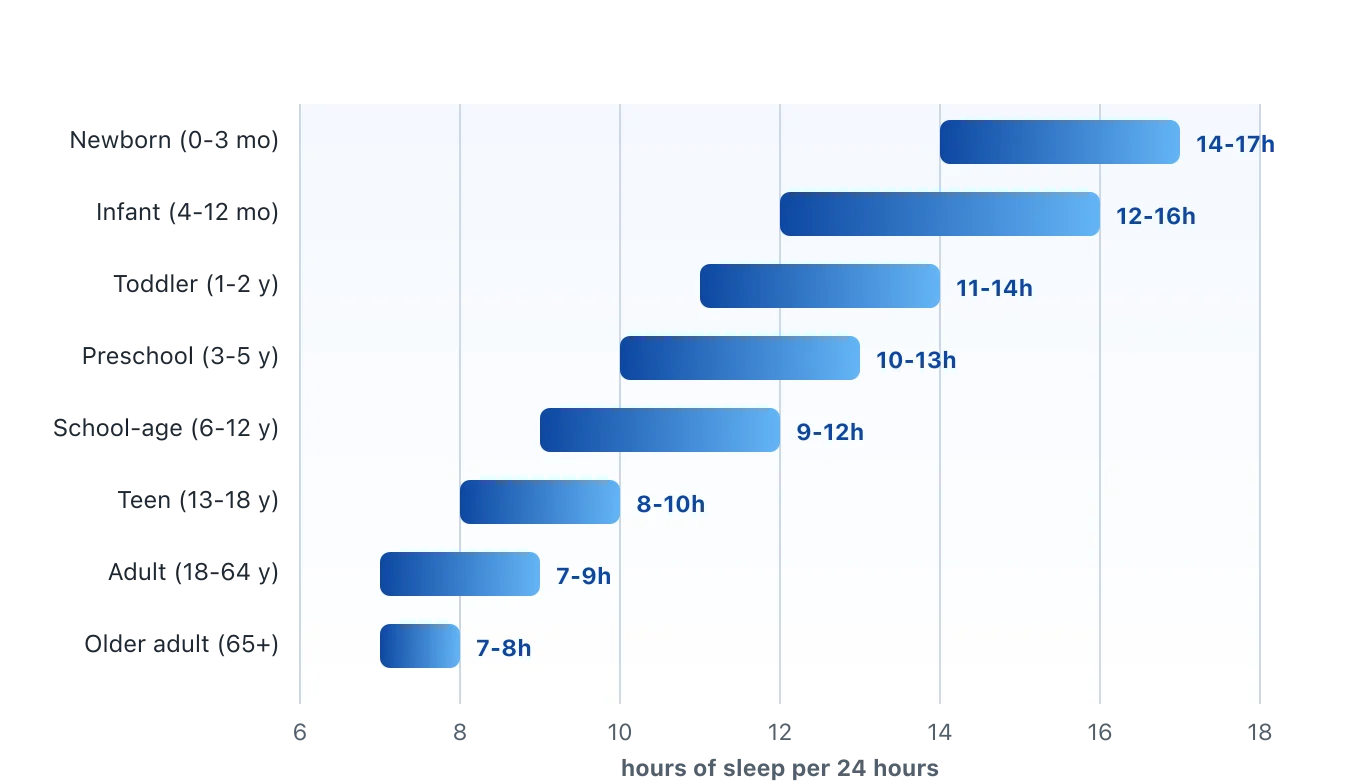
The chart at the top of this article shows the recommended sleep ranges from birth to older adulthood, and the pattern is easy to read at a glance: the bars are longest for the very young and shorten steadily with age. Newborns need by far the most, spread in short bursts around the clock, while a healthy adult settles into a much narrower nightly window. The table below sets out the same figures with a little more precision, including the slight step down that happens in later life.
| Age group | Recommended sleep per 24 hours |
|---|---|
| Newborn (0-3 months) | 14 to 17 hours |
| Infant (4-12 months) | 12 to 16 hours, including naps |
| Toddler (1-2 years) | 11 to 14 hours, including naps |
| Preschool (3-5 years) | 10 to 13 hours |
| School-age (6-12 years) | 9 to 12 hours |
| Teen (13-18 years) | 8 to 10 hours |
| Adult (18-60 years) | At least 7 hours, commonly 7 to 9 |
| Adult (61-64 years) | 7 to 9 hours |
| Older adult (65+ years) | 7 to 8 hours |
A few things stand out when you look at the whole span together. The drop is steepest early in life: a toddler needs several hours less than a newborn, and the total keeps easing down through childhood as naps disappear and the overnight block does more of the work. By the teenage years, the range has settled to 8 to 10 hours, which is a figure many teenagers famously struggle to reach against early school starts and late body clocks. From there the change into adulthood is small, and across the whole of adult life the target barely moves.
For adults, the headline number to remember is straightforward: aim for at least 7 hours, and treat 7 to 9 as the comfortable zone that suits most people. The very slight decline in later life, to around 7 to 8 hours for those over 65, is real but modest. It is nowhere near the dramatic drop that popular belief often assumes, which is one of the more persistent myths about sleep and ageing, and one worth correcting.
Why needs fall with age
The reason the youngest ages need so much sleep comes down to development. In the first years of life the brain and body are growing and wiring themselves at an extraordinary pace, and a great deal of that work happens during sleep. Deep sleep supports physical growth, and the sleeping brain is busy consolidating the flood of new experiences a young child gathers each day. As that furious early development slows, so does the sheer volume of sleep required to support it, which is why the recommended totals ease down year by year through childhood.
By adulthood the need has levelled off, and from then on it changes only a little. What shifts more clearly with age is not how much sleep you need but how easily you get it. Older adults often find their sleep becomes lighter and more broken, they may wake more during the night, and many drift toward an earlier body clock, feeling sleepy sooner in the evening and waking earlier in the morning. These are changes in the structure and timing of sleep rather than in the underlying requirement.
That difference is the heart of a common misunderstanding. Because older adults frequently sleep less well, it is easy to assume they simply need less sleep, but the evidence points the other way. The need stays close to that of younger adults, at roughly 7 to 8 hours, while the ability to achieve it in one solid block declines. Recognising that gap matters, because writing off poor sleep as a natural and acceptable part of getting older can mean missing problems that are actually treatable.
Quality vs quantity
Hours are only half the story. Eight hours of restless, fragmented sleep does not leave you as restored as eight hours of deep, continuous sleep, because what happens during those hours is what does the repair work. Across a night your sleep moves through repeating cycles of lighter and deeper stages, including the slow-wave deep sleep tied to physical restoration and the dreaming REM sleep linked to memory and mood. If that structure is broken up too often, the benefit is blunted even when the total time looks fine on paper.
This is why two people who both spend eight hours in bed can feel so different in the morning. Continuity matters: sleep that is repeatedly interrupted by noise, a restless partner, alcohol, or an untreated breathing problem tends to be shallower and less refreshing. It is entirely possible to hit your recommended number of hours and still wake up feeling unrested, and when that happens the fix usually lies in the quality of the sleep rather than simply adding more time in bed.
A useful way to hold both ideas together is to treat the hours as a target and the way you feel as the test. If you are consistently reaching your age-appropriate range but still dragging through the day, the total is probably not the problem, and it is worth looking at what might be fragmenting your nights. Understanding how the stages of sleep fit together makes this easier to picture, which is a subject worth exploring on its own.
Signs you are short on sleep
Your body is fairly honest about a shortfall, and the signs are worth knowing because it is easy to normalise being tired. The most common gauge for adults is the 7 to 9 hour window, and falling short of it night after night tends to show up in predictable ways. The band below marks that adult target so you can see where a typical night lands and how the picture changes when you dip below it.
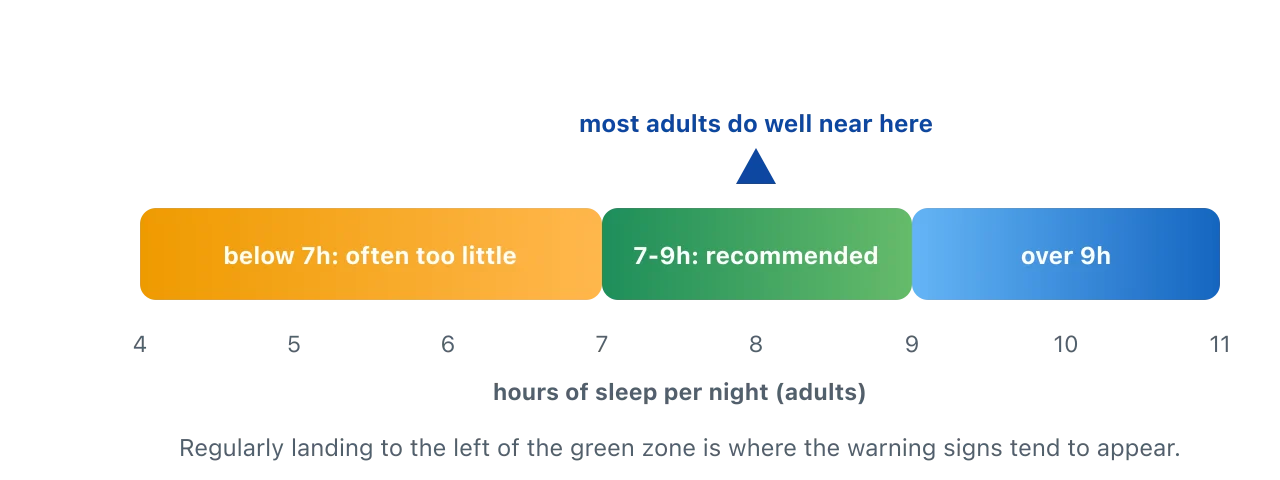
The everyday signs of not getting enough sleep are familiar to most people: needing an alarm to wake and still feeling groggy, hitting a heavy slump in the afternoon, leaning hard on caffeine to stay functional, and feeling irritable or low. Concentration and memory tend to suffer, small tasks feel harder than they should, and many people notice their appetite and cravings creep up, since short sleep nudges the hormones that govern hunger. Falling asleep the instant your head hits the pillow, or sleeping far longer on days off, are both quiet hints that you are running a deficit during the week.
Over the longer term, the picture matters more than any single tired morning. Consistently short sleep is linked in research to weight gain, poorer concentration and mood, weakened immune defences, and higher cardiometabolic risk, including effects on blood pressure and blood sugar. None of this means one rough week will harm your health, and it is not a reason to lie in bed anxious about the clock. It simply means that a steady pattern of too little sleep is worth treating as a genuine health issue rather than a personal failing or an unavoidable cost of a busy life.
Simple ways to sleep better
Most of what improves sleep is unglamorous and free, and consistency is the foundation. Going to bed and waking at roughly the same times every day, weekends included, is one of the most powerful things you can do, because it keeps your internal clock steady and makes falling asleep easier. A calm wind-down in the last hour helps too, giving your mind and body a chance to shift down a gear rather than lurching from a busy evening straight into bed. Dimming the lights and stepping away from bright screens in that final stretch supports the natural rise in the hormones that prepare you for sleep.
The daytime habits matter as much as the bedtime ones. Getting natural light in the morning, staying active during the day, and being mindful of caffeine, which can linger for many hours, all make it easier to sleep at night. Alcohol is a common trap, since a drink may help you drift off but tends to fragment sleep later in the night, leaving it shallower and less refreshing. Keeping the bedroom cool, dark, and quiet, and reserving it as far as possible for sleep, gives your body the clearest possible signal that it is time to rest. None of these are dramatic interventions, but stacked together they add up, and they tend to work better than any single trick.
When to see a doctor
Occasional poor sleep is a normal part of life, tied to stress, travel, a new baby, or simply a busy stretch, and it usually settles on its own. Some patterns, though, are worth raising with a healthcare professional. Trouble falling or staying asleep that persists for weeks and affects your days, loud snoring paired with gasping or pauses in breathing that a partner notices, and heavy daytime sleepiness despite spending enough time in bed can all point to a treatable sleep problem rather than a simple habit that needs tightening.
It is also reasonable to seek advice if poor sleep is dragging down your mood, concentration, or daily functioning, or if you find yourself relying on alcohol or over-the-counter aids to get through the night. These figures and signs are a screening guide to help you notice when something may be off, not a diagnosis, and a qualified healthcare provider can look at the fuller picture, rule out underlying conditions, and point you toward help that actually fits your situation. Sleep is too important to your overall health to leave a persistent problem unaddressed, and most sleep issues respond well once they are properly understood.