Sleep can look like a single blank stretch of nothing, but the sleeping brain is anything but idle. Over the course of a night you move through a repeating sequence of distinct stages, each with its own character and its own job, from the featherlight drift of first dropping off to the vivid dreaming that fills the early morning. Understanding these stages, and the roughly ninety-minute cycle that strings them together, turns sleep from a mystery into something you can actually make sense of, and it explains why both how long and how well you sleep matter so much.
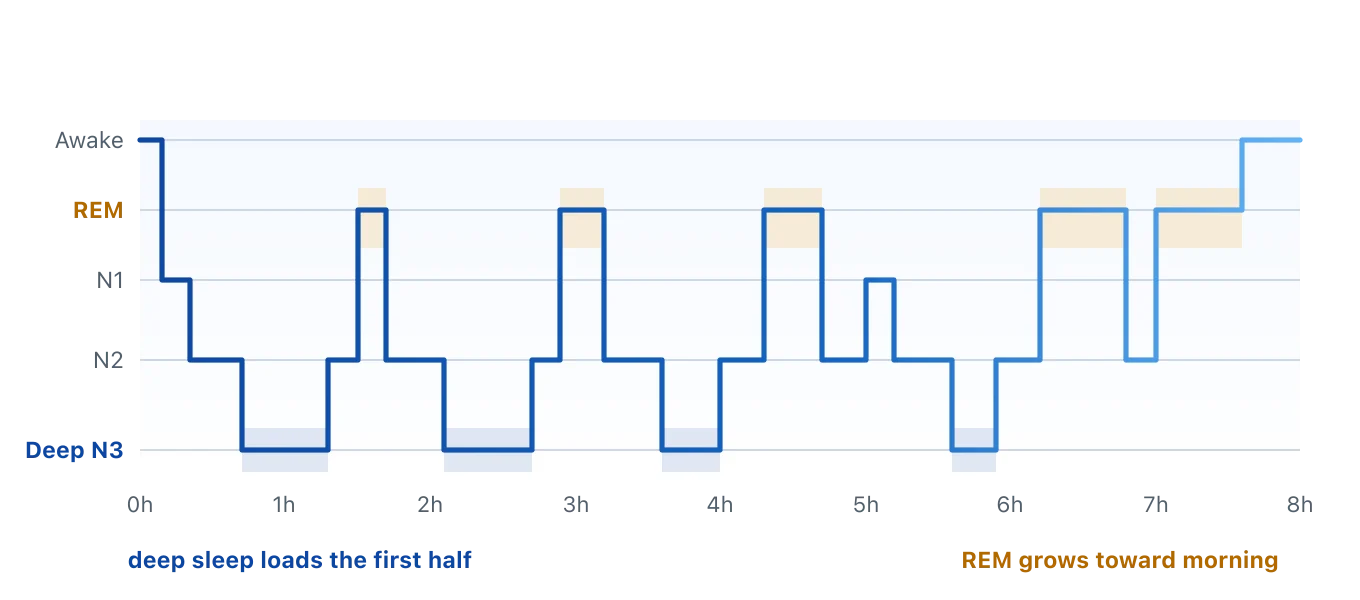
A night of sleep runs through four stages: N1 and N2 light sleep, N3 deep sleep, and REM dreaming sleep. These are grouped into cycles of about 90 minutes, and you complete four to six a night, with deep sleep loaded into the early hours and REM stretching longer toward morning.
The sleep cycle overview
Sleep is not a steady descent into a single deep state and back again. Instead it is cyclical. Once you drop off, you pass through a series of stages, reach the dreaming state, then surface toward lighter sleep and begin the sequence again. One full trip through the stages is called a sleep cycle, and it lasts roughly 90 minutes, though in practice it can run anywhere from about 70 to 120 minutes. A typical night holds four to six of these cycles stacked back to back, which is one reason the 7 to 9 hours recommended for adults tends to line up so neatly with feeling rested.
The stages fall into two broad families. The first is non-REM sleep, which covers three stages of steadily deepening rest, labelled N1, N2, and N3. The second is REM sleep, short for rapid eye movement, the stage most associated with vivid dreaming. The hypnogram at the top of this article traces this journey across a single night, and its jagged, stepped shape captures something important: your sleep is constantly moving between levels rather than sitting still at any one of them. Reading that line from left to right is a good way to picture how a real night actually unfolds.
Why does the body bother with this elaborate structure at all? Because each stage does different work, and the ordering is not random. Passing through the lighter stages sets up the deep restorative sleep of the early night, and later cycles make room for the mental housekeeping of REM. The cycle is essentially the body running through a checklist several times over, and completing enough full cycles is what allows every item on that list to get done. Cut the night short, and you do not just lose time evenly; you lose specific kinds of sleep, a point we will come back to.
The four stages of sleep
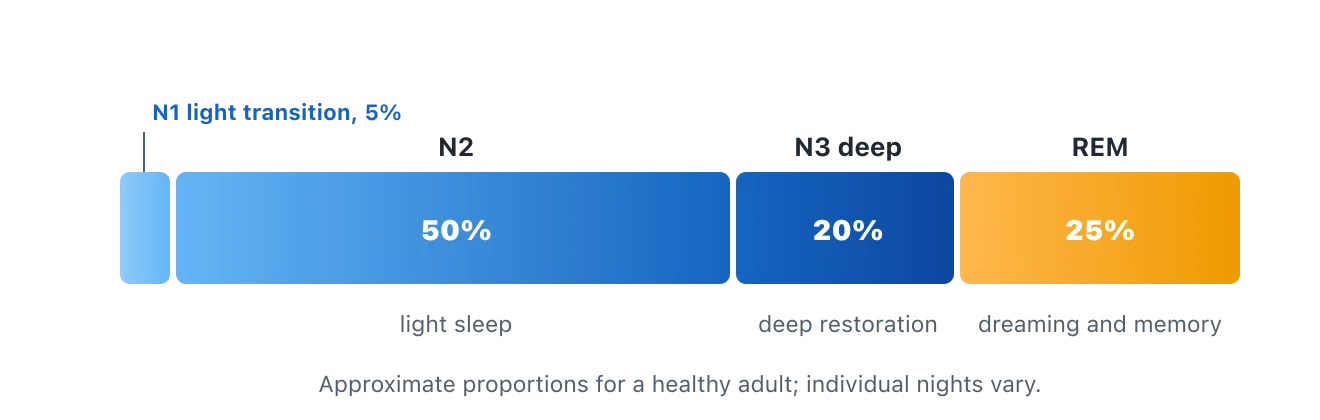
Each stage occupies a different share of the night, and the proportions are surprisingly consistent from person to person. Light sleep dominates, deep sleep and REM take meaningful slices, and the brief transition stage is just a sliver. The bar below shows roughly how a typical night divides between the four, which is a helpful map to keep in mind as we look at what each one actually does.
N1: the light transition
N1 is the doorway into sleep, the brief, light stage you pass through as you first drift off. It usually lasts only a few minutes and makes up around 5 percent of the night. Your muscles begin to relax, your heartbeat and breathing start to slow, and your brain waves shift from their busy waking pattern toward something calmer. This is the stage where you can be woken easily and may not even feel you were asleep, and it is often where the sudden jerk of the legs or the sensation of falling, familiar to many people, tends to happen. N1 is short and unglamorous, but it is the necessary threshold between wakefulness and real sleep.
N2: light sleep and the backbone of the night
N2 is where you spend the largest share of your sleep, roughly half of the whole night across all its cycles. It is a deeper form of light sleep than N1: your body temperature drops a little further, your heart rate and breathing settle, and awareness of the outside world fades. The sleeping brain produces brief bursts of activity known as sleep spindles during N2, and these are thought to help protect sleep from disturbance and to play a role in locking in new memories. Because it recurs in every cycle and fills the gaps between the deeper states, N2 is the connective tissue of the night, and it does far more quiet work than its unassuming, light label suggests.
N3: deep, slow-wave sleep
N3 is deep sleep, also called slow-wave sleep after the large, slow brain waves that define it. This is the most physically restorative stage and the hardest to wake from; someone roused out of N3 tends to feel groggy and disoriented for a while, a state sometimes called sleep inertia. Deep sleep makes up somewhere around 15 to 25 percent of the night, and it is heavily concentrated in the first few hours, which is why the early part of the night is so valuable. During N3 the body carries out much of its repair and maintenance, supporting tissue growth, immune function, and the sense of feeling genuinely refreshed. Skimp on the early hours of sleep and it is deep sleep that you lose most.
REM: dreaming and mental housekeeping
REM sleep is the stage most people picture when they think of dreaming. Named for the rapid eye movements that flicker beneath closed lids, it is a curious state in which the brain becomes highly active, close to its waking pattern, while the body's main muscles are temporarily paralysed, most likely to stop you acting out your dreams. REM accounts for roughly 20 to 25 percent of a night's sleep and is strongly tied to memory consolidation, learning, and the processing of emotions. Its periods are short in the first cycle and grow longer with each one, so the bulk of your REM, and your most vivid dreams, arrive in the hours before waking.
How the cycle repeats
Once you reach the end of a REM period, you do not simply start the next cycle from deep sleep. Instead you surface toward lighter sleep, sometimes almost to the edge of waking, before descending again. These brief near-awakenings are completely normal and usually forgotten by morning; everyone has them, several times a night, whether they remember them or not. From that light point the sequence begins again, moving down through the stages and back up to REM, and this loop repeats through the night.
With each cycle lasting around 90 minutes, four to six repetitions add up to the 6 to 9 hours that most nights occupy. But the cycles are not carbon copies of one another. The blend of stages inside each one changes as the night goes on, so an early cycle looks quite different from a late one. That gradual shift in the recipe is one of the most important and least appreciated features of a night's sleep, and it is the reason the timing of your sleep, not just its total length, has real consequences for how you feel.
Evening to morning shift
Look again at the hypnogram and you can see the pattern clearly. In the first half of the night, the deep N3 dips are large and frequent, and REM periods are brief. In the second half, deep sleep all but disappears while REM stretches out, so that the longest dreaming periods come in the hours just before you wake. The body front-loads the deep, physically restorative sleep and saves the memory and emotional work of REM for later, and it does this reliably, night after night.
This uneven distribution has practical consequences. If you go to bed much later than usual but still have to wake at a fixed time, you compress the whole night and tend to lose a slice of every stage. If instead you sleep your normal bedtime but cut the morning short, you preferentially lose REM, since so much of it is packed into those final hours. Neither shortfall is trivial, but they cost you different things, which is part of why both a consistent bedtime and a full night's length matter rather than just one or the other.
It also explains a few everyday experiences. The grogginess of being woken by an alarm in the early hours can come from being hauled out of deep sleep, while the rich, story-like dreams people recall on a relaxed morning reflect those long, late REM periods. Far from being a flat and uniform process, sleep has a clear arc from evening to morning, and knowing its shape helps make sense of how different a night can feel depending on when it starts and when it ends.
What disrupts the stages
Several common things can distort this careful architecture, and alcohol is one of the most misunderstood. A drink before bed may help you fall asleep faster, but it suppresses REM in the first part of the night and fragments sleep later as the body processes it, often producing a rebound of lighter, broken sleep in the early hours. The result is a night that looks long enough but delivers less genuine rest, which is why a nightcap so often leaves people feeling unrefreshed. Caffeine works differently but also interferes, since it blocks the signals that build sleep pressure, and consumed too late in the day it can delay sleep onset and trim the amount of deep sleep you get, even if you still manage to drop off.
Light and screens are another disruptor, mostly by affecting when sleep starts rather than the stages directly. Bright light in the evening, especially from screens held close to the face, can hold back the natural rise of the hormones that prepare you for sleep, nudging your body clock later and delaying the whole sequence. Age matters too: as the years pass, deep N3 sleep tends to shrink, night-time awakenings become more frequent, and sleep in general grows lighter and more easily broken. Stress, an irregular schedule, and untreated conditions such as sleep apnea can all fragment the night as well, repeatedly pulling you toward lighter sleep and preventing the deeper stages from doing their work.
Why every stage matters
It is tempting to crown one stage the most important and chase it alone, but that misreads how sleep works. Deep N3 sleep handles much of the physical restoration, the tissue repair and immune support that leave you feeling bodily refreshed. REM does the mental work, consolidating memories, supporting learning, and helping process the emotional residue of the day. Even the lighter stages are not filler: N2 recurs constantly, contributes to memory, and knits the night together, while N1 is the necessary bridge into sleep. You cannot pick and choose, because the stages arrive in a set order and build on one another, and a night that is cut short or badly broken robs you of specific kinds of sleep rather than simply a bit less of everything.
The practical message is reassuringly simple. You do not need to engineer your individual stages or track them obsessively; a healthy brain assembles the right sequence on its own, provided you give it enough time and reasonable conditions. Protecting a consistent bedtime, allowing a full night's length, and easing off the things that fragment sleep will let the natural architecture do its job. This is general educational information rather than a diagnosis, so if disrupted or unrefreshing sleep persists despite spending enough time in bed, or if loud snoring, gasping, or heavy daytime sleepiness are part of the picture, it is worth talking to a qualified healthcare provider who can look at the fuller picture and help you sleep more soundly.