It is one of the most-searched questions about coffee, and it spiked again after the American Heart Association reassured drinkers that a real coffee habit is fine for most people. The number worth remembering is not a count of cups but a dose of caffeine: about 400 mg a day for healthy adults. Because cups vary so much, that guideline is the honest way to answer how many is too many.
Healthy adults can generally have up to 400 mg of caffeine a day - about four to five cups of brewed coffee - without expecting harm. The exact number of cups depends on their size and strength, and on the tea, cola, and energy drinks you have alongside them.
The short answer
For most healthy adults, up to 400 mg of caffeine a day is not generally linked with harmful effects. That figure comes from the U.S. Food and Drug Administration and is echoed by European food-safety regulators, and it lines up with the American Heart Association's view that up to roughly five cups of caffeinated coffee a day appears safe for most people. In brewed-coffee terms, 400 mg is about four to five standard cups.
A ceiling is not a target. Plenty of people feel best on one or two cups, and there is no health reason to drink up to the limit. Think of 400 mg as the point where the science stops offering reassurance for the average adult, not a daily goal to chase. And remember that it is an average: some people clear caffeine slowly and feel four cups as if it were eight.
Why a cup is slippery
The trouble with counting cups is that a cup is not a fixed thing. Nutrition guidance usually means an 8-ounce (240 ml) serving, but a small coffee-shop cup is 12 ounces and the largest sizes reach 20 ounces or more. Strength varies just as much: the beans, the roast, the grind, and the brewing method can move the caffeine in a single cup from around 70 mg to 140 mg, and a strong batch brew or a double-shot drink pushes higher still. Two people can each say they had "three cups" and be hundreds of milligrams apart.
That is why the caffeine dose, not the cup count, is the number that keeps you safe. Once you have a rough sense of how much caffeine your usual drinks carry, staying under 400 mg becomes easy arithmetic rather than guesswork.
Caffeine by the drink
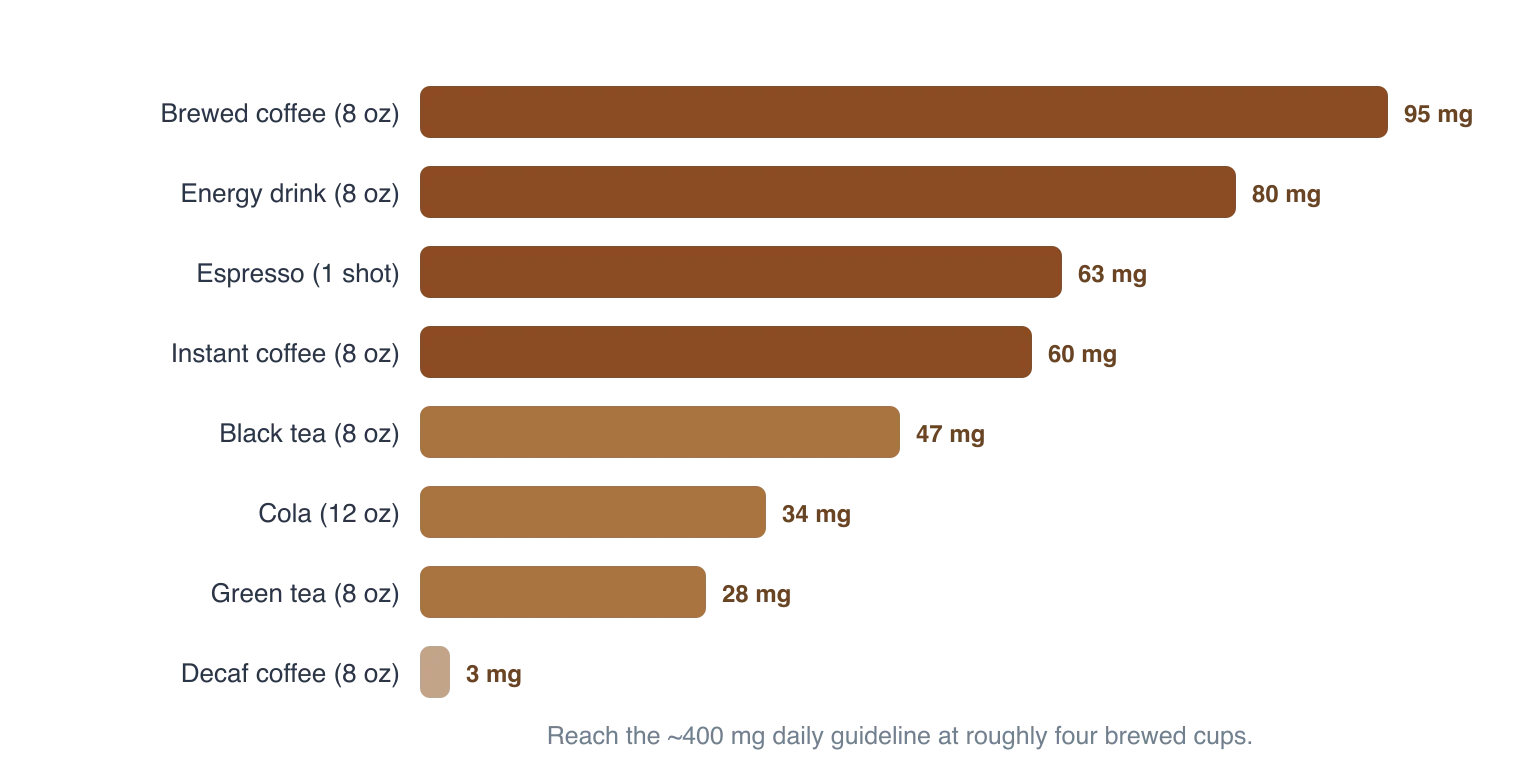
The chart below shows typical caffeine in common servings. Treat the figures as ballpark averages; real drinks vary, and coffee-shop sizes are often far larger than the 8-ounce serving used here.
Add up your whole day
Coffee is rarely the only caffeine in a day. Tea, cola, energy drinks, pre-workout powders, dark chocolate, and even some pain relievers and supplements all contribute. To stay under 400 mg you count the total, not just the coffees. The table below turns the guideline around: it shows roughly how many servings of each drink it takes to reach 400 mg on their own.
| Drink | Typical caffeine | Servings to reach ~400 mg |
|---|---|---|
| Brewed coffee (8 oz) | ~95 mg | About 4 cups |
| Energy drink (8 oz) | ~80 mg | About 5 cans |
| Espresso (1 shot) | ~63 mg | About 6 shots |
| Black tea (8 oz) | ~47 mg | About 8 cups |
| Cola (12 oz) | ~34 mg | About 12 cans |
| Green tea (8 oz) | ~28 mg | About 14 cups |
The practical lesson is that a mixed day adds up faster than it feels. Two large coffees, an afternoon tea, and an energy drink can quietly cross 400 mg without a single cup feeling excessive. If you drink coffee heavily, it also helps to balance it with plain fluid across the day; our guide to how much water you need puts that in context.
Signs you have gone over
Your body is good at signalling too much caffeine. The common signs are restlessness and jitteriness, a fast or pounding heartbeat, anxiety or irritability, an upset stomach, headaches, and trouble sleeping later that night. None of these are usually dangerous on their own, but together they are a clear message to ease off. Because caffeine lingers for hours, an afternoon over-shoot often shows up as a restless night rather than an obvious buzz.
If you notice your heart racing or fluttering after a strong cup, that specific worry is common enough that we cover it in its own guide on coffee and heart palpitations. For most people the sensation is harmless and passes, but it is worth knowing when it is not.
Tolerance and timing
Two people can drink the same amount of coffee and feel completely different, and a big reason is tolerance. When you drink caffeine regularly, your body adapts, so a daily three-cup habit feels milder than three cups would to someone who rarely touches it. That adaptation is real but partial: it blunts the jitters and the blood-pressure bump more than it changes the effect on sleep, which is why even seasoned drinkers can be caught out by a late cup. If you have taken a break from caffeine, expect your old amount to hit harder for the first week or two until tolerance rebuilds.
Genetics add another layer. Some people carry gene variants that clear caffeine quickly and can handle more without trouble, while slow metabolisers feel a single afternoon coffee well into the night. This is why there is no single honest answer to how many cups are fine for everyone. The 400 mg ceiling is a population guideline; your comfortable number sits somewhere underneath it, set by your habit, your genes, and how you feel on any given day.
Timing matters as much as the total. Because caffeine lingers for hours, when you drink is nearly as important as how much. Front-loading your caffeine earlier in the day gives your body time to clear most of it before bed, while the same dose after lunch can quietly erode that night's sleep. A simple caffeine curfew - nothing after early afternoon if you are sensitive - protects your rest without asking you to give up coffee, and poor sleep is one of the fastest ways to end up reaching for more the next day. Our guide to how much sleep you need shows what you are protecting.
Put those together and you can build a simple caffeine budget. Start from the 400 mg ceiling, subtract a buffer for any tea, cola, or energy drinks you expect, and spread what is left across the morning and early afternoon. If you feel wired, anxious, or sleepless, trim the budget; if you feel fine and sleep well, you are within your range. It flexes with your day and your body far better than a rigid count of cups.
A worked example makes it concrete. Say you have a large morning coffee, about 165 mg in a 12-ounce cup, a second standard cup mid-morning at 95 mg, and a black tea after lunch at 47 mg. That is roughly 307 mg, comfortably under the ceiling, with room for a small afternoon pick-me-up if you want one. Swap the second coffee for a large energy drink and add a cola with dinner, though, and the same day can sail past 400 mg without ever feeling excessive. Totting up the real numbers once or twice is usually enough to recalibrate your sense of a normal day.
When your number is lower
The 400 mg figure is for healthy adults, and several groups should aim lower. During pregnancy, guidance is to stay under about 200 mg a day. People with an anxiety disorder, a heart rhythm problem, or uncontrolled high blood pressure often do better with less, and if you are in that last group our guide on coffee and blood pressure is worth a read. Children and teenagers should have far less caffeine than adults, and some medications and supplements interact with it.
Sensitivity is also just personal. Genetics influence how fast you clear caffeine, so some people happily handle four cups while others feel two too many. The best number is the one that gives you the lift you want without the jitters, the racing heart, or the lost sleep. Stay under the 400 mg ceiling, count every source, and let your own body fine-tune the rest. For the wider view of how coffee fits into your health, start with our guide on whether coffee is good or bad for you.