
Few drinks get as much attention as coffee. One week the headlines say it protects your heart, the next they warn it raises your blood pressure. The truth is calmer than either extreme: for most healthy adults, moderate coffee is fine, and some of its effects are even positive. What matters is how much you drink, when you drink it, what you add to it, and how your own body responds.
Moderate coffee - up to about 400 mg of caffeine, or roughly four to five cups a day - is considered safe for most healthy adults. Coffee itself is nearly calorie-free; the milk, sugar, and syrups are what turn it into a treat. Your sleep, your heart history, and your sensitivity decide the right amount for you.
Is coffee good or bad?
The honest answer is that plain coffee is closer to good than bad for most people, and the fear that once surrounded it has faded as the research has grown. Coffee is rich in plant compounds and antioxidants, and large reviews of habitual drinkers have generally found no increase in cardiovascular risk at moderate intake, with some studies pointing to modest links with better outcomes. That does not make coffee a health tonic or a reason to start drinking it if you do not enjoy it, but it does mean a daily cup or three is not something most people need to feel guilty about.
The important word is moderate. Coffee is a delivery system for caffeine, a genuine stimulant drug, and the dose makes the difference between a helpful lift and a jittery, sleepless afternoon. The rest of this guide walks through what caffeine actually does inside you, how coffee touches your heart and your sleep, why the extras matter more than the coffee, and where the sensible ceiling sits.
What caffeine does to you
Caffeine works by blocking adenosine, the molecule that builds up through the day and makes you feel drowsy. With adenosine blocked, you feel more alert and less tired, which is exactly why that first cup feels so good. It is absorbed quickly: most people notice something within 15 to 45 minutes, and the level in the blood tends to peak within the first hour or so.
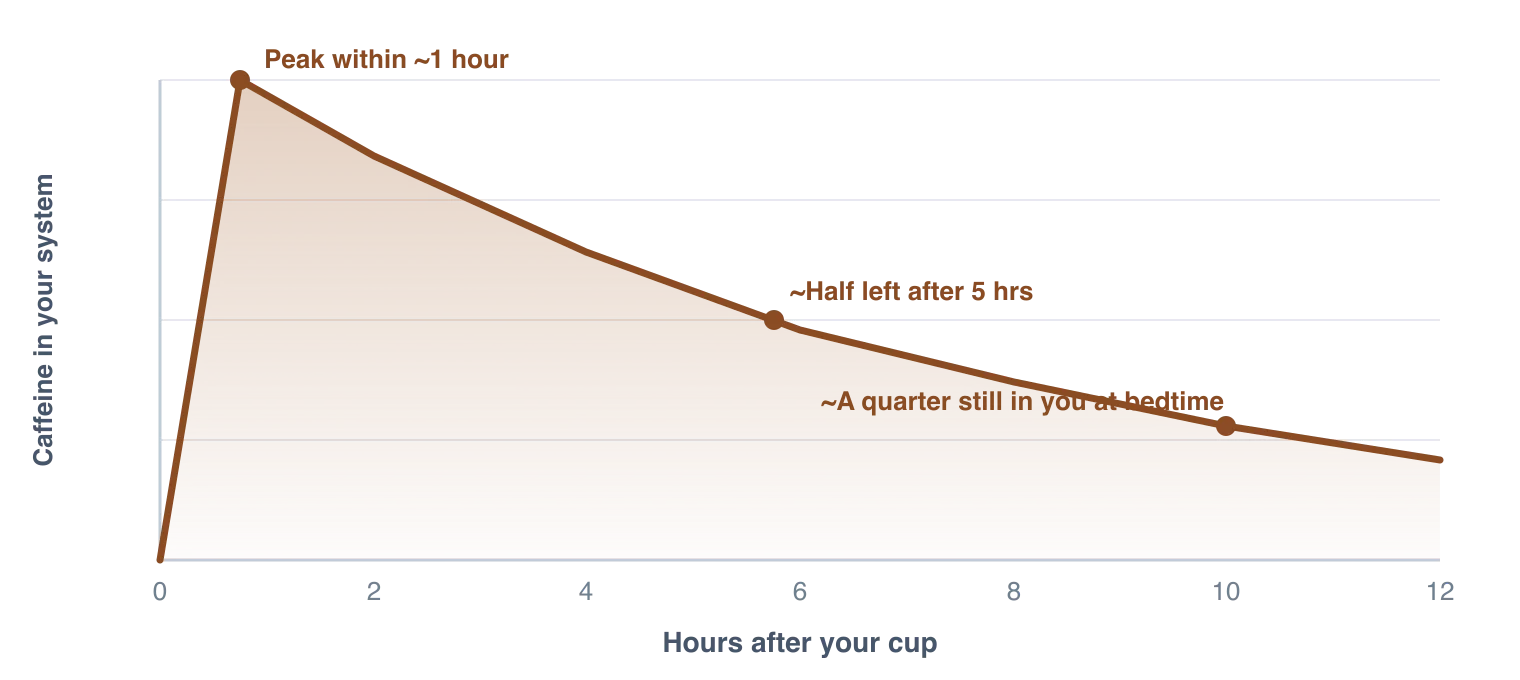
What surprises people is how long caffeine lingers. Its half-life - the time your body needs to clear half of a dose - averages around five hours, though it ranges widely from person to person. That means a good share of an afternoon coffee is still circulating at bedtime, even if you no longer feel it. The chart below shows the shape of a typical day: a fast climb, an early peak, and then a slow, hours-long fade.
Coffee and your heart
Coffee and the heart is where worry runs highest, and it is the reason coffee keeps trending in the news. Caffeine is a stimulant, so it can nudge your heart rate and give blood pressure a short-lived bump, especially if you do not drink it often. For years that led to blanket advice to go easy. The larger picture from population studies is more reassuring: for most people, habitual moderate coffee is not tied to a higher risk of heart disease, and the American Heart Association has said that up to about five cups a day appears safe for most adults.
That does not mean coffee is free of heart effects, only that they are usually modest and temporary. If you are curious about the specifics, we cover the two questions people ask most in their own guides: whether coffee raises blood pressure and whether coffee causes heart palpitations. Both come down to dose and personal sensitivity, and both are worth reading if you have ever felt your heart flutter after a strong cup. It also helps to know your baseline, which you can read about in our guide to resting heart rate by age.
Coffee, sleep, and energy
The biggest hidden cost of coffee is not your heart; it is your sleep. Because caffeine lingers for hours, a cup after lunch can quietly shave the depth and length of that night's rest, even if you fall asleep on time. Poorer sleep then makes you more tired the next day, which tempts another late coffee, and the loop tightens. Many people who cut their afternoon cup are surprised by how much better they sleep within a week.
A simple rule helps: give yourself a caffeine curfew. Since roughly a quarter of a dose can still be present ten hours later, stopping caffeine six to eight hours before bed is a reasonable target for most people, and earlier still if you are sensitive. If you want to see how much rest you are aiming for in the first place, our guide to how much sleep you need by age sets the target, and the stages of sleep explains what caffeine can quietly interrupt.
What you add matters most
Here is the part that changes the health story more than anything else: black coffee has almost no calories, around two to five for a plain cup. The moment you add sugar, flavoured syrups, cream, or whipped toppings, the picture changes fast. A large sweetened coffee-shop drink can carry as many calories as a small meal, along with a large dose of added sugar. If coffee ever seems to be working against your goals, the culprit is almost always the extras, not the coffee.
This is where a drink you barely think about can matter for weight over time. A couple of sweetened coffees a day, every day, add up to a meaningful number of calories across a week. Reading the menu the way you would read a food label helps; our guide to reading a nutrition label carries straight over to the cafe counter. And if you are tracking your own numbers, you can always check where you stand with the BMI calculator. None of this is about fearing coffee - it is about seeing the whole cup clearly.
How much is too much
The widely used ceiling for healthy adults is about 400 mg of caffeine a day, a figure from the FDA and echoed by European regulators. That works out to roughly four to five cups of brewed coffee, though the exact number depends on how strong your coffee is and what else contains caffeine in your day, from tea to cola to energy drinks. Because the amount per cup varies so much, we break the maths down drink by drink in how many cups of coffee a day are safe.
Going above that ceiling now and then is not an emergency, but a pattern of very high intake can bring restlessness, a racing heart, an upset stomach, anxiety, and disrupted sleep. Those symptoms are your body asking you to ease back. The goal is not a rigid rule but a comfortable amount that gives you the lift you want without the side effects you do not.
Who should be careful
Averages do not fit everyone, and some people have good reason to keep caffeine lower. During pregnancy, the usual guidance is to stay under about 200 mg a day, roughly two small cups. People living with an anxiety disorder often find caffeine sharpens the very feelings they are trying to calm. Anyone with a known heart rhythm disorder, uncontrolled high blood pressure, acid reflux, or a strong personal sensitivity may do better with less, or with decaf.
Certain medications interact with caffeine too, and children and teens should have far less than adults. If any of these apply to you, the safest move is a short conversation with a healthcare provider about the right amount for your situation. For everyone else, the takeaway is refreshingly simple: enjoy your coffee, keep an eye on the total, watch the add-ins, and protect your sleep. Do that, and coffee earns its place as one of life's genuinely pleasant habits.